
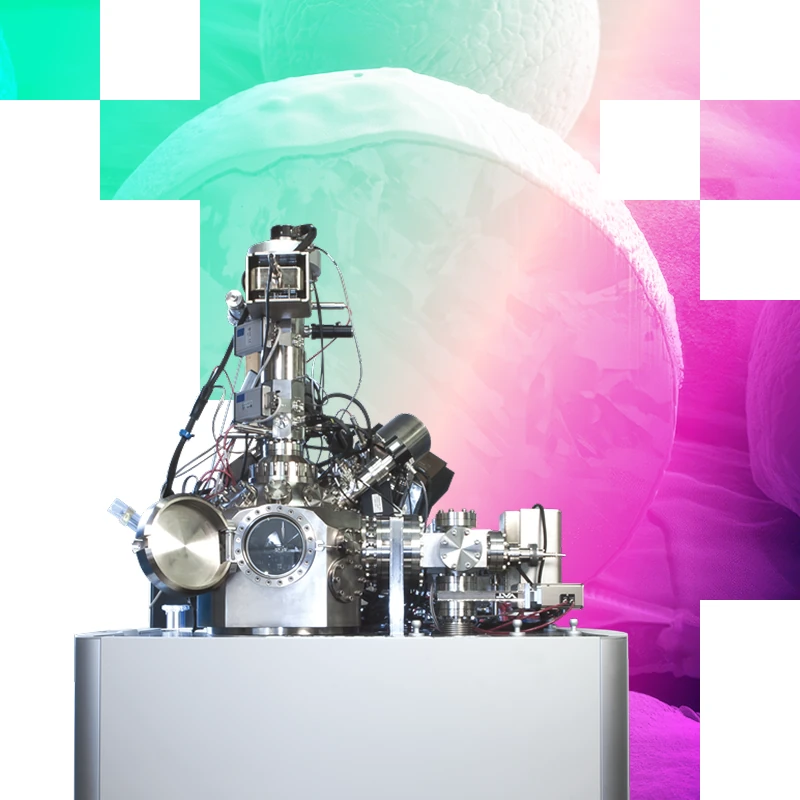
Shimadzu Tescan Nanospace
Shimadzu Tescan Nanospace — Microscopes.
The Tescan Nanospace is a UHV-compatible FIB-SEM platform configurable as a multi FIB-SEM, dual FIB-FIB, mono-beam FIB, or stand-alone SEM, built around a 6-axis stage and a Secondary Electron Detector. Its ultra-high vacuum design and UHV-compatible GIS enable local metal deposition and selective etching directly in the analysis chamber. The system is intended for integration with third-party UHV infrastructure such as MBE clusters, APT chambers, and synchrotron beamlines, where correlated FIB-SEM analysis under UHV is required.
Spécifications complètes
Description
Construction and configuration
- The Nanospace is a UHV FIB-SEM platform whose configuration is selected at order: multi FIB-SEM, dual FIB-FIB, mono-beam FIB, or stand-alone SEM. - The electron beam column can be specified as fully electrostatic or electromagnetic; the FIB ion source can be LMAIS, gas plasma, Wien-filtered LMAIS, or Wien-filtered gas plasma. - A Secondary Electron Detector is the listed detector type; a UHV-compatible GIS provides local metal deposition and selective etching. - The stage is 6-axis, and the chamber footprint is indicated by 100 mm length and 100 mm width. ### Behavior and media
- The system operates at ultra-high vacuum (UHV), which is the defining process condition for all modes and media. - No digitized curve points or measured performance ranges were supplied, so beam-current, resolution, and pressure-vs-throughput behavior cannot be stated here. ### Installation, connection, and operation
- The platform is designed for third-party UHV connection to MBE clusters, APT chambers, and synchrotron beamlines, meaning the chamber interface and vacuum protocol must be coordinated with the host infrastructure.
Integration & Operating Notes
The Nanospace is specified as an ultra-high vacuum instrument; operating the column, stage, or GIS outside UHV conditions is outside the stated design basis and risks invalid results and contamination of the UHV chamber. Vacuum performance of the host system must be verified before integration.
Connection to MBE clusters, APT chambers, or synchrotron beamlines requires that the mating flange, vacuum level, and mechanical interface of the host be agreed with the instrument configuration; the 100 mm by 100 mm footprint and 6-axis stage define the space envelope to be reserved.
The electron column (fully electrostatic or electromagnetic) and the FIB ion source (LMAIS, gas plasma, Wien-filtered LMAIS, or Wien-filtered gas plasma) are configuration options; the control architecture and operating modes follow from this selection, so the choice must be made before integration planning.
Only UHV-compatible GIS precursors for local metal deposition and selective etching are within the stated capability; introducing non-compatible chemistries would compromise the UHV environment and the analysis conditions of the chamber.
Selection & Integration Q&A
Choose multi FIB-SEM when the workflow needs combined electron and ion beam operation in one UHV chamber; mono-beam FIB or stand-alone SEM configurations suit single-beam tasks. Dual FIB-FIB is for two ion beams. The configuration is fixed at order, so define the beam requirement first.
The host must provide a UHV-compatible interface matching the Nanospace chamber, since the instrument is specified for ultra-high vacuum and third-party UHV connection. Flange geometry, pump-down protocol, and the 100 mm by 100 mm envelope with 6-axis stage travel must be agreed before installation.
The FIB source can be LMAIS, gas plasma, Wien-filtered LMAIS, or Wien-filtered gas plasma, and the electron column fully electrostatic or electromagnetic. These are order-time choices that determine beam behavior and control requirements; they cannot be changed after delivery.