
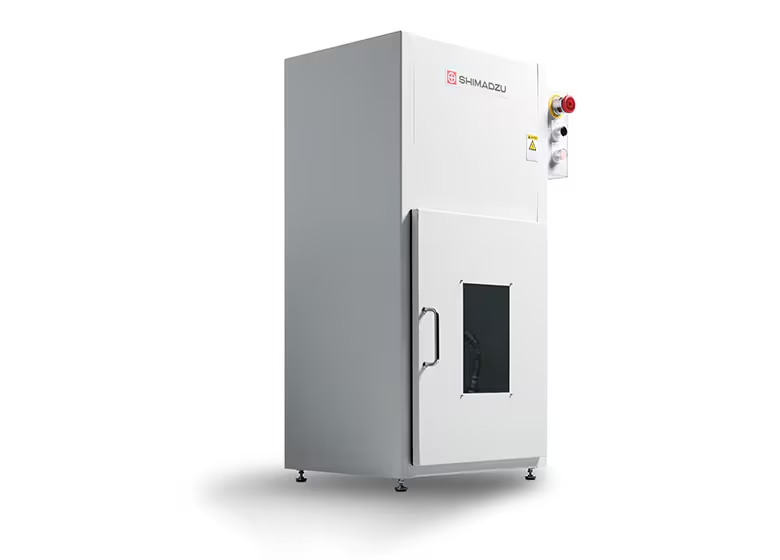
Shimadzu USF 2000A
Shimadzu USF 2000A — Machines d'essai.
The Shimadzu USF-2000A is an ultrasonic fatigue testing system that uses a piezoelectric element with horn amplification to drive specimens at 20 kHz ±500 Hz, with a recommended test range of 20 kHz ±30 Hz. It applies fully reversed (stress ratio -1) loading via ±10 to ±50 μm horn-tip displacement, with actual stress depending on specimen geometry and material properties. This model is suited for high-cycle fatigue testing of metals such as high-strength steel, duralumin, titanium alloy, and aluminum that resonate at 20 kHz with minimal heat generation.
Spécifications complètes
Description
Construction and positioning
- The USF-2000A is a complete ultrasonic fatigue testing system comprising the main unit (including table), ultrasonic resonance system, control computer, ultrasonic testing control and measurement software, and a cooling unit (air dryer). - It operates on the principle of piezoelectric excitation with horn amplification, achieving test frequencies around 20 kHz. ### Behavior under load and media
- Test frequency is not fixed but is determined by the resonance frequency of the sample; the system operates at 20 kHz ±500 Hz, with a recommended test range of 20 kHz ±30 Hz. - Vibration at the horn tip is adjustable from ±10 to ±50 μm, which translates to stress in the specimen depending on its shape and physical properties. The stress ratio is fixed at -1 (fully reversed). - Testable materials are those that can resonate at 20 kHz and generate minimal heat during resonance, such as high-strength steel, duralumin, titanium alloy, and aluminum. Materials that cannot resonate at 20 kHz, are difficult to attach, or generate significant heat (e.g., resins) are not testable. ### Installation, connection, and operation
- Power requirements include 3-phase 200 V (2 kVA) for the air compressor, 1-phase 200 V (3.5 kVA) for the ultrasonic fatigue testing system, and 1-phase 100 V (1 kVA) for the computer, displacement logger, air dryer, etc. - An air compressor (3-phase 200 V, 2 kVA) is a required optional product for regions with 50 Hz or 60 Hz power. The cooling unit (air dryer) is included in the standard contents. - The system is controlled via the included control computer and software, which manage ultrasonic testing control and measurement.
Integration & Operating Notes
The system requires 3-phase 200 V for the air compressor, 1-phase 200 V for the ultrasonic fatigue testing system, and 1-phase 100 V for the computer and peripherals. Ensure all three supplies are available and properly rated; missing any one will prevent full system operation.
The test frequency is derived from the specimen's resonance, so specimens must be designed to resonate within 20 kHz ±500 Hz (recommended ±30 Hz). Materials that generate significant heat during resonance, such as resins, cannot be tested because excessive heating would invalidate results or damage the specimen.
Samples must be securely attached to the ultrasonic resonance system. Materials for which samples are difficult to attach are listed as not testable. Proper specimen geometry and clamping are essential to achieve the required resonance and avoid energy loss or premature failure at the grip.
The standard system includes a cooling unit (air dryer), but an air compressor (3-phase 200 V, 2 kVA) is a required optional product that must be supplied separately. The air dryer depends on a continuous compressed air supply; without it, the system cannot maintain proper cooling during extended high-frequency testing.
The included control computer and ultrasonic testing control and measurement software manage the excitation frequency and horn-tip displacement. The software must maintain resonance as the specimen heats or stiffens; operators should monitor frequency drift and displacement to ensure the test remains within the recommended 20 kHz ±30 Hz range.
Selection & Integration Q&A
Choose the USF-2000A for very high-cycle fatigue testing (10^9 cycles and beyond) of metals that resonate at 20 kHz with minimal heat, such as high-strength steel, duralumin, titanium, and aluminum. Conventional machines are better for low-cycle fatigue or materials that heat significantly at 20 kHz.
The system needs 3-phase 200 V (2 kVA) for the air compressor, 1-phase 200 V (3.5 kVA) for the ultrasonic system, and 1-phase 100 V (1 kVA) for the computer and peripherals. An air compressor is a required optional product and must be ordered separately if not available.
Specimens must be designed to resonate at 20 kHz ±500 Hz (recommended ±30 Hz) and must not generate significant heat during resonance. Materials like resins are not testable. Attachment must be secure; samples difficult to attach are excluded. Stress depends on specimen shape and properties.
The standard delivery includes the main unit, ultrasonic resonance system, control computer, software, and cooling unit (air dryer). An air compressor (3-phase 200 V, 2 kVA) is a required optional product and is not included. Regular maintenance includes air dryer servicing and specimen fixture inspection.
Plans dimensionnels et documentation technique
Dessins dimensionnels
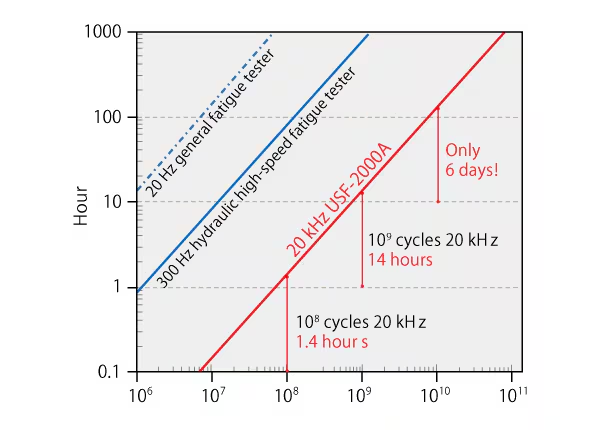
Click drawing to inspect vector dimensions