
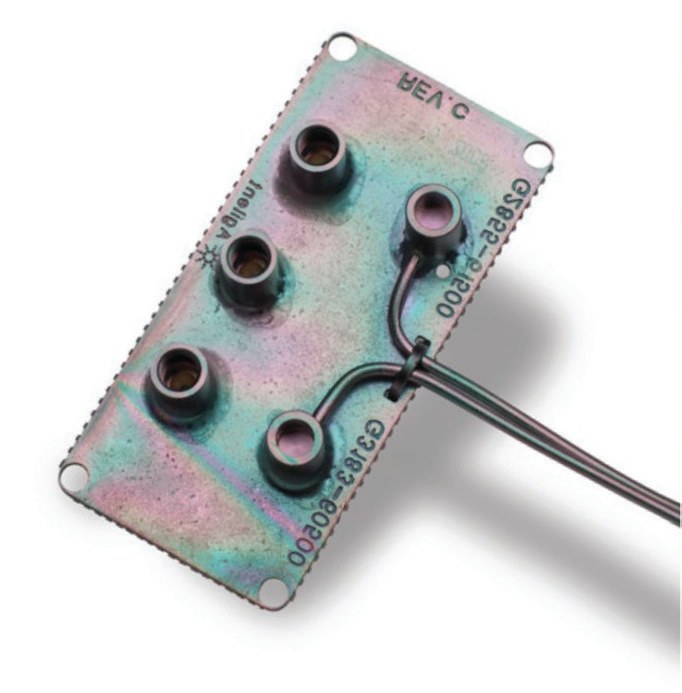
Agilent Technologies Accurate and Reliable GC System with Faster Cycle Times
Agilent Technologies Accurate and Reliable GC System with Faster Cycle Times — Gas chromatography.
The Agilent 8890B GC System is a dual-column, dual-FID gas chromatograph configured for residual solvent analysis per USP <467> and ChP 0861, with an 8697 headspace sampler. It runs a 19.3-minute high-resolution method on 50 m columns and supports helium or nitrogen carrier gas. This modification targets routine compendial residual-solvent testing with fast cycle times.
Agilent Technologies GC Systems Series — Model Comparison & Selection
| Model | Operating temperature, °C | Sample volume, milliliter | Carrier gas | Collision gas nitrogen, mL/min | Column temperature, °C | Data rate, Hz |
|---|---|---|---|---|---|---|
| Accurate and Reliable GC System with Faster Cycle Times Current | — | 0.002 | 2 | 1.5 | 85 | 10 |
| Reliable routine analysis gas chromatography system | 8...425 | — | — | — | — | — |
Full specifications
| Carrier gas | 2 |
| Collision Gas (nitrogen) | 1.5 mL/min |
| Column temperature | 85 °C |
| Data Rate | 10 Hz |
| Electron Energy | 70 eV |
| Oven Ramp 1 Rate | 3 °C/min |
| Oven Ramp Rate 2 | 50 °C/min |
| Purge Flow To Split Vent | 50 mL/min |
| Quench Gas (helium) | 2.25 mL/min |
| Run Time | 19.3 minutes |
| Sample volume | 1.5 µL |
| Septum Purge | 6 mL/min |
| Switching Time | 4.9 min |
| Carrier gas and flow rate mfr | 1 flow |
| Tune mfr | Etune: atunes.eiex.tune.xml s.eiex.tune.xml |
| Cleaning interval mfr | 350...400 injections |
| Headspace vial pressurization gas mfr | 2 |
| Headspace inject time mfr | 0.5 min |
| Detector mfr | FID FID |
| S/N acceptance criterion, Class 1 (1,1,1-trichloroethane) mfr | 5 |
| S/N acceptance criterion, Class 1 (other solvents) mfr | 3 |
| S/N acceptance criterion, Class 1 (benzene) mfr | 5 |
| S/N acceptance criterion, Class 2A mfr | 1 |
| S/N acceptance criterion, Class 2B (1,2-dimethoxyethane and ...) mfr | 1.5 |
| RT %RSD, 1,1-Dichloroethene mfr | 0.021 |
| Area %RSD, 1,1-Dichloroethene mfr | 1.275 |
| RT %RSD, Benzene mfr | 0.004 |
| Area %RSD, Benzene mfr | 1.833 |
| RT %RSD, Toluene mfr | 0.003 |
| Area %RSD, Toluene mfr | 0.641 |
| RT %RSD, Methanol mfr | 0.047 |
| Area %RSD, Methanol mfr | 2.521 |
| Column dimensions mfr | 50 μm |
| Oven ramp 2 hold mfr | 1 minute |
| Vial pressurization gas mfr | 2 |
| Inject time mfr | 0.5 min |
| Vial Pressurization Gas mfr | 2 |
| Loop Size mfr | 1 mL |
| Vial Size mfr | 20 mL |
| Vial Shaking mfr | 8 |
| Vial Equilibration Time mfr | 40 min |
| Inject Time mfr | 0.5 min |
| Vial Fill Pressure mfr | 15 psi |
| Loop Fill Mode mfr | Custom Custom |
| Loop Ramp Rate mfr | 40 psi/min |
| Loop Final Pressure mfr | 4 psi |
| Liner mfr | 1 id |
| CFT Device mfr | Unpurged two-way splitter splitter |
| Tubing mfr | 0.32 tubing |
| FID (Both Channels) mfr | 250 |
| A mfr | 1 |
| B mfr | 1 |
| Split ratio mfr | 10 |
| FID hydrogen flow mfr | 30 mL/min |
| FID air flow mfr | 300 mL/min |
| Fid Temperature | 250 °C |
| Initial Oven Temperature | 40 °C |
| Inlet Temperature | 250 °C |
| Ion Source Temperature | 280 °C |
| Transfer Line Temperature | 300 °C |
| Signal-to-noise, Class 1 (1,1,1-trichloroethane) mfr | 5 |
| Signal-to-noise, Class 1 (benzene) mfr | 5 |
| Signal-to-noise, Class 1 (other solvents) mfr | 3 |
| Signal-to-noise, Class 2A mfr | 1 |
| Signal-to-noise, Class 2B (1,2-dimethoxyethane and others) mfr | 1.5 |
Description
Construction and positioning
- The 8890B is a dual-column, dual-FID GC configured with an Agilent 8697 headspace sampler for residual solvent analysis per 2025 USP <467> and ChP 0861.
- Columns are Agilent DB-Select 624 UI and DB-WAX UI, both 50 m × 0.200 mm × 0.4 µm, enabling the 19.3-minute high-resolution method.
- Within the GC Systems series, this model is the routine compendial residual-solvent configuration; sibling models cover flexible/expandable intelligent GC, routine GC analysis, Micro GC fast chromatography, and reliable routine analysis.
Behavior under method conditions
- The high-resolution method uses a 50 m × 0.200 mm, 0.4 µm column and a 19.3-minute run; a high-speed variant uses a 20 m × 0.100 mm, 0.2 µm column and a 13.83-minute run.
- Oven program: initial 40 °C, ramp 1 at 3 °C/min, ramp 2 at 50 °C/min with a 1-minute hold.
- Inlet at 250 °C; ion source at 280 °C; transfer line at 300 °C; electron energy 70 eV.
- Flows: carrier gas 2 (unit as given), collision gas nitrogen 1.5 mL/min, quench gas helium 2.25 mL/min, purge flow to split vent 50 mL/min, septum purge 6 mL/min.
- Sample volume 1.5 µL; switching time 4.9 min.
- Headspace: vial pressurization gas 2, inject time 0.5 min, loop temperature 85 °C.
- Detector: FID. Tune file: atunes.eiex.tune.xml.
- Acceptance criteria: S/N Class 1 benzene 5, 1,1,1-trichloroethane 5, other solvents 3; Class 2A 1; Class 2B (1,2-dimethoxyethane and ...) 1.5.
- Repeatability examples: RT %RSD benzene 0.004, toluene 0.003, methanol 0.047, 1,1-dichloroethene 0.021; area %RSD benzene 1.833, toluene 0.641, methanol 2.521, 1,1-dichloroethene 1.275.
Installation, control and operation
- The system is evaluated with helium and nitrogen carrier gases and supports Procedure A and Procedure B of USP <467>.
- A Deans switch application note covers diverting derivatization agents (MSTFA) from the EI source in anti-doping GC/MS/MS workflows on 7000/7010 Series GC/TQ with hydrogen or helium carrier gas and SSL or PTV inlets; this is a related configuration, not this model's base setup.
- Cleaning interval: 350–400 injections.
Integration & Operating Notes
The system is evaluated with both helium and nitrogen carrier gases; switching carrier gas requires revalidation of retention times and acceptance criteria because selectivity and efficiency differ between the two.
The specified cleaning interval is 350–400 injections; deferring septum/liner maintenance beyond this window risks carryover and degraded S/N, particularly for Class 1 solvents with acceptance criteria of 3–5.
The method references the tune file atunes.eiex.tune.xml; using a different tune file changes ion-source response and can shift the S/N margins used for Class 1 and Class 2 acceptance.
Selection & Integration Q&A
Choose this dual-column, dual-FID 8890B with 8697 headspace sampler when the workflow is compendial residual-solvent testing per USP <467>/ChP 0861 with helium or nitrogen carrier gas. Sibling models target flexible/expandable intelligent GC, routine GC analysis, or Micro GC fast chromatography instead.
The method requires an Agilent 8697 headspace sampler, DB-Select 624 UI and DB-WAX UI columns (50 m × 0.200 mm × 0.4 µm for the 19.3-min high-resolution method), FID detectors, and either helium or nitrogen carrier gas. The 20 m × 0.100 mm, 0.2 µm column is needed only for the 13.83-min high-speed variant.
The base system does not include the application-specific columns (DB-Select 624 UI, DB-WAX UI), the 8697 headspace sampler, carrier/collision/quench gases, or the tune file atunes.eiex.tune.xml; these must be specified separately. The Deans switch for MSTFA diversion is a separate configuration for 7000/7010 GC/TQ, not part of this model.