
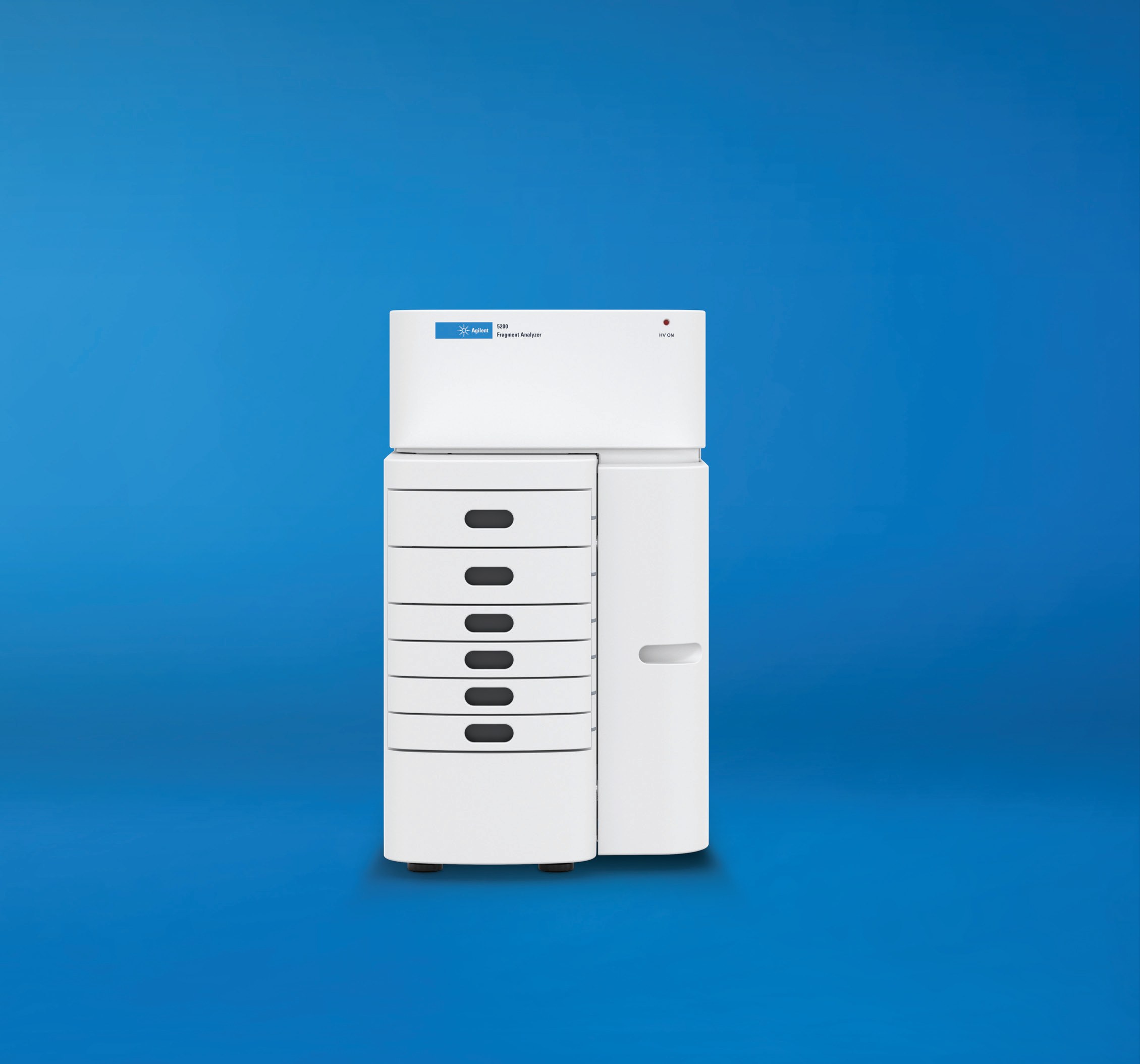
Agilent Technologies Capillary arrays for
Agilent Technologies Capillary arrays for — Automated electrophoresis.
Capillary array consumable for the Agilent 5200/5300/5400 Fragment Analyzer Systems, which differ only in throughput: 5200 handles 12–96 samples one to three times per day, 5300 one to two 96-well plates up to three times per day, and 5400 more than two plates per day with robotic automation. The array pairs a Charged Coupled Device detector with 2 µL sample volume per well and resolves fragments differing by 3 bp, enabling automated electrophoresis of nucleic acids with a single dilution per sample and an input concentration dynamic range spanning two orders of magnitude.
Full specifications
| Detector type | Charged Coupled Device |
| Sample Volume Per Well | 2 µL |
| Separation resolution mfr | 3 bp |
| Dilutions per sample mfr | single single |
| Gel capacity mfr | two two |
| Input concentration dynamic range mfr | two orders of magnitude magnitude |
| RQN quality score scale mfr | 1...10 |
Description
Construction and series positioning
- The capillary array is the separation consumable for the Agilent Fragment Analyzer Systems; the platform comprises three models that differ only in throughput: 5200 (medium, 12–96 samples one to three times per day), 5300 (high-throughput, one to two 96-well plates up to three times per day) and 5400 (ultrahigh-throughput, robotic automation, more than two 96-well plates per day).
- Detection is by Charged Coupled Device; each well consumes 2 µL of sample.
- Separation resolution is 3 bp, and each sample requires a single dilution.
Analytical behavior
- The input concentration dynamic range covers two orders of magnitude, so samples of widely differing concentration can be run without re-dilution.
- Quality scoring uses the RQN scale from 1 to 10.
- The gel capacity is two, and reagents are room-temperature stable.
Operation
- The attached brochure digest provides no installation, connection or control details; operating specifics beyond the facts above are not documented here.
Integration & Operating Notes
The array's stated dynamic range spans two orders of magnitude; samples outside that window fall outside the documented range, and each sample is loaded at a single dilution, so concentration must be estimated before the run rather than corrected by re-dilution on the instrument.
The array is specified with a gel capacity of two; plan plate batches so that gel supply matches the number of runs, since the facts give no further replenishment interval or service schedule.
Reagents are room-temperature stable, so no cold-chain storage or equilibration step is required before use; the facts do not specify shelf life or expiry handling.
Selection & Integration Q&A
The three models differ only in throughput: 5200 for 12–96 samples one to three times per day, 5300 for one to two 96-well plates up to three times per day, and 5400 for more than two 96-well plates per day with robotic automation. Pick by daily plate volume.
The input concentration dynamic range covers two orders of magnitude, and each sample needs only a single dilution. Concentrations outside that window are not covered by the documented range, so estimate concentration before loading.
Gel capacity is two, so plan runs against gel supply; reagents are room-temperature stable, avoiding cold-chain handling. The facts give no service interval, accessory list or cable requirements beyond these points.