
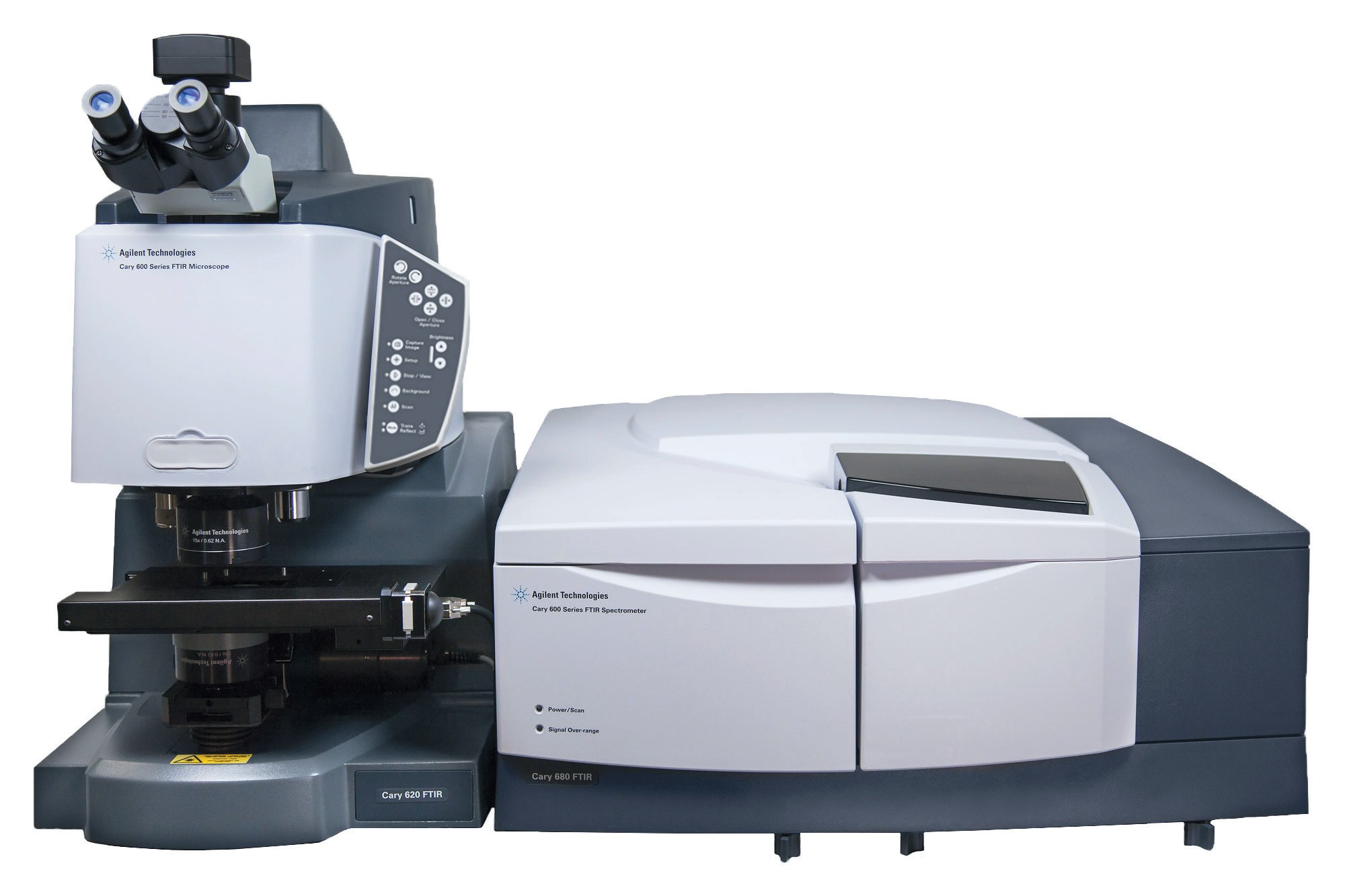
Agilent Technologies Cary 620-FTIR
Agilent Technologies Cary 620-FTIR — Molecular spectroscopy with Flow rate 10 liter/minute.
The Cary 620-FTIR is an FTIR microscope that couples to Cary 600 Series spectrometers, using a 64×64 FPA (5.5 µm pixels) and a 15× IR objective for chemical imaging. It operates on 100–240 VAC, 50–60 Hz, 60 W, with a 350 µm field of view and 4 cm⁻¹ spectral resolution. It is used for spatially resolved molecular mapping of heterogeneous samples such as tissue sections.
Full specifications
| Flow rate | 10 L/min |
| Temperature | 20...26 °C |
| Wavelength range | 4000...900 |
| Dewar Equilibrium Time | 10 minutes |
| Disk Usage | 4.3 GB |
| Field of view | 350 µm |
| Integration Time | 12 µs |
| Magnification | 15 x |
| Rotational speed | 5 kHz |
| Spectral resolution | 4 dimensionless |
| Tissue section thickness mfr | 7 μm |
| Animal age mfr | 13 old |
| Olefinic functional group (C=C-H) absorption band mfr | 3012 |
| Lipid carbonyl (C=O) absorption band mfr | 1735 |
| Number of scans mfr | 256 scan |
| FPA size mfr | 64 pixels |
| Pixel size mfr | 5.5 μm |
| Co-added scans (sample) mfr | 16 |
| Co-added scans (background) mfr | 32 |
| Under-sampling (UDR) scan setting mfr | 4 |
| Low pass optical filter cut-off mfr | 3975 |
| Attenuation setting mfr | Open Open |
| Mosaic configuration mfr | 27 |
| Total mosaic size mfr | 8.4 mm |
| Purge source pressure mfr | 60 psi |
| Rear clearance mfr | 30 centimeters |
| Overhead clearance mfr | 75 cm |
| Loaded flatness tolerance mfr | 0.4 length |
| Laser wavelength mfr | 632.8 nanometers |
| Gas outlet distance from instrument mfr | 1.5 meters |
| Cryosection thickness mfr | 7 μm |
| Number of scans for co-addition mfr | 256 scans |
| Spectral cutoff (Fourier transform limit) mfr | 3975 |
| Low pass optical filter cutoff mfr | 3975 |
| Spectral cutoff mfr | 1000 |
| Maximum purge source pressure mfr | 60 psi |
| Minimum rear clearance mfr | 30 cm |
| Scans mfr | 256 |
| Spatial resolution mfr | 5.5 μm |
| Mosaic mfr | 7 tiles |
| cryosection thickness mfr | 7 μm |
| number of scans mfr | 256 scans |
| pixel resolution mfr | 5.5 micron |
| detector array size mfr | 64 pixel |
| olefinic band mfr | 3012 |
| carbonyl band mfr | 1735 |
| Single FPA tile FOV (μm) mfr | 1230 |
| Nominal pixel size (μm) mfr | 19.2 |
| Mosaic config. mfr | 7 |
| Total mosaic size (mm) mfr | 8.6 |
| Collection time (hh:mm) mfr | 1 |
| sample co-added scans mfr | 16 |
| background co-added scans mfr | 32 |
| UDR scan setting mfr | 4 |
| low-pass filter cutoff mfr | 3975 |
| 4x objective spectral cutoff mfr | 1000 |
| tissue section size mfr | 8 mm |
| total mosaic size 4x mfr | 8.6 mm |
| data size 4x mfr | 4.3 GB |
| data size 15x mfr | 42.4 GB |
| collection time 4x mfr | 1 |
| collection time 15x mfr | 10 |
| UDR 8 spectral limit mfr | 1975 |
| region of interest size mfr | 750 μm |
| General mfr | 8 |
| Verifying Safe State mfr | 8 |
| Ultraviolet radiation mfr | 9 |
| Compressed gas cylinders mfr | 9 |
| Electrical hazards mfr | 10 |
| Laser safety mfr | 11 |
| Other precautions mfr | 13 |
| Warnings or symbols mfr | 14 |
| Color coding mfr | 15 |
| Electromagnetic compatibility mfr | 15 |
| Agilent Cary 600 Series FTIR spectrometer mfr | 4 equivalent |
| Agilent Cary 610/620 FTIR microscope (typical) mfr | 1 equivalent |
| Maximum source pressure mfr | 60 psi |
| Dewar initial LN2 fill mfr | 475 milliliters |
| Dewar top-up LN2 mfr | 200 milliliters |
| Depth | 68.9 cm |
| Height | 66.8 cm |
| Weight | 50 kg |
| Width | 39.6 cm |
| Power consumption | 60 W |
| Microscope voltage mfr | 100...240 max |
| Mains frequency mfr | 50...60 Hz |
| Power circuit rating mfr | 10 A |
| Fuse type (Cary 600 Series FTIR spectrometer) mfr | 4 equivalent |
| Fuse type (Cary 610/620 FTIR microscope, typical) mfr | 1 equivalent |
| Power circuit mfr | 10 A |
| Liquid Nitrogen Temperature | 196 °C |
| Liquid nitrogen initial fill mfr | 475 milliliters |
| Liquid nitrogen top-off mfr | 200 milliliters |
| Liquid nitrogen initial fill volume mfr | 475 mL |
| Liquid nitrogen top-off volume mfr | 200 mL |
| Operating temperature | 20 °C |
| Purge Gas Dew Point | -70 °C |
| Storage temperature | -70 °C |
| Relative humidity mfr | 20 condensing |
| Cryogenic cooling mfr | 9 |
| CE compliance mfr | 15 |
Description
Construction and positioning
- The Cary 620 is a microscope accessory that mounts to a Cary 600 Series FTIR spectrometer; it is not a standalone instrument. The manual covers installation with Cary 600 Series spectrometers and references Cary 610/620 variants in the fuse table.
- The optical path uses a standard 15× IR objective; the application note also describes a 4× IR objective for large-area work. The FPA detector is a 64×64 array with 5.5 µm pixels, giving a 350 µm field of view.
- Physical envelope: 39.6 cm wide × 68.9 cm deep × 66.8 cm high, 50 kg. Rear clearance 30 cm, overhead 75 cm.
Behavior under load and in different modes
- Spectral resolution is 4 cm⁻¹; integration time 12 µs. The application note reports co-added scans of 16 (sample) and 32 (background), 256 scans in some settings, and under-sampling (UDR) setting 4 with a low-pass optical filter cut-off at 3975.
- Mosaic acquisition is supported: a 7-tile mosaic totaling 8.6 mm is described, with a 1 mm collection time. The 64×64 and 128×128 FPA configurations are referenced in the application note.
- Detectors are liquid-nitrogen cooled (MCT, InSb, FPA). Dewar fill: ~475 mL initial, 10–20 min to thermal equilibrium, then ~200 mL top-off. Do not fill to the top; freezing the o-ring seal causes vacuum loss and requires factory pump-down.
Installation, connection and control
- Power: 100–240 VAC, 50–60 Hz, 60 W max, on a dedicated 10 A grounded circuit with no other instruments. Fuse 1FS1 is T2.0 AH 250 V (5×20 mm); spectrometer fuse is T4 AH 250 V.
- Purge: water-free air at −70 °C dew point or dry nitrogen, max 10 L/min, source pressure ≤60 psi unless an additional regulator is fitted.
- FPA cabling differs by type: Type A (two cables) needs two PC serial ports (FPA data and motorized stage); Type B (three cables) needs one serial port for the stage. The Type B trigger cable uses a two-pin snap-in at the detector and a 26-pin D-connector at the spectrometer FPA/TRS port.
- Motorized stage controller has six connectors: RS-232, Power, USB (not used), Joystick, Z, Stage.
- Control software is Agilent Resolutions Pro; troubleshooting is via F1 > Contents > Troubleshooting, not a printed fault table.
Integration & Operating Notes
A warped or sagging support surface misaligns the optical path and degrades imaging; verify loaded flatness before installation. The 50 kg microscope also requires a bench rated for the load and a fork lift or suitable lifting device for moving.
The auto-ranging 100–240 VAC supply draws 60 W max but must sit on a clean, dedicated grounded branch with no other instruments. Shared circuits risk electrical noise and interference with sensitive IR measurements. Use only the specified time-lag fuses (T2.0 AH for the microscope).
Use water-free air dried to −70 °C dew point or dry nitrogen. Source pressure must not exceed 60 psi (420 kPa) unless an additional regulator is fitted. Wet or over-pressured purge compromises the optics. Gas drops should be within 1.5 m of the instrument with stop valves and gauges.
Fill about 475 mL initially, wait 10–20 min for thermal equilibrium, then add about 200 mL. Overfilling freezes the elastomer o-ring seal, causing loss of vacuum and requiring return of the detector assembly for pump-down. Use the half-funnel incremental fill method.
Type A FPA detectors use two cables and require two PC serial ports (FPA data and motorized stage), with an interface converter on Serial Port 1 and an RS232 pigtail to the FPA/TRS penthouse connector. Type B uses three cables and only one serial port for the stage; its trigger cable runs from a two-pin snap-in at the detector to a 26-pin D-connector at the spectrometer FPA/TRS port.
Laboratory HVAC must hold a tight temperature band; rapid room-temperature swings degrade FTIR microscope performance. Humidity must be non-condensing. The instrument is Class A ISM equipment for professional/non-domestic environments and may cause EMC disturbances in residential settings.
Wipe spills immediately with a soft cloth dampened with water or mild detergent. Organic solvents and abrasives must not be used as they can damage exterior surfaces and optics. Routine maintenance procedures are in Resolutions Pro Help; non-listed maintenance must be performed by Agilent-trained representatives.
The product is ITAR-regulated (22 CFR 120-130). A U.S. export license is required to export it from the United States. Export, shipment, service and use are subject to ITAR restrictions; verify licensing before international transfer.
Selection & Integration Q&A
The Cary 620 is specified for coupling to Cary 600 Series spectrometers and supports FPA imaging with 64×64 and 128×128 configurations. The manual's fuse table distinguishes Cary 610/620 microscope fuses from the spectrometer fuse. Choose the 620 when FPA-based chemical imaging with mosaic capability (e.g., 7-tile, 8.6 mm) is required; the 610 is referenced only in the fuse table, so confirm its imaging capability with Agilent.
Purge must be water-free air at −70 °C dew point or dry nitrogen, max 10 L/min, source pressure ≤60 psi unless an additional regulator is fitted. The microscope connects to a Cary 600 Series spectrometer; FPA cabling depends on detector type: Type A needs two PC serial ports, Type B needs one serial port for the stage plus a trigger cable to the spectrometer FPA/TRS port.
Bench must be level, vibration-free, rigid, and flat to 0.4 mm per 300 mm loaded. Allow 30 cm rear clearance and 75 cm overhead. Operating environment: 20–26 °C, ≤1 °C/hr gradient, 20–50% RH non-condensing, sea-level operation. Power on a dedicated 10 A circuit, 100–240 VAC, 50–60 Hz.
Liquid nitrogen is a consumable: ~475 mL initial fill plus ~200 mL top-off per cooldown. Routine maintenance procedures are in Resolutions Pro Help; non-listed service must be by Agilent-trained representatives. Cleaning only with water or mild detergent. Spare fuses (T2.0 AH microscope, T4 AH spectrometer) and purge gas regulators/flow meters are not included and must be sourced separately.