
Agilent Technologies GC nitrogen chemiluminescence detector, NOx analyzer
Agilent Technologies GC nitrogen chemiluminescence detector, NOx analyzer — Gas chromatography.
The Agilent 8255 nitrogen chemiluminescence detector (NCD) is a GC detector configured here as a dedicated NOx analyzer for trace ammonia in hydrocarbon and hydrogen matrices. Its 900 °C burner, 200 °C base, and 131 Torr burner pressure define the chemiluminescence reaction zone, while a 1 mL gas sample loop and 5 Hz data rate support ppb-level quantitation from 37.1 to 495 ppb. It is positioned in the GC detector series as the nitrogen-selective alternative to the FID, NPD, FPD, and sulfur chemiluminescence detectors.
Full specifications
| Data Rate | 5 Hz |
| Sample Loop Volume | 1 mL |
| Oxidizer flow during analysis mfr | 30 mL/min |
| Oxidizer flow at ammonia elution mfr | 4 mL/min |
| Valve switch-off time after injection mfr | 0.25 minutes |
| Ammonia run area mfr | 264.08 |
| Column mfr | Select Low Ammonia Ammonia |
| Burner pressure mfr | 131 Torr |
| Calibration level L1 concentration mfr | 37.1 ppb |
| Calibration level L2 concentration mfr | 49.5 ppb |
| Calibration level L3 concentration mfr | 79.2 ppb |
| Calibration level L4 concentration mfr | 99 ppb |
| Calibration level L5 concentration mfr | 198 ppb |
| Calibration level L6 concentration mfr | 495 ppb |
| Response factor L1 mfr | 0.228 |
| Response factor L2 mfr | 0.236 |
| Response factor L3 mfr | 0.218 |
| Response factor L4 mfr | 0.215 |
| Response factor L5 mfr | 0.175 |
| Response factor L6 mfr | 0.156 |
| Linearity range mfr | 37.1...495 ppb |
| Quality control requirement mfr | 100 ppb |
| Burner Temperature | 900 °C |
| Ammonia standard deviation mfr | 7.20 |
| Ammonia relative standard deviation (RSD) mfr | 2.73 |
Description
Construction and series positioning
- The NCD is a chemiluminescence detector, not a flame or thermionic detector: it converts nitrogen species to NO in a 900 °C burner and measures the NO/O3 chemiluminescence. Within the Agilent GC detector family it is the nitrogen-selective member, alongside the universal FID, the phosphorus/sulfur-selective FPD, the sulfur-only SCD, and the nitrogen/phosphorus NPD.
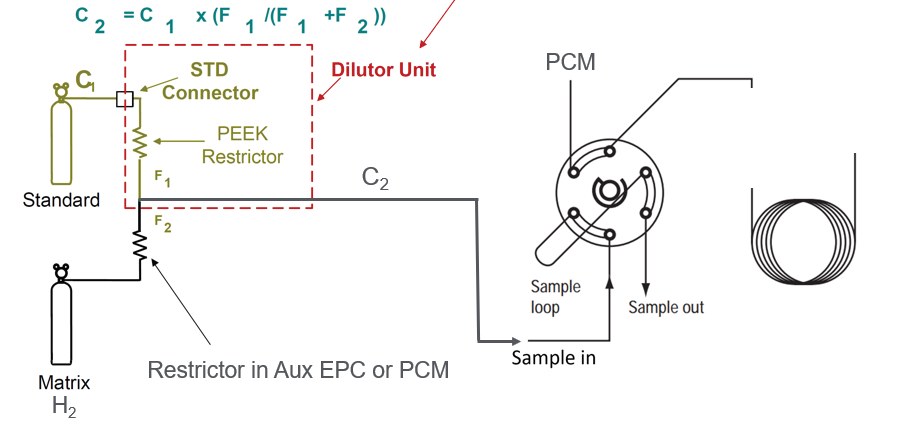
- This configuration is application-specific: a 6-port gas sample valve with a 1 mL sample loop, a Select Low Ammonia megabore column (CP8590), and UltiMetal Plus deactivated stainless steel surfaces, as described in application note 5991-8061EN for trace ammonia in ethylene.
- The second referenced method (5994-7439EN) uses the same NCD and Select Low Ammonia column but with a 2 mL sample loop on an 8890 GC, showing that loop volume is a method variable rather than a fixed detector property.
Behavior under load and in different modes
- The detector operates with a burner at 900 °C, an NCD base at 200 °C, and a burner pressure of 131 Torr. Oxidizer flow is switched during the run: 30 mL/min during analysis and 4 mL/min at ammonia elution, with the valve switched off 0.25 min after injection.
- Calibration data span 37.1 to 495 ppb across six levels (37.1, 49.5, 79.2, 99, 198, 495 ppb). Response factors decline from 0.228 at L1 to 0.156 at L6, indicating a non-linear response that requires multi-level calibration rather than a single-point factor.
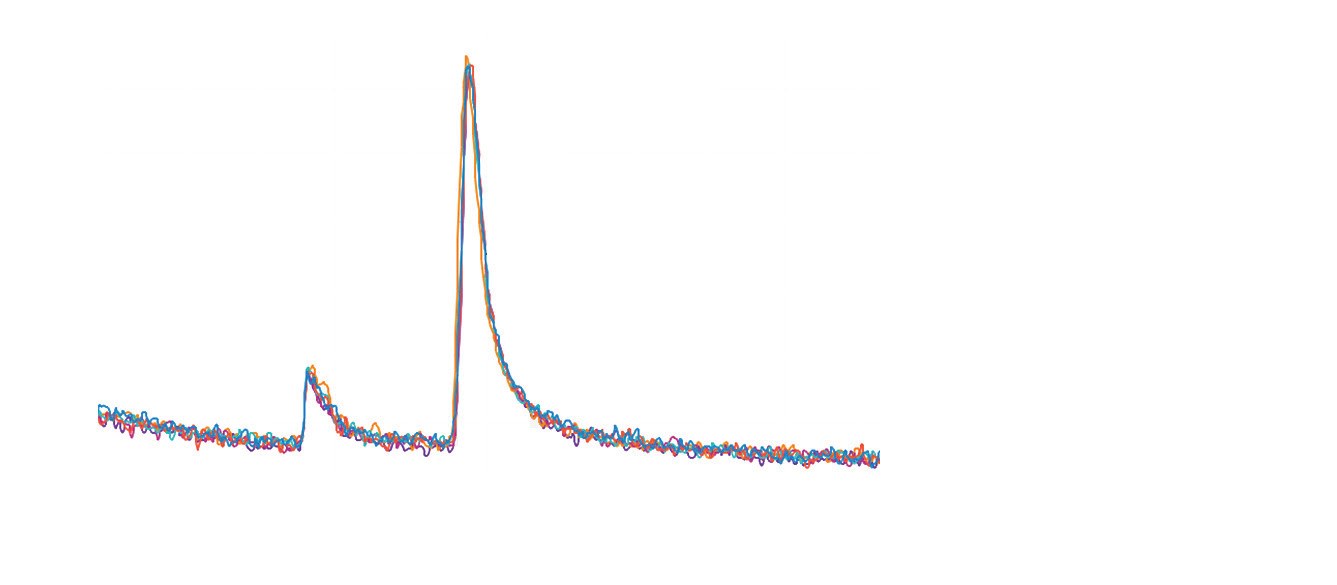
- The ammonia run area is 264.08 with a standard deviation of 7.20 and RSD of 2.73 %, reflecting repeatability under the stated method conditions.
Installation, control and operation
- The valve/valve box is held at 125 °C and the column oven program includes a 100 °C setpoint. The detector outputs at a 5 Hz data rate, compatible with OpenLAB CDS as named in the application note.
- The method uses a 6-port gas sampling valve for gas-phase ammonia introduction; the 1 mL loop is the configuration described for the 7890B/8255 NCD setup.
Integration & Operating Notes
The method requires the sample valve to close 0.25 minutes after injection, with oxidizer flow reduced from 30 mL/min to 4 mL/min at ammonia elution. The GC timetable must sequence valve and oxidizer flow together; a missed event will distort the ammonia peak and the run area.
Response factors fall from 0.228 at 37.1 ppb to 0.156 at 495 ppb, so a single-point calibration will bias results across the range. The method defines six calibration levels and a 100 ppb quality-control requirement; bracketing QC checks must be run within this range.
The method specifies the CP8590 Select Low Ammonia megabore column and UltiMetal Plus deactivated stainless steel surfaces to prevent ammonia adsorption. Substituting an untreated column or unpassivated tubing will cause low recovery and tailing, so these consumables must be maintained as specified.
Selection & Integration Q&A
Choose the NCD for nitrogen-selective trace analysis such as ammonia at ppb levels (37.1–495 ppb calibrated here). The FID is universal and not nitrogen-selective; the NPD is nitrogen/phosphorus-selective but not a chemiluminescence detector; the FPD targets sulfur and phosphorus; the SCD is sulfur-only. The NCD is the dedicated nitrogen chemiluminescence option.
The referenced configuration uses a 6-port gas sample valve with a 1 mL sample loop, a CP8590 Select Low Ammonia megabore column, UltiMetal Plus deactivated stainless steel surfaces, and OpenLAB CDS. The second method uses a 2 mL loop on an 8890 GC, so loop volume and GC platform are method variables to confirm before ordering.
The base detector does not include the CP8590 Select Low Ammonia column, UltiMetal Plus deactivated tubing, the 6-port gas sample valve with 1 mL or 2 mL loop, calibration standards for the six levels (37.1–495 ppb), or the OpenLAB CDS data system. These must be specified separately, and the multi-level calibration and 100 ppb QC check must be scheduled as ongoing service tasks.
Dimensional Drawings & Technical Documentation
Dimensional drawings
Click drawing to inspect vector dimensions