
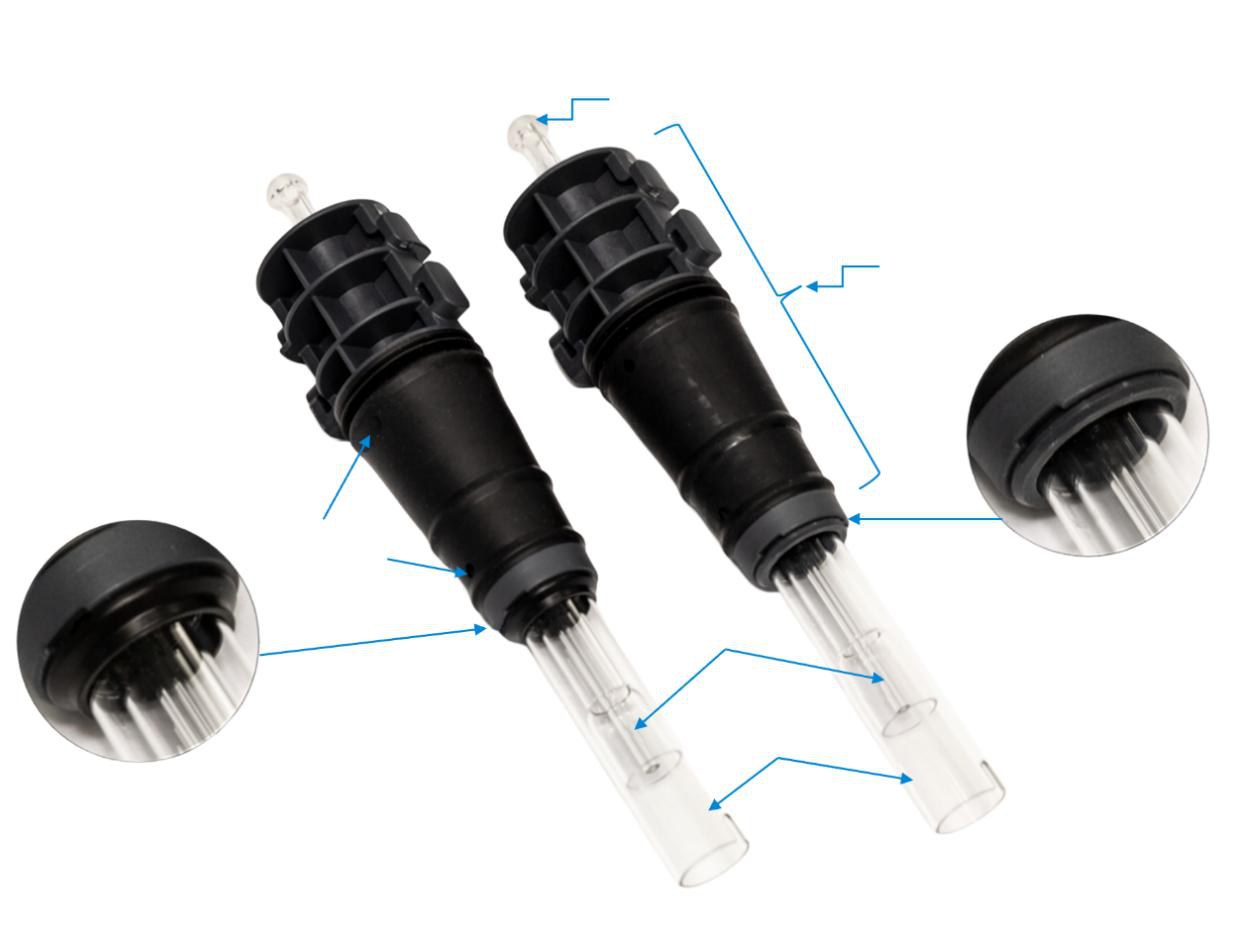
Agilent Technologies 5100 ICP OES
Agilent Technologies 5100 ICP OES — Atomic spectroscopy.
The Agilent 5100 ICP OES is a dual-view (RV/DV) inductively coupled plasma optical emission spectrometer configured with a fully demountable Easy-fit torch. Its standard quartz outer tube-set with 1.8 mm id injector serves most aqueous and acidic samples, while the ceramic outer tube-set with 2.4 mm id inert alumina injector extends the working range to HF digests and high-TDS matrices up to 35% TDS. It is intended as the excitation and sample-introduction front end of an atomic emission analytical system.
Full specifications
| Injector Internal Diameter (id) | 1.8 mm |
| Maximum Total Dissolved Solids (tds) | 35 % |
| Cooling time before torch removal mfr | at least five minutes minutes |
Description
Construction and series positioning
- The 5100 ICP OES is built around the Easy-fit torch family shared with the 5800/5900 and 5110 instruments; the torch is available as one-piece, semi-demountable, or fully demountable, and in Radial View (RV) or Dual View (DV) outer tube-set variants.
- This model's fully demountable torch is a five-part assembly: locking nut, injector (quartz or inert alumina), torch body, top seal, and outer tube-set (quartz or ceramic). It can be run in RV or DV mode by fitting the corresponding outer tube-set; the RV tube-set is shorter and lacks the top slot of the DV tube-set.
- The torch is shipped without the injector installed; the injector is inserted until it clicks into the retaining clamp and the locking nut is hand-tightened only.
Behavior across sample matrices
- Standard quartz outer tube-set with 1.8 mm id injector is the general-purpose, most economical configuration for aqueous and acidic samples.
- Organic high-purity quartz outer tube-sets with 0.8 mm id (volatile) or 1.4 mm id (semi-volatile) injectors improve resistance to solarization for organic matrices.
- The ceramic outer tube-set with 2.4 mm id inert alumina injector (G8020-47004) gives the longest service life and resistance to devitrification for high-TDS matrices, HF digests, fusions, and Li battery materials; total dissolved solids must not exceed 35% with this injector.
- Replacement injectors are offered in quartz and inert alumina at 0.8, 1.4, 1.8, and 2.4 mm id, allowing the injector bore to be matched to the matrix.
Installation, control, and operation
- Assembly requires seating the top seal, aligning the outer tube-set groove with the 'T' mark on the torch body, pressing the tube-set fully home, inserting the injector until it clicks, and hand-tightening the locking nut.
- The ceramic outer tube-set's quartz intermediate tube carries a fixed polymer adapter that must not be removed; the supplied tube-set tool is used for assembly and disassembly of the ceramic outer tube from the quartz intermediate tube.
- Torch installation, maintenance, and cleaning procedures are referenced to the ICP Expert Help and Learning Center and to the Easy-fit Torch Maintenance and Cleaning guide (5994-8864EN).
- After plasma switch-off, the torch and torch compartment must cool for at least five minutes before the torch is removed.
Integration & Operating Notes
The 2.4 mm id inert alumina injector G8020-47004 is rated for HF digests and high-TDS samples up to 35% total dissolved solids. Exceeding this matrix load risks injector blockage and devitrification-related failure; dilute or switch to a more suitable sample-introduction configuration before running higher-TDS digests.
The torch and torch compartment remain hot after the plasma is extinguished. Allow at least five minutes of cooling before attempting removal, and maintain a straight, parallel movement when inserting or removing the torch and its quartz or ceramic components to avoid breakage and hand injury.
The locking nut must be tightened by hand; using tools or overtightening can damage both the injector and the torch body. During reassembly, seat the top seal and align the outer tube-set groove with the 'T' mark before pressing the tube-set fully into the body and inserting the injector until it clicks.
Standard quartz with 1.8 mm id injector suits most aqueous and acidic samples; organic high-purity quartz with 0.8 mm id (volatile) or 1.4 mm id (semi-volatile) injectors resist solarization in organic matrices; ceramic outer tube-set with 2.4 mm id inert alumina is reserved for high-TDS, HF digest, and fusion work. Selecting the wrong combination shortens torch life or compromises analytical results.
The fully demountable torch kit with ceramic outer tube-set does not include an injector and must be ordered separately. The quartz intermediate tube of the ceramic outer tube-set has a fixed polymer adapter that should not be removed; use the supplied tube-set tool when separating the ceramic outer tube from the quartz intermediate tube.
Selection & Integration Q&A
Choose the fully demountable torch when the sample matrix varies and you need to swap injectors (quartz or inert alumina, 0.8–2.4 mm id) and outer tube-sets (quartz, organic high-purity quartz, or ceramic) independently. The one-piece and semi-demountable torches are ready to use out of the box and suit fixed, routine aqueous/acidic workloads where reconfiguration is not required.
The ceramic outer tube-set kit does not include an injector, so a compatible quartz or inert alumina injector must be ordered separately. For HF digests and high-TDS matrices, the 2.4 mm id inert alumina injector G8020-47004 is specified, with total dissolved solids limited to 35%.
The torch is shipped without the injector installed; insert it until it clicks into the retaining clamp and hand-tighten the locking nut only. After plasma switch-off, allow at least five minutes for the torch and compartment to cool, and keep a straight parallel movement when inserting or removing the torch and its quartz or ceramic parts to avoid breakage.
Replacement injectors (quartz or inert alumina, 0.8/1.4/1.8/2.4 mm id), outer tube-sets (standard quartz, organic high-purity quartz, ceramic for RV or DV), top seal pack of 3 (G8014-60023), and injector locking nut (G8020-60810) are separate parts. Cleaning and maintenance procedures are covered in publication 5994-8864EN.