
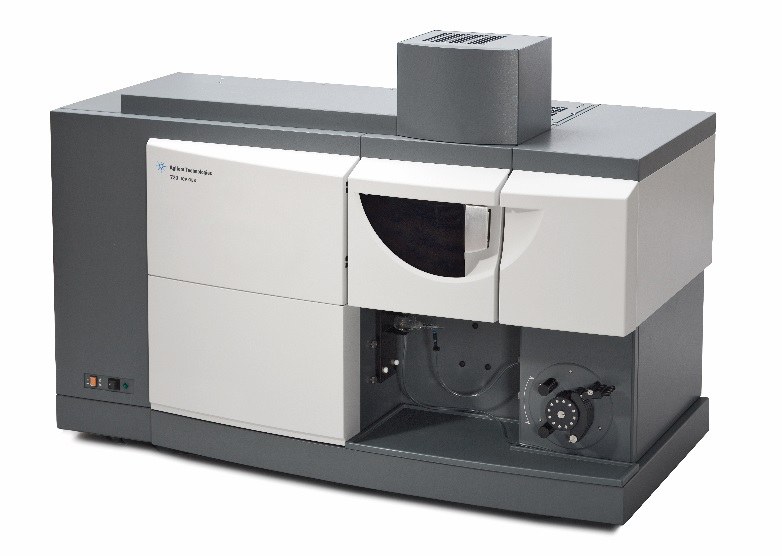
Agilent Technologies 725 ICP OES
Agilent Technologies 725 ICP OES — Atomic spectroscopy.
The Agilent 725 ICP OES is a radial-plasma optical emission spectrometer in the 700 Series, distinguished from the axial-plasma 710/720 by its radial induction coil (4.7 mm pitch) and side-on plasma viewing. It operates a ~10,000 K argon plasma driven by a 40 MHz, 1500 V RMS work coil, with argon flows of 9–32.8 L/min and optional nitrogen purge. It is used for multi-element trace analysis in laboratory atomic spectroscopy.
Full specifications
| Consumables | 42 |
| Nitrogen (argon Only) | 20 ppm |
| Oxygen Content | 5 ppm |
| Plasma Temperature | 10000 K |
| Standby Mode Flow | 0.75 L/min |
| Water Vapor | 4 ppm |
| Argon purity mfr | 99.996 |
| Nitrogen purity mfr | 99.996 |
| Permissible pressure range mfr | 400...600 kPa |
| Recommended pressure mfr | 550 regulated |
| Operational range (plasma on) mfr | 9...32.8 L/min |
| Measuring wavelengths > 200 nm (poly boost off) mfr | 13.5...21.75 L/min |
| Measuring wavelengths < 200 nm (poly boost on) mfr | 15.75...24 L/min |
| Drain vessel minimum capacity mfr | 2 liters |
| Standby mode nitrogen flow mfr | 0.45 L/min |
| Operational range (plasma on) argon flow mfr | 8.3...29.1 L/min |
| Operational range (plasma on) nitrogen flow mfr | 0.45...2.1 L/min |
| Measuring wavelengths > 200 nm (poly boost off) argon flow mfr | 12.75...21 L/min |
| Measuring wavelengths > 200 nm (poly boost off) nitrogen flow mfr | 0.45 L/min |
| Measuring wavelengths < 200 nm (poly boost on) argon flow mfr | 12.75...21 L/min |
| Measuring wavelengths < 200 nm (poly boost on) nitrogen flow mfr | 2.1 L/min |
| Purity mfr | 99.996 |
| General mfr | 7 |
| Verifying Safe State mfr | 8 |
| Heat, Vapors and Fumes mfr | 9 |
| Compressed Gas Hazards mfr | 9 |
| Electrical Hazards mfr | 10 |
| Other Precautions mfr | 10 |
| Warning Symbols mfr | 11 |
| Color Coding mfr | 14 |
| Electromagnetic Compatibility mfr | 15 |
| Analysis Checklist mfr | 27 |
| Turning On the Instrument and Software mfr | 28 |
| Preparing for Analysis mfr | 30 |
| Calibrating the Detector mfr | 30 |
| Aligning the Torch mfr | 30 |
| Setting Operating Conditions mfr | 31 |
| Creating/Opening a Worksheet mfr | 31 |
| Developing a Method mfr | 31 |
| Running Samples mfr | 32 |
| Printing a Report mfr | 32 |
| Turning Off the Instrument mfr | 32 |
| Routine Maintenance mfr | 38 |
| Induction Coil Maintenance mfr | 39 |
| Cleaning mfr | 41 |
| Troubleshooting mfr | 42 |
| Spare Parts mfr | 42 |
| Oxygen impurity limit mfr | 5 ppm |
| Permissible gas pressure range mfr | 400...600 kPa |
| Recommended gas pressure mfr | 550 regulated |
| Radial induction coil pitch mfr | 4.7 mm |
| Axial induction coil pitch mfr | 7.5 mm |
| Instrument weight mfr | 203 kg |
| Gas supply hose length mfr | 1.8 meters |
| Work Coil Frequency | 40 MHz |
| Fuse 1FS1 and 1FS2 mfr | 6.3 mm |
| Circuit breaker 1CB1 mfr | 30 A |
| Work coil voltage mfr | 1500 RMS |
| Fuse 1FS1 and 1FS2 rating mfr | 6.3 V |
| Circuit breaker 1CB1 rating mfr | 30 trip |
| Ambient temperature limit | 20 °C |
| Maximum permissible cooling water pressure mfr | 310 kPa |
| Minimum cooling water flow mfr | 1.1 L/min |
| South Korean Class A EMC declaration mfr | 16 |
| Cooling water flow trip threshold mfr | 1.1 L/min |
| CE Compliance mfr | 14 |
Description
Construction and series positioning
- The 725 is the radial-plasma member of the 700 Series; the 710/720 use an axial plasma with a 7.5 mm coil pitch, while the 725 uses a radial coil with 4.7 ±0.5 mm pitch.
- Radial viewing reduces matrix effects and is suited to higher-concentration or complex-matrix samples; the axial siblings favor lower detection limits.
- The instrument weighs ~203 kg and requires mechanical lifting; installation is by Agilent-trained field service engineers only.
Plasma and gas behavior
- The plasma runs at ~10,000 K; the work coil operates at 1500 V RMS and ~40 MHz.
- Argon is the plasma gas: standby flow 0.75 L/min, operational range 9–32.8 L/min. With the optional nitrogen purge kit, argon drops to 8.3–29.1 L/min and nitrogen is 0.45–2.1 L/min.
- Gas purity must be 99.996% for argon and nitrogen, with O2 <5 ppm, H2O <4 ppm, and N2 in argon <20 ppm. Supply pressure 400–600 kPa, recommended 550 kPa.
- Poly Boost purge must run ≥20 min before wavelength calibration; dark current scan ~2 min, wavelength calibration 2–3 min.
Installation, control and operation
- Cooling water is required: flow must stay above 1.1 L/min or the sensor stops the plasma and camera Peltier; supply pressure must not exceed 310 kPa without regulation.
- Exhaust must vent outside and run before plasma ignition; the plasma interlock extinguishes the plasma on mains failure or torch door opening.
- Both the rear RF supply circuit breaker and the front power switch must be on. Communication uses the National Instruments USB-GPIB-HS converter with ICP Expert II on Windows 10.
- The torch area stays hot up to five minutes after plasma off; a chemically inert drain vessel of ≥2 L is required and checked hourly.
Integration & Operating Notes
Argon and nitrogen must be 99.996% pure with O2 <5 ppm, H2O <4 ppm and N2 in argon <20 ppm. Lower purity affects plasma stability and optical purge performance, so specify instrument-grade gas and suitable filters at the regulator.
A water flow sensor stops the plasma and camera Peltier assembly if flow drops below 1.1 L/min (0.3 gpm). The cooling system must be on before ignition, and supply pressure above 310 kPa requires a pressure regulator.
Coil pitch must be 4.7 ±0.5 mm for the radial coil; out-of-tolerance pitch degrades RF field uniformity and risks melting the torch or torch clamp. Coil service is strongly recommended only by an Agilent field service engineer; the torch must be centered with uniformly spaced loops.
Poly Boost purge must be left on for at least 20 minutes before wavelength calibration. A dark current scan takes about 2 minutes and wavelength calibration up to 2–3 minutes; plan this time during installation and after any purge interruption.
Provide a chemically inert container, not glass or narrow-necked, holding at least 2 liters, located underneath the sample compartment or on the right side. Check and empty it hourly during operation to avoid overflow.
Selection & Integration Q&A
Choose the 725 when radial viewing suits your matrices (reduced matrix effects, higher-concentration samples). The 710/720 use an axial plasma with a 7.5 mm coil pitch; the 725 uses a radial coil at 4.7 mm pitch. Axial siblings favor lower detection limits.
Argon (and nitrogen if the purge kit is fitted) at 99.996% purity, O2 <5 ppm, H2O <4 ppm, N2 in argon <20 ppm. Regulated pressure 400–600 kPa, recommended 550 kPa. PTFE hoses are 1.8 m with Swagelok fittings; size for 9–32.8 L/min operational argon flow.
Ambient 20–25 °C held within ±2 °C through the working day. Exhaust must vent outside and run before ignition. Cooling water flow >1.1 L/min and pressure ≤310 kPa. The torch area stays hot up to 5 min after plasma off; the drain vessel must be checked hourly.
Operator tasks: torch replacement, cone cleaning, peristaltic pump tubes, fuses, exterior cleaning. Coil service and internal fuses are Agilent field service only. Not included: cooling water chiller, exhaust system, drain vessel, gas regulators/cylinders, and the USB-GPIB-HS converter is required for software communication.