
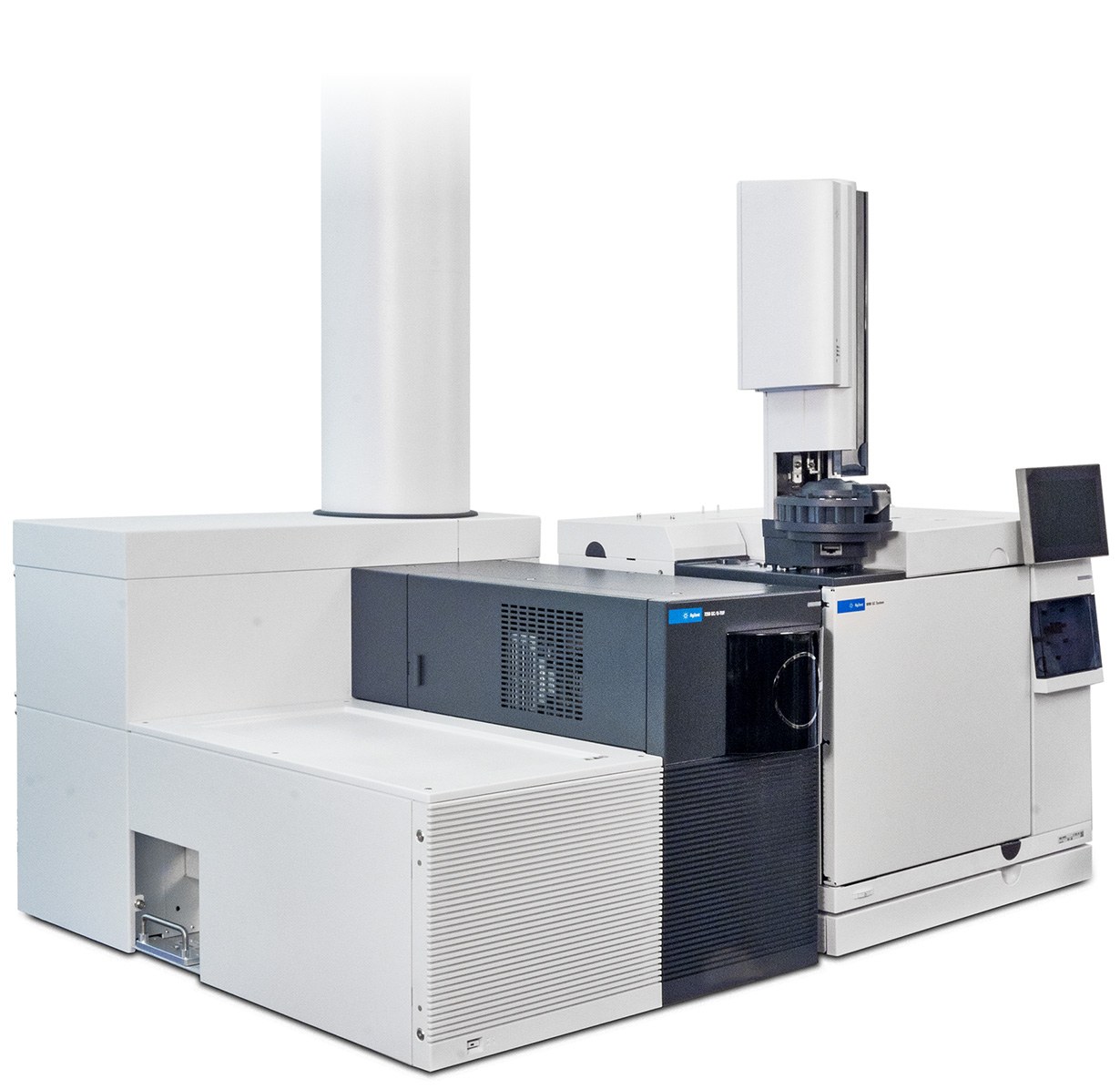
Agilent Technologies 7250 GC Q TOF
Agilent Technologies 7250 GC Q TOF — Gas chromatography with Noise level 70 dB.
The Agilent 7250 GC Q-TOF is a quadrupole time-of-flight GC/MS mainframe with three turbomolecular pumps, an LE-EI ion source (optional Axial CI), and either a DS202 rotary vane or IDP dry scroll foreline pump. It is distinguished within the 7250 series by its accurate-mass TOF analyzer and collision cell, supporting EI and CI operation with total gas flow into the MS limited to 2.0 mL/min recommended (2.4 mL/min maximum). It serves as the mass-selective detector in a GC/MS system for high-resolution accurate-mass analysis.
Full specifications
| Noise level | 70 dB |
| Gas Flow | 2.4 mL/min |
| Maximum Column Id | 0.32 mm |
| Maximum Recommended Gas Flow | 2.0 mL/min |
| Quad Vacuum | 3.50 Torr |
| Rough Vacuum | 1.25 mTorr |
| Tof Vacuum | 2.61 Torr |
| Flight tube extension over top of instrument mfr | 136 cm |
| Optimal carrier gas flow mfr | 1.0...1.5 mL/min |
| Collision cell nitrogen gas flow mfr | 1 mL/min |
| Collision cell helium gas flow mfr | 4 mL/min |
| High-vacuum pump 1 mfr | Split-flow turbo turbo |
| High-vacuum pump 2 mfr | Turbo Turbo |
| High-vacuum pump 3 mfr | Turbo Turbo |
| Optimal carrier gas flow, mL/min mfr | 1.0...1.5 |
| Collision cell Nitrogen gas flow, mL/min mfr | 1 |
| Collision cell Helium gas flow, mL/min mfr | 4 |
| MS Source mfr | 230 dependent. |
| Complete assembly mfr | Axial CI Ion Source Assy Assy |
| Flight tube extension above instrument mfr | 136 cm |
| Ammonia supply maximum pressure mfr | 5 psig |
| Turbo pump speed at 10–15 min mfr | 80 |
| Turbo pump final speed mfr | 95 |
| Thermal equilibration wait mfr | 2 hours |
| Depth | 92 cm |
| Foreline Pump Weight | 25 kg |
| Height | 53.5 cm |
| Instrument Depth | 92 cm |
| Instrument Height | 53.5 cm |
| Instrument Width | 69 cm |
| Width | 69 cm |
| Instrument mainframe weight mfr | 159 kg |
| Mainframe weight mfr | 159 kg |
| GC/MS interface operating range mfr | 250...350 °C |
| Sound pressure | 70 dB |
| PCI mfr | 300 °C |
| NCI mfr | 150 °C |
| Quadrupole maximum setpoint mfr | 200 °C |
| Ion source maximum setpoint mfr | 350 °C |
Description
Construction and positioning
- The 7250 Q-TOF is a standalone GC/MS mainframe (159 kg, 69 cm W × 53.5 cm H × 92 cm D) with a flight tube extension of 136 cm above the instrument top; plan vertical clearance accordingly.
- Vacuum is maintained by three turbomolecular pumps backed by either a DS202 rotary vane foreline pump (25 kg) or an optional IDP dry scroll foreline pump.
- The standard ion source is the LE-EI for EI mode (standard or low-energy); an optional Axial CI ion source enables chemical ionization with isobutane, ammonia, or carbon dioxide.
- It is used with Agilent 8890 and 7890 Series GCs; no sibling models are listed in the verified facts, so series positioning is limited to the configurations described in the manual.
Behavior under load and in different modes
- Total gas flow into the MS (column flow plus collision cell gas) should not exceed 2.0 mL/min recommended; 2.4 mL/min is the maximum before spectral performance and sensitivity degrade. Optimal carrier gas flow is 1.0–1.5 mL/min.
- Collision cell gas flows are 1 mL/min nitrogen and 4 mL/min helium. Maximum column id is 0.32 mm at 30 m length.
- Typical EI vacuum pressures vary by as much as 30% between instruments; example at 1 mL/min column flow with collision cell gas on: rough vacuum 1.30E+02 mTorr, quad vacuum 3.49E-05 Torr, TOF vacuum 2.61E-07 Torr. These are references, not absolute acceptance limits.
- In CI mode with ammonia, supply pressure must be less than 5 psig to prevent condensation; when running ammonia five or more hours per day, the foreline pump must be ballasted for at least one hour per day and the MS purged with methane after flowing ammonia.
Installation, connection, and operation
- Carrier gas must be at least 99.9995% pure; hydrogen gas use is specifically prohibited.
- Column installation: in the split/splitless inlet, extend the column 4–6 mm past the ferrule; in the GC/MS interface, 4–5 mm past the transfer line end. For a self-tightening column nut, finger-tighten until it grips the column then turn an additional 30–60 degrees; for a standard nut, tighten an additional 1/4 to 1/2 turn.
- During pump down, turbo pump speed should reach 80% within 10–15 minutes and eventually 95%; otherwise MS electronics shut off the foreline pump and a power cycle is required. Turn on carrier gas flow after vacuum pumps have been running for 15 minutes; after 'Okay to run' appears, wait 2 hours for thermal equilibrium before acquiring data.
- Do not turn on any GC heated zones until carrier gas flow is on; heating a column without carrier gas flow damages the column.
- The interface tip seal must be in place for the LE-EI ion source; the analyzer should close all the way with no resistance except spring tension from the tip seal. The top thumbscrew on the analyzer side plate must be finger-tight; do not over-tighten as this can cause air leaks. Collision cell chamber top plate shipping brackets must remain fastened during normal operation.
- Condition a capillary column before installation: minimum velocity 30 cm/s, flow at room temperature 15–30 minutes, program oven to column maximum temperature at 10–15 °C/min, hold 30 minutes.
Integration & Operating Notes
Column flow plus collision cell gas flow should stay at or below 2.0 mL/min recommended; 2.4 mL/min is the maximum before spectral performance and sensitivity degrade. Select column length and id so that combined flows remain within limits during tuning and acquisition.
Carrier gas must be at least 99.9995% pure. Hydrogen gas use is specifically prohibited; do not plumb hydrogen to the system. Use high-purity helium or another approved carrier.
In CI mode with ammonia, supply pressure must be less than 5 psig; higher pressure can cause ammonia to condense from gas to liquid. Install a pressure regulator limiting ammonia delivery pressure below 5 psig.
Do not turn on any GC heated zones until carrier gas flow is on; heating a column without carrier gas flow damages the column. This interlock protects both column and MS.
During pump down, turbo pump speed should reach 80% within 10 to 15 minutes and eventually 95%; otherwise MS electronics shut off the foreline pump and a power cycle is required. Monitor pump speed; failure to reach speed indicates a vacuum problem requiring troubleshooting.
Turn on carrier gas flow after vacuum pumps have been running for 15 minutes; after 'Okay to run' appears, wait 2 hours for thermal equilibrium before acquiring data. Data acquired before thermal equilibrium may not be reproducible.
When running ammonia five or more hours per day, the foreline pump must be ballasted (flushed with air) for at least one hour per day, and the MS must be purged with methane after flowing ammonia. This minimizes damage to pump seals and removes residual ammonia.
Check the calibration vial every 6 months to ensure tune and mass calibration reference is available and valid.
The top thumbscrew on the analyzer side plate must be fastened finger-tight; do not over-tighten as this can cause air leaks. Collision cell chamber top plate shipping brackets must remain fastened during normal operation.
The interface tip seal must be in place for the LE-EI ion source; the analyzer should close all the way with no resistance except spring tension from the tip seal. Misalignment or missing seal causes leaks or damage; align by wiggling the side plate on its hinge.
Selection & Integration Q&A
Choose the LE-EI source for routine EI operation (standard or low-energy). Specify the optional Axial CI ion source only if chemical ionization with isobutane, ammonia, or carbon dioxide is required; CI mode adds reagent gas handling and maintenance procedures.
Carrier gas must be at least 99.9995% pure; hydrogen is prohibited. Maximum column id is 0.32 mm at 30 m length. Optimal carrier gas flow is 1.0–1.5 mL/min, and total gas flow into the MS (column plus collision cell) must not exceed 2.0 mL/min recommended (2.4 mL/min maximum).
Check foreline pump oil weekly; replace rotary vane pump oil and oil mist filter every 6 months (or IDP tip seals yearly). Check calibration vial every 6 months. Columns, carrier gas, collision cell gases, and reagent gases are not included and must be supplied separately.