
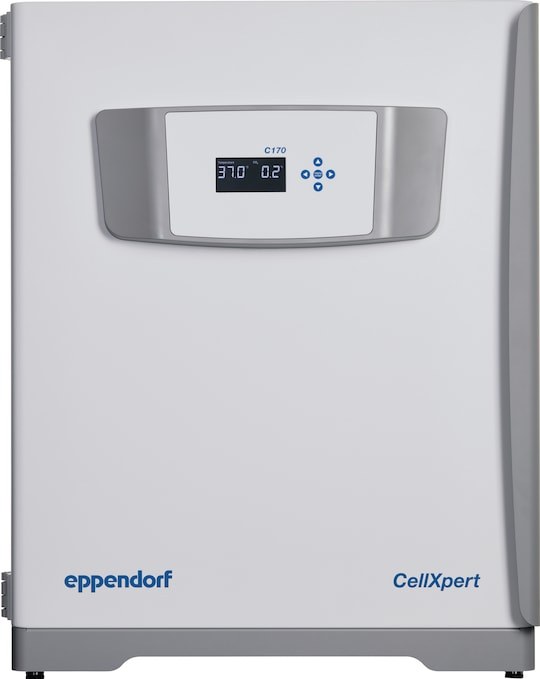
Eppendorf CellXpert ® C170 - Cell Culture Incubator
Eppendorf CellXpert ® C170 - Cell Culture Incubator — Incubators with Capacity 170 L.
The CellXpert C170 is a 170 L benchtop CO2 incubator with a 4–50 °C working range, 0.1 % CO2 control resolution and 140 °C high-temperature disinfection. It is the standard-display, non-O2 modification of the CellXpert family, distinguished from the C170i by its LED interface, 140 °C HTD cycle and absence of tri-gas control. It serves as a primary culture vessel in cell biology workflows requiring reproducible temperature and CO2 atmosphere.
Full specifications
| Capacity | 170 L |
| Benchtop (b), Under Bench (u), Floor (f) Or Stackable (s) | B, U, F, S |
| Bms Relay | yes |
| Co 2 Control Increment | 0.1 % |
| Co 2 Range | 0.1...20 % |
| Co 2 Stability At 5 % Co 2 | 0.1 % |
| Co 2 Uniformity | 0.1 % |
| Copper Package | – |
| Dimensions (w × D × H) | 71,8 × 71,5 × 90,0 cm |
| High Temperature Disinfection (htd) | 140 °C |
| Load per rack | 40 kg |
| Max. Load/shelf | 10 kg |
| On-board Data Logging | – |
| Remote Device Monitoring And Notifications (visionize ® ) | VisioNize ® box enabled |
| Sealed Inner Glass Doors | yes |
| Segmented Door Options | 4 |
| Temperature Accuracy | 0.4 °C |
| Temperature Control Increment | 0.1 °C |
| Temperature range | 4...50 °C |
| Temperature Stability At 37 °c | 0.1 °C |
| Temperature uniformity | 0.3 °C |
| Product Weight | 113 kg |
| Rated voltage | 220 – 240 V |
| Data Export Interface | Ethernet |
| Power Plug | power plug type F |
| Access port mfr | 2 |
| Water/humidity Monitoring | – |
| Number Of Shelves (standard/max) | 3 |
Description
Construction and series positioning
The CellXpert C170 is a 170 L benchtop incubator (71.8 × 71.5 × 90.0 cm, 113 kg) built for stand-alone benchtop use; the specification also lists under-bench and stackable configurations. Within the CellXpert family it is the economical modification: the C170i sibling adds a VisioNize touch interface, O2/tri-gas control (1–20 %) and a 180 °C HTD cycle, whereas this C170 uses a standard LED display, omits O2 control and performs HTD at 140 °C. The chamber has sealed inner glass doors and is available with 1, 4 or 8 door segments (4 listed as standard) and right- or left-hand handle.
Atmosphere and thermal behavior
Temperature is controlled over 4–50 °C in 0.1 °C increments, with 0.4 °C accuracy, 0.1 °C stability at 37 °C and 0.3 °C uniformity. CO2 is controlled from 0.1 to 20 % in 0.1 % steps, with 0.1 % stability at 5 % CO2 and 0.1 % uniformity. No digitized performance curves are supplied, so behavior under load is defined by these control tolerances rather than by a published recovery curve. Humidity monitoring and a water-level sensor are not part of the base specification; they appear only in the accessory/ordering tables of the brochure.
Installation, control and operation
Mains input is 220–240 V with a type F power plug; the brochure additionally lists 100–120 V 50/60 Hz variants for USA/Japan, so the supply must be confirmed against the nameplate before installation. Data export is via Ethernet, and the unit is VisioNize box enabled for remote monitoring and notifications; a BMS relay is provided for alarm forwarding. Two access ports are fitted for sensor or cable pass-through. The 140 °C HTD cycle is the routine decontamination routine; the copper package is not included (listed as “–”).
Integration & Operating Notes
The specification gives 220–240 V with a type F plug, while the brochure also lists 100–120 V 50/60 Hz variants for USA/Japan. Connecting a 230 V unit to a 120 V supply, or the reverse, will prevent correct heating and CO2 control; verify the nameplate and order code against the actual mains before commissioning.
The BMS relay and Ethernet data-export interface are the only alarm and logging paths on this model; there is no on-board data logging. Plan the relay wiring to the building management system and the Ethernet connection to the VisioNize box during installation, because a CO2 or temperature deviation will otherwise go unreported outside the local display.
The control range is 0.1–20 % CO2 and 4–50 °C; setpoints outside these limits are not supported by the controller. Cultures requiring hypoxic O2 control (1–20 %) cannot be run on this C170 modification and need the C170i tri-gas sibling instead.
High-temperature disinfection on this model runs at 140 °C, not the 180 °C of the C170i. Build the HTD cycle into the contamination-control schedule and remove all temperature-sensitive samples, sensors and accessories from the chamber before starting it; the copper package is not fitted and does not substitute for the cycle.
Selection & Integration Q&A
Choose the C170 for standard CO2/ temperature culture with a 140 °C HTD cycle and LED display. Pick the C170i if you need O2/tri-gas control (1–20 %), the VisioNize touch interface or the 180 °C HTD cycle.
Provide a 220–240 V supply with type F socket (confirm nameplate against 100–120 V variants), an Ethernet drop for data export and VisioNize box, and BMS wiring to the alarm relay. Two access ports are available for sensor cables.
The base unit has no humidity monitoring, water-level sensor, copper package or on-board data logging; these appear only in the brochure accessory tables. The 140 °C HTD cycle is the routine decontamination step; plan it into the service schedule.