
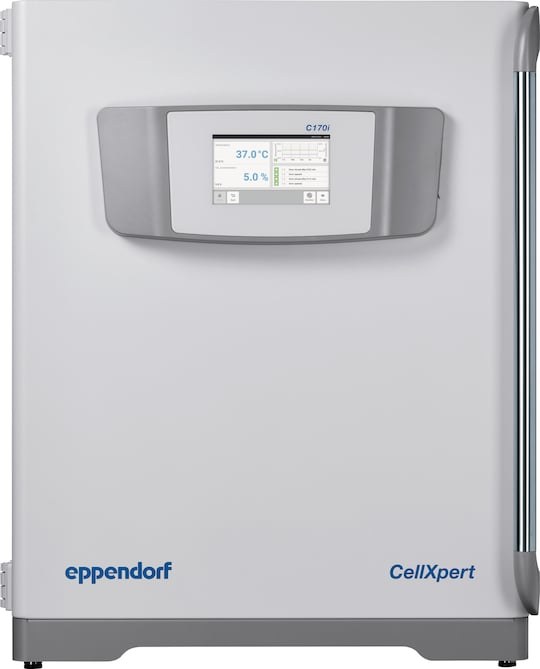
Eppendorf CellXpert ® C170i - Cell Culture Incubator
Eppendorf CellXpert ® C170i - Cell Culture Incubator — Incubators with Capacity 170 L.
The CellXpert C170i is a 170 L benchtop CO2 incubator with 4–50 °C control, 0.1 °C stability at 37 °C, and 180 °C high-temperature disinfection. It is the VisioNize touch-enabled variant of the C170 series, adding on-board data logging and BMS relay output for continuous culture monitoring.
Full specifications
| Capacity | 170 L |
| Benchtop (b), Under Bench (u), Floor (f) Or Stackable (s) | B, U, F, S |
| Bms Relay | yes |
| Co 2 Control Increment | 0.1 % |
| Co 2 Range | 0.1...20 % |
| Co 2 Stability At 5 % Co 2 | 0.1 % |
| Co 2 Uniformity | 0.1 % |
| Copper Package | no |
| Dimensions (w × D × H) | 71,8 × 71,5 × 90,0 cm |
| High Temperature Disinfection (htd) | 180 °C |
| Load per rack | 40 kg |
| Max. Load/shelf | 10 kg |
| On-board Data Logging | yes |
| Remote Device Monitoring And Notifications (visionize ® ) | VisioNize ® touch enabled |
| Sealed Inner Glass Doors | yes |
| Segmented Door Options | 4 |
| Temperature Accuracy | 0.4 °C |
| Temperature Control Increment | 0.1 °C |
| Temperature range | 4...50 °C |
| Temperature Stability At 37 °c | 0.1 °C |
| Temperature uniformity | 0.3 °C |
| Product Weight | 113 kg |
| Rated voltage | 220 – 240 V |
| Data Export Interface | USB, Ethernet, VisioNize ® |
| Power Plug | power plug type F |
| Access port mfr | 2 |
| Water/humidity Monitoring | no |
| Number Of Shelves (standard/max) | 4 |
Description
Construction and series positioning
The C170i is a 170 L benchtop incubator (71.8 × 71.5 × 90.0 cm, 113 kg) with sealed inner glass doors and a segmented outer door available in 1, 4, or 8 segments with right- or left-hand handle. Within the CellXpert C170 family it is the instrumented modification: VisioNize touch interface, on-board data logging, USB and Ethernet data export, and a BMS relay. The sibling C170 uses a standard LED display, 140 °C HTD, and no O2 control; the C170i supports O2/tri-gas control (1–20 %) and 180 °C HTD. Two 2-port access ports pass sensor or probe cabling into the chamber.
Control and atmosphere behavior
Temperature is controlled from 4 to 50 °C in 0.1 °C increments, with 0.1 °C stability at 37 °C, 0.3 °C uniformity, and 0.4 °C accuracy. CO2 is controlled from 0.1 to 20 % in 0.1 % steps, with 0.1 % stability at 5 % CO2 and 0.1 % uniformity. Water-humidity monitoring is not part of the base unit; a humidity monitor and water-level sensor are listed as accessories. No digitized performance curves are supplied, so load-dependent recovery behavior cannot be quantified from the available facts.
Installation, connection, and operation
Mains is 220–240 V with a type F power plug; the brochure also lists 100–120 V 50/60 Hz variants for USA/Japan, so the supply must be confirmed against the nameplate before installation. Data interfaces are USB, Ethernet, and VisioNize touch for remote monitoring and notifications. The BMS relay provides an external alarm contact. Shelving is rated 10 kg per shelf and 40 kg per rack, with 4 shelves standard. The 180 °C HTD cycle is the built-in disinfection routine; the copper package is not included.
Integration & Operating Notes
The unit is specified at 220–240 V with a type F plug, but the series brochure lists separate 100–120 V 50/60 Hz builds for USA/Japan. Connecting a 100–120 V build to a 230 V supply, or the reverse, will damage the controller; verify the nameplate and plug type against the site supply before commissioning.
The BMS relay must be wired to the building management or alarm system so that CO2 or temperature deviations trigger an external notification. Because the unit also supports VisioNize remote notifications, decide whether the BMS relay or the network path is the primary alarm route and configure both so they do not contradict each other.
Relative humidity is not measured in the base configuration; a humidity monitor and water-level sensor are accessory items. If the culture protocol depends on documented humidity or on low-water alarm, these must be ordered and installed before the unit is qualified for that process.
The 180 °C high-temperature disinfection cycle is the built-in decontamination routine and requires the chamber to be emptied of cultures and heat-sensitive items. Schedule HTD between experimental runs, not during active culture, and allow the chamber to return to 37 °C and CO2 setpoint before reseeding.
Two access ports allow temperature probes, CO2 sensors, or sampling lines to be introduced without disturbing the door seal. Use them for validation probes during mapping studies, and reseal unused ports to preserve chamber uniformity and gas consumption.
Selection & Integration Q&A
Pick the C170i when you need O2/tri-gas control (1–20 %), 180 °C HTD, VisioNize touch remote monitoring, on-board data logging, and a BMS relay. The C170 is the economical choice with a standard LED display, 140 °C HTD, and no O2 control.
A 220–240 V supply with a type F receptacle (confirm the nameplate, since 100–120 V builds exist), plus an Ethernet drop for VisioNize and USB for local export. Wire the BMS relay to the alarm system if facility-level notification is required.
The humidity monitor, water-level sensor, O2 control option, copper package, and segmented door configurations (1/4/8 segments, right/left handle) are order options. The 180 °C HTD cycle is built in; plan it as scheduled downtime between culture runs.