
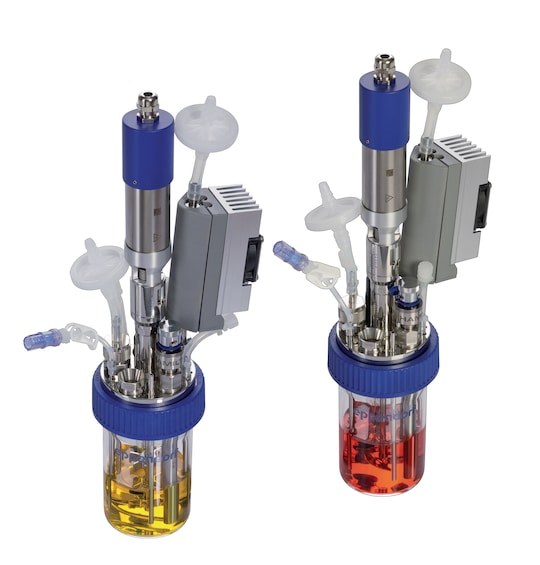
Eppendorf DASbox ® /SciVario ® Mini Bioreactor
Eppendorf DASbox ® /SciVario ® Mini Bioreactor — Bioreactors & fermenters.
The DASbox® Mini Bioreactor for Cell Culture (model 76DS0250ODSS) is a 4-fold parallel benchtop system using autoclavable glass vessels with stainless steel GLS 80® head plates, working volume 60–250 mL (350 mL total). It is the cell-culture (CC) variant of the DASbox series, expandable in 4-fold increments to 24 parallel reactors, and is intended for controlled parallel cultivation screening in process development.
Full specifications
Description
Construction and series positioning
- The DASbox is a benchtop parallel bioreactor system built around 4-fold reactor units; the CC variant is configured for cell culture, while the MB variant serves microbiology and SU single-use versions exist for both.
- This model (76DS0250ODSS) uses an autoclavable glass vessel with a stainless steel GLS 80® head plate; working volume 60–250 mL, total vessel volume 350 mL.
- Parallel capacity scales in 4-fold increments from the base 4-fold unit up to 24 bioreactors, so the same vessel/head-plate architecture is replicated across the train.
Vessel and media behavior
- The 60–250 mL working range defines the operating window; the 350 mL total volume leaves headspace above the working fill for aeration and foam.
- The GLS 80® stainless steel head plate is the port interface for sensors, gassing and sampling; the glass vessel is autoclavable, so the wetted path is sterilized as an assembled unit rather than by in-place steam.
- Single-use operation is possible only by switching to BioBLU 0.3 vessels (0.3c for cell culture, 0.3f for microbiology, 0.3sc for stem cells); these are not part of the glass-vessel configuration of this model.
Control and operation
- The system is organized as a 4-fold unit, meaning control and gassing hardware are shared across four parallel vessels; the attached document digests do not specify controller I/O, drive or power details, so electrical and interface requirements must be taken from the full technical data sheet.
- No digitized curve points, certificates or application lists were supplied with this record; performance claims beyond the volume range and parallel expansion should be confirmed against the manufacturer's technical data.
Integration & Operating Notes
The vessel is rated for a 60–250 mL working volume against a 350 mL total volume. Operating below the minimum leaves insufficient volume for the impeller and sensors; operating above the maximum removes the headspace needed for aeration and foam, so both limits must be respected when defining the fill recipe.
The vessel is an autoclavable glass bioreactor with a stainless steel GLS 80® head plate. Sterilization is therefore a batch autoclave step on the assembled vessel, not an in-place steam cycle; the head-plate ports must be capped or fitted before autoclaving and the assembly cooled before connection to the gassing and sensor lines.
This model is delivered as an autoclavable glass-vessel configuration. To run single-use, the vessel must be replaced with a BioBLU 0.3 variant matched to the culture: BioBLU 0.3c for cell culture, 0.3f for microbiology, 0.3sc for stem cells. The glass vessel and the single-use vessel are not interchangeable without that change.
The system is built from 4-fold units and expands in 4-fold increments to a maximum of 24 parallel bioreactors. Facility planning (bench space, gassing supply, controller channels) should therefore be laid out for the final 4/8/12/…/24 configuration rather than for a single unit, since each increment adds a full set of four vessels.
The attached technical data and brochure digests cover vessel volume, head plate, parallel expansion and vessel variants only; they contain no supply voltage, power, drive or controller I/O figures. Electrical integration must be taken from the full DASbox technical data sheet before specifying power distribution or signal wiring.
Selection & Integration Q&A
Pick the CC glass model for autoclavable, reusable cell-culture vessels in the 60–250 mL range. Choose the MB variant for microbiology cultures, and an SU version with BioBLU 0.3c/0.3f/0.3sc vessels when single-use, non-autoclaved operation is required.
The vessel is an autoclavable glass body with a stainless steel GLS 80® head plate; sensors, gassing lines and sampling hardware must fit that head-plate port pattern. The supplied digests do not list port sizes, so confirm the port configuration against the full technical data sheet.
The vessel is autoclavable, so each run requires an autoclave cycle on the assembled glass vessel and head plate rather than in-place sterilization. Fill must stay within 60–250 mL working volume (350 mL total) to preserve headspace; the digests give no further cycle-count or lifetime limits.
The digests describe the 4-fold unit, glass vessel and GLS 80 head plate; sensors, gassing and sampling hardware, single-use BioBLU 0.3 vessels and controller/electrical accessories are not listed as included. Confirm the delivery scope and required accessories against the full technical data sheet before ordering.