
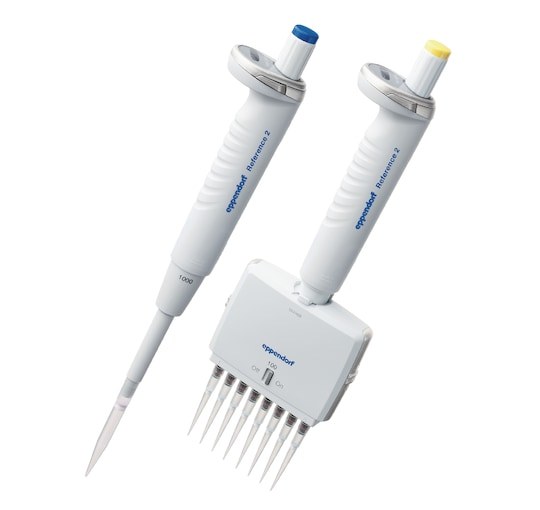
Eppendorf Eppendorf Reference ® 2 - Single-Button Pipette
Eppendorf Eppendorf Reference ® 2 - Single-Button Pipette — Pipettes.
The Eppendorf Reference® 2 single-button pipette is a multichannel air-cushion pipette available in 8- and 12-channel configurations, covering 20–1,200 µL depending on channel count. Its one-button operation distinguishes it from the multi-button Research® plus and electronic Xplorer® lines. It is intended for parallel liquid transfers in microplate workflows.
Full specifications
| Pipetting Type | Air-cushion system |
Description
Construction and series positioning
- The Reference® 2 is the single-button, multichannel member of Eppendorf's liquid-handling family, offered in 8- and 12-channel formats.
- It sits between the manual multi-button Research® plus (8–24 channels, 10–1,200 µL) and the electronic Xplorer®/Move It® lines (4–24 channels, adjustable tip spacing).
- Unlike Move It® variants, the Reference® 2 has fixed tip spacing; channel count and volume range are the only configuration axes documented.
Working principle and media
- Air-cushion (air-displacement) system: the aspirated sample never contacts the piston; a trapped air cushion transmits piston motion to the liquid.
- This makes the pipette suitable for aqueous solutions; volatile or high-viscosity liquids require pre-wetting and slow aspiration, but no correction curves are supplied in the source facts.
- Volume range depends on the channel configuration: 20–1,200 µL for 8-/12-channel units, with 16-/24-channel models limited to 20 or 100 µL (per the flyer scope).
Operation and control
- Single-button operation: one plunger controls aspiration, dispensing and tip ejection, reducing hand movement in repetitive plate work.
- No electrical interface, data output or electronic volume setting is documented; the device is purely mechanical.
- The flyer digest provides no installation, calibration or service-interval details; those must be taken from the separate operating manual.
Integration & Operating Notes
Because the sample is held by an air cushion, volatile solvents (e.g. ethanol, acetone) can evaporate and drift the dispensed volume, while high-viscosity or foaming liquids aspirate unevenly. Pre-wet tips and slow pipetting are required; no viscosity or vapour-pressure correction data is supplied.
The 8- and 12-channel Reference® 2 have fixed nozzle spacing; they align with standard 96-well (9 mm pitch) or 384-well plates only if the channel count matches the plate column count. For variable spacing between tube racks and plates, the Move It® variant is required instead.
The attached flyer digest contains no calibration frequency, cleaning procedure or spare-part list. The engineer must obtain the separate Reference® 2 operating manual for gravimetric calibration intervals, seal replacement and tip-ejector service before putting the unit into a regulated workflow.
Selection & Integration Q&A
Pick the Reference® 2 for simple, repetitive 8- or 12-channel plate transfers where one-button aspiration/dispensing/ejection reduces hand fatigue. Choose Research® plus if you need 16/24 channels or multi-button volume adjustment; choose Xplorer® or Move It® for electronic volume setting or adjustable tip spacing.
Tips must match the channel format and volume range (20–1,200 µL for 8/12-channel). The fixed nozzle pitch must align with the plate column spacing (9 mm for 96-well). No electronic controller, cable or power supply is used; the device is fully mechanical, so no interface compatibility applies.
The attached flyer digest lists no ambient temperature, humidity or duty-cycle limits. Only the air-cushion principle is stated. For autoclaving, chemical resistance and operating temperature, consult the separate Reference® 2 operating manual; do not assume the flyer's silence means unlimited conditions.
The flyer digest does not list pipette tips, tip boxes, calibration certificates, seals or spare ejector parts as included. Tips are consumables to be ordered separately in the matching volume range. Calibration and seal replacement intervals are absent from the flyer and must be taken from the operating manual.