
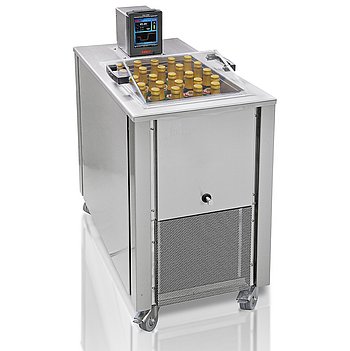
Peter Huber Kältemaschinenbau BFT5 Bier-Forciertest-Thermostat
Peter Huber Kältemaschinenbau BFT5 Bier-Forciertest-Thermostat — Thermostatic baths with Noise level 31 dB.
The BFT5 is a 40-litre air-cooled recirculating chiller/thermostat with a 350 x 410 mm bath opening, covering -40 to 80 °C with 2 kW heating and 1.2 kW cooling at 20 °C. Its Pilot ONE controller, variable-speed pressure/suction pump and Pt100 external sensor port make it a self-contained temperature source for forced-test and bath applications.
Direct drop-in replacements
Full specifications
| Noise level | 31 dB(A) |
| Bath volume | 40 l |
| Filling volume | 8.5 l (min) |
| Heating capacity | 2 kW |
| Pump speed adjustable | Yes |
| Pump type | Pressure and suction pump, variable speed |
| Refrigerator | air-cooled, CFC- and HCFC-free |
| External sensor connection | Pt100 |
| Temperature range | -40...80 °C |
| Temperature stability | 0.03 K |
| Dimensions (W x D x H) mfr | 460 x 710 x 911 mm |
| Bath opening WxD/BD mfr | 350 x 410 / 270 mm |
| Weight | 76 kg |
| Current consumption | 13 A (max) |
| Fuse rating | 16 A |
| Power supply | 230V 1~ 50/60Hz |
| Controller | Pilot ONE |
| Digital interface | Ethernet, USB (Host u. Device), RS232 |
| Refrigerant | R-452A (A1, H280) (1st stage) |
| Refrigerant quantity | 1.44 kg (1st stage) |
| Ambient temperature limit | 5...40 °C |
| Cooling capacity | 1.2 kW (20 °C) 0 °C: 0.9 kW · -20 °C: 0.35 kW · -30 °C: 0.2 kW |
| Protection rating | IP20 |
| Safety class | III / FL |
Description
Construction and positioning
- Single-stage air-cooled refrigeration circuit using R-452A (1.44 kg, A1/H280, CO2 equivalent 3.1 t), CFC/HCFC-free, with a 40 l bath and 350 x 410 / 270 mm opening.
- Safety class III / FL per DIN 12876 with adjustable overtemperature protection; IP20 enclosure, 460 x 710 x 911 mm, 76 kg.
- No sibling variants are listed for this series, so the BFT5 stands as the defined 40-litre configuration.
Thermal behaviour
- Cooling capacity is strongly temperature-dependent: 1.2 kW at 20 °C, 0.9 kW at 0 °C, 0.35 kW at -20 °C and 0.2 kW at -30 °C; the required heat load must be checked against these points before selection.
- Heating capacity is 2 kW across the -40…80 °C range; stability is stated as 0.03 K.
- The variable-speed pressure and suction pump allows flow adjustment to the load; thermal fluid viscosity must stay ≤ 50 mm²/s at the lowest working temperature and density ≤ 1 kg/dm³.
Control and operation
- Pilot ONE controller with Ethernet, USB (host and device) and RS232; external Pt100 sensor connection for monitoring at the sample.
- Restart behaviour after power failure is selectable (Standby, ON, Power Failure Auto).
- Bath operation: place the sample in the empty bath first, then fill; removing the sample can trigger a low-level shutdown.
Integration & Operating Notes
The unit draws up to 13 A on 230 V 1~ 50/60 Hz and requires a 16 A fuse. Voltage tolerance is ±5% with simultaneous frequency tolerance ±2%, but the combined worst case (-5% voltage with +2% frequency) is not permitted; verify the site supply before connection.
Single-phase devices are delivered with a power cable and a country-specific plug; the plug type must be stated when ordering, otherwise commissioning can be delayed until the correct cable is sourced.
Transport and store the unit upright only, as horizontal transport damages the compressor. At the site, unscrew/activate the leveling feet and brake the casters before switching on, then tighten the lock screws; casters are for positioning only and moving requires at least 2 persons.
The responsible body must install a condensation water / thermal fluid drip tray below the unit. With IP20 protection the unit must sit in a dry, protected environment, and the air-cooled condenser needs unobstructed supply air with ambient temperature between 5 and 40 °C.
Water used as thermal fluid must have hardness ≤ 8.4 °dH and pH 6.0–8.5; distilled or deionized water is not approved. Different fluid types must never be mixed, and the circuit must be rinsed when changing fluid type.
After a power failure the Pilot ONE can be set to Standby, ON or Power Failure Auto. Power Failure Auto resumes temperature control automatically, which is convenient for unattended runs but must be assessed against process safety before enabling.
The air filter mat behind the supply air connection must be checked and replaced regularly so that airflow into the unit is not reduced; a clogged mat degrades cooling capacity and can lead to overtemperature trips.
When the unit is moved from a cold to a warm environment (or vice versa), allow about 2 hours before power-on to prevent condensation-related electrical damage.
Selection & Integration Q&A
No sibling variants are listed for this series; the BFT5 is the defined 40-litre configuration. Select it when the process needs a 350 x 410 mm bath opening and heat loads within 1.2 kW at 20 °C down to 0.2 kW at -30 °C.
A 230 V 1~ 50/60 Hz supply with a 16 A fuse, sized for up to 13 A. Voltage tolerance ±5% and frequency ±2% apply, but the combined worst case (-5% voltage with +2% frequency) is not allowed. Specify the country-specific plug at ordering.
Indoors, dry, IP20 environment, ambient 5–40 °C, with a drip tray below and unobstructed condenser airflow. Transport and store upright only; level and brake the casters before power-on. Not permitted in an ATEX zone.
The air filter mat behind the supply air connection must be checked/replaced regularly. Thermal fluid is not included and must meet viscosity ≤ 50 mm²/s at the lowest working temperature; water must be ≤ 8.4 °dH and pH 6.0–8.5. A drip tray is site-supplied.