
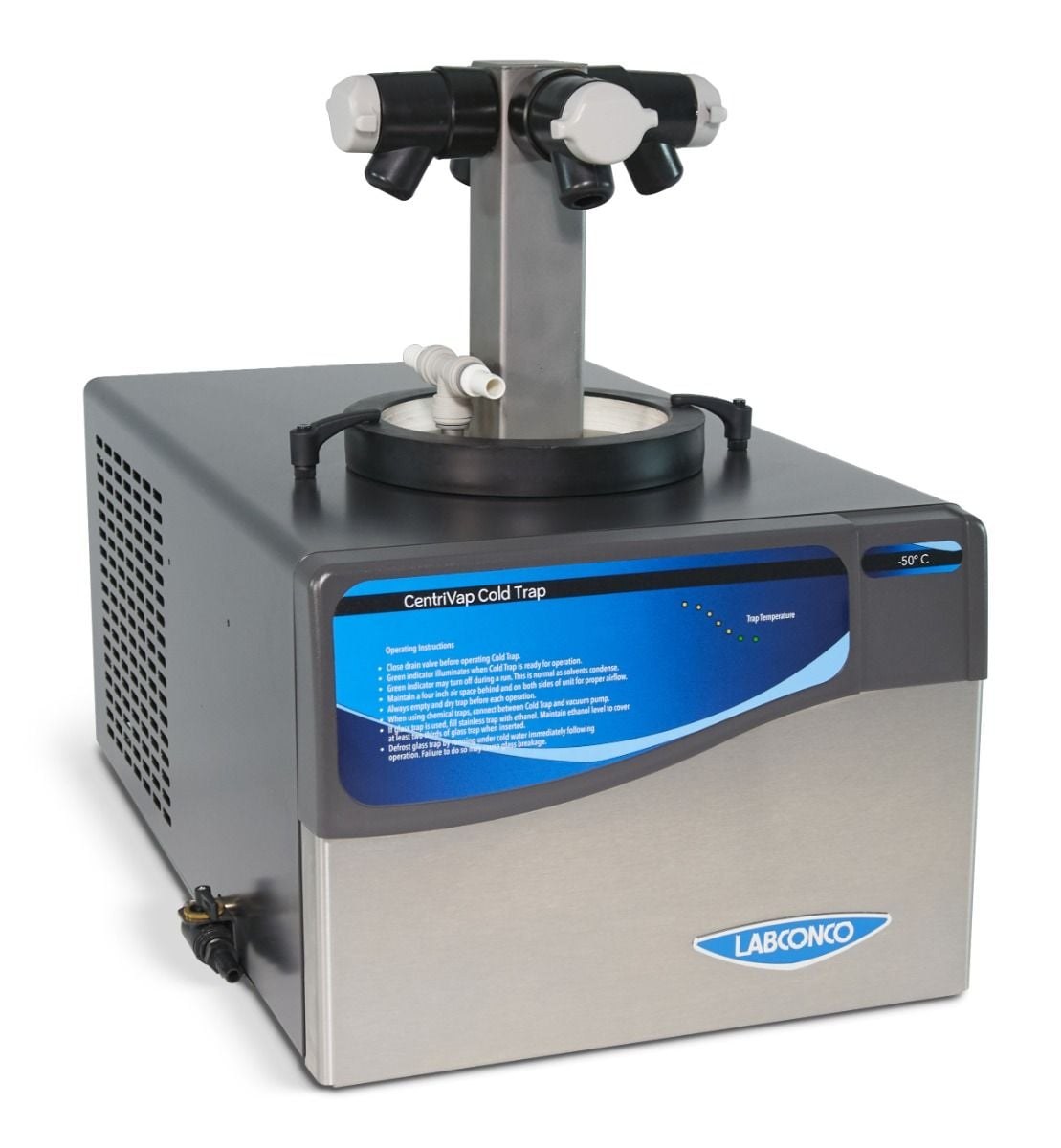
Labconco CT-Series Freeze Dryers
Labconco CT-Series Freeze Dryers — Freeze dryers.
The Labconco CT-Series is a cold-trap freeze dryer available in three collector-temperature classes (-50°C, -84°C, -105°C) and two manifold configurations (4-port, 8-port). It is placed upstream of a vacuum pump and removes water or solvent from frozen material by sublimation, with collector temperature selected 15–20°C below the sample eutectic point.
Full specifications
Description
Construction and series positioning
- The CT-Series is a cold-trap (collector) freeze dryer, not a complete lyophilizer: the collector, manifold, and vacuum tubing are supplied, while the vacuum pump is a separate, user-supplied component.
- Three refrigeration classes share one cabinet architecture: -50°C (8700xxx), -84°C (8701xxx), and -105°C (8702xxx). The class is chosen from the sample eutectic temperature, not from capacity alone.
- Manifold options are 4-port (7232800) and 8-port (7232900); the manifold is latched onto the chamber with two latches and a centered gasket.
- Catalog-number suffixes encode voltage/frequency and plug type: 00 = 115 V/60 Hz, 10 = 230 V/60 Hz, 15 = 230 V/50 Hz, and 30/40/50/70/80/90 = 230 V/50 Hz with different plug types.
Behavior under load and in different media
- Capacity is limited by instantaneous ice load: 1.6 L for -50°C, 2.1 L for -84°C, and 1.6 L for -105°C. Samples must be added one flask at a time with about 5 minutes of vacuum recovery; if vacuum does not recover, capacity has been exceeded.
- Samples with eutectic temperatures of -20°C or lower are added one flask at a time; samples at -40 to -60°C require cascade refrigeration below -75°C (the -84°C or -105°C class) or a dry-ice/solvent trap.
- Recommended operating vacuum is 0.133 mbar or less; the vacuum pump must be capable of less than 0.02 mbar and its inlet must accept 0.50 ID hose.
- Volatile solutes (acetonitrile, methanol, acetic acid, formic acid, pyridine) tend to melt more readily and should be diluted with water. The chamber, lid, and gasket have material-compatibility ratings (C = moderate degradation/questionable use, D = severe degradation/infrequent use with immediate cleaning).
Installation, connection, and control
- The Cold Trap must always be placed before the vacuum pump. A 3-inch vacuum tubing piece connects to a vacuum gauge (or a plug fitting replaces the barb), and the other barb fitting connects to the pump.
- The power cord plugs into the receptacle on the back of the Cold Trap; the vacuum pump plugs into a separate receptacle. A ground wire attaches to the stainless-steel elbow on the drain tubing, and a grounding clip attaches to the solvent catch pot during draining.
- Start-up: verify hose connections, secure the manifold with two latches, turn power on (amber indicator; green at operating temperature), close all valves, start the pump, confirm vacuum after 5 minutes, then add pre-frozen samples.
- Shutdown: vent samples, stop pump and Cold Trap, allow ice to melt without chipping, drain immediately, flush with water, and never start the pump with liquid in the trap.
Integration & Operating Notes
Airflow enters the right side and exits the left side of the cabinet, so walls or adjacent equipment closer than 3 inches (7.6 cm) to the sides or back will degrade refrigeration performance. Place the unit on a stable, flat, level surface.
Select the -50°C, -84°C, or -105°C class from the sample eutectic temperature, not from ice volume. Samples at -40 to -60°C eutectic require cascade refrigeration below -75°C or a dry-ice/solvent trap; the standard -50°C collector is insufficient for these.
Maximum instantaneous ice load is 1.6 L for -50°C, 2.1 L for -84°C, and 1.6 L for -105°C. Add pre-frozen samples one at a time and allow about 5 minutes of vacuum recovery; if vacuum does not recover, capacity has been exceeded and the sample should be removed.
All models are single-phase and require a dedicated outlet with an appropriate circuit breaker and a protective earthing ground. Typical operating currents range from 2.6 A to 13 A depending on model and voltage; for example, 8702X00 requires 115 V/60 Hz/13 A, while 8700X30/-40/-50/-70/-80/-90 require 230 V/50 Hz/3 A at 2.6 A typical.
Main supply voltage fluctuations must not exceed ±10% of nominal, and transient overvoltages up to 1500 V (115 V models) or 2500 V (230 V models) are allowed per Installation Category II. Verify facility power quality before installation; the environment is Pollution Degree 2, indoor use only.
The user-supplied vacuum pump must achieve less than 0.02 mbar and its inlet fitting must accept 0.50 ID hose. Recommended operating vacuum for many applications is 0.133 mbar or less. Flammable solvents require an explosion-proof or solvent-suitable pump; aggressive vapors require PTFE or PTFE-coated wetted parts.
Liquid present in the Cold Trap or vacuum tubing can be drawn into the pump and damage it. During shutdown, allow ice to melt without chipping, drain immediately, and flush with water before any restart. Attach the grounding clip to the solvent catch pot when draining to eliminate electrostatic spark ignition risk.
Empty the trap after each run, clean spills, and clean the manifold and gasket with a mild non-abrasive cleaner. After acid use, clean immediately. Check vacuum pump oil level and condition (change if cloudy, particle-laden, or discolored; level between MIN and MAX), check protective earth continuity annually, inspect hoses and gaskets, and clean the condenser with a vacuum brush.
Refrigeration performance is adversely affected by high ambient temperature. The permitted operating range is 41° to 104°F (5° to 40°C) with maximum 80% RH decreasing linearly to 50% at 104°F. Install in a temperature-controlled room and keep flammable or hazardous solvents at least 12 inches (300 mm) away.
Selection & Integration Q&A
Choose from the sample eutectic temperature: the collector must be 15–20°C colder. Samples at -40 to -60°C eutectic require cascade refrigeration below -75°C, so the -50°C class is insufficient; use the -84°C or -105°C class or a dry-ice/solvent trap. The -84°C class also has the largest instantaneous ice load (2.1 L vs 1.6 L).
The pump must achieve less than 0.02 mbar and its inlet fitting must accept 0.50 ID hose; recommended operating vacuum is 0.133 mbar or less. The pump plugs into a separate receptacle from the Cold Trap. Flammable solvents require an explosion-proof or solvent-suitable pump, and aggressive vapors require PTFE or PTFE-coated wetted parts.
Indoor use only, ambient 41–104°F (5–40°C) with optimal 70–75°F (21–24°C), max 80% RH decreasing to 50% at 104°F. Keep 3 in (7.6 cm) clear on both sides and rear because air enters right and exits left. Supply voltage must stay within ±10% of nominal on a dedicated earthed circuit.
Empty and clean the trap after each run, clean manifold and gasket with mild non-abrasive cleaner, check pump oil (change if cloudy or discolored), check earth continuity annually, and clean the condenser with a vacuum brush. The vacuum pump, pump oil, and 0.50 ID hose are user-supplied; the manual's Appendix A lists replaceable parts such as gaskets, valves, and sensors.