
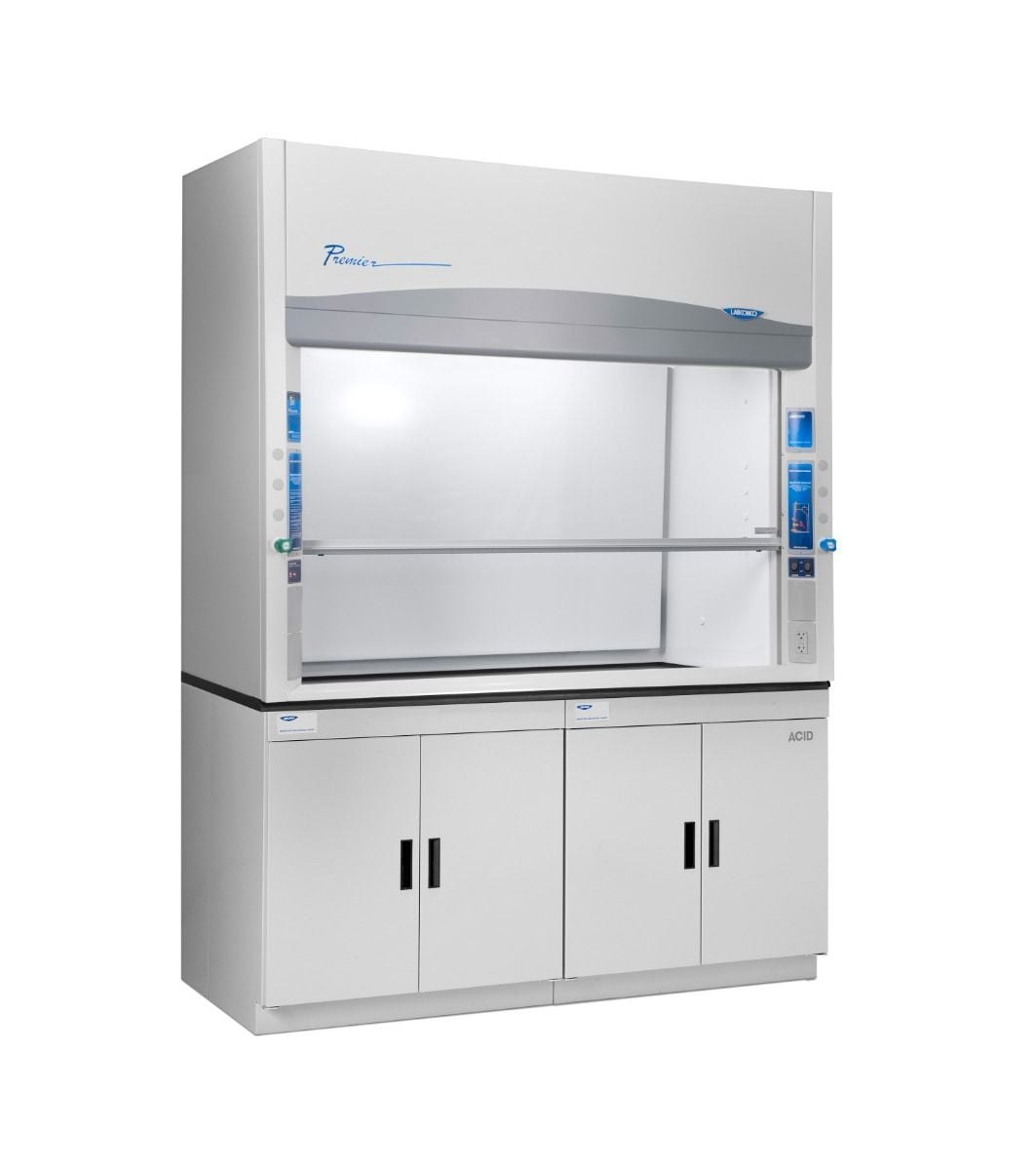
Labconco Protector Premier Laboratory Hoods
Labconco Protector Premier Laboratory Hoods — Fume hoods.
The Protector Premier 8' laboratory hood is a by-pass, vertical-rising sash fume hood with a 48" interior height and 28" maximum operating sash opening. It requires 1640 CFM at 100 fpm sash open and 0.28" static pressure, distinguishing it as the widest standard model in the Premier line. It serves as the primary containment device in laboratory exhaust systems, factory-rated to ASHRAE 110-1995 AM<0.05.
Full specifications
| Airflow At 100 Fpm Sash Open | 705 CFM |
| Built-in Blower Airflow | 725 CFM |
| Static pressure at 100 fpm sash open mfr | 0.28 s.p. |
| Built-in blower maximum external static pressure mfr | 0.17 S.P. |
| Hood width mfr | 8 ft |
| Built-in blower motor HP mfr | 1 HP |
Description
Construction and Series Positioning
- The Protector Premier is a by-pass fume hood available in 4', 5', 6', and 8' widths; this 8' model is the largest standard width and requires 1640 CFM at 100 fpm face velocity with 0.28" static pressure.
- Unlike integral blower variants (4', 5', 6' only), this 8' hood is designed for connection to a remote blower via 12" nominal (12.75" OD) exhaust duct; the 4' integral blower model uses 10" duct.
- Standard features include a vertical-rising sash with 37.5" high visibility and 28" maximum operating height, 48" interior height, LED T8 lighting rated 50,000 hours, and factory preparation for up to 8 service fixtures.
Airflow and Containment Behavior
- By-pass airflow maintains containment as the sash is lowered; face velocity must be certified between 60 and 100 fpm, with transport velocity in the exhaust duct maintained between 1000 and 2500 fpm.
- Factory ASHRAE 110-1995 rating is AM<0.05 at 4 L/min; field certification requires a certified contractor.
- The work surface must be at least as wide as the hood and aligned flush with the back to ensure proper bypass airflow under the air foil.
Installation and Operation
- Hoods weigh 400–800 lbs (182–363 kg) and must be mounted on a level base cabinet with a chemically resistant work surface supported by a cross support; exhaust ductwork must be supported independently of the hood.
- Electrical service is 115 V 50/60 Hz 20 A or 230 V 50/60 Hz 10 A with overload protection and a marked disconnecting device in close proximity.
- Service lines are ¼" OD copper (brass for natural gas) with recommended pressure 40 PSI and maximum 200 PSI; natural gas must only be connected to the brass-tubed fixture, and oxygen is not permitted with standard fixtures.
Integration & Operating Notes
The weight of the exhaust ductwork must be carried by separate supports, not by the hood superstructure. Supporting duct load on the hood can distort the cabinet, misalign the sash, and compromise airflow containment.
The hood is designed for an average face velocity of 60 to 100 fpm at the sash opening. Operating outside this range risks inadequate containment or excessive turbulence; certification by a qualified contractor is required after installation and after any change to the exhaust system.
Natural gas must be connected only to the service fixture that is pre-plumbed with brass tubing. Standard copper supply lines are not suitable due to sulfur content deterioration. Oxygen must never be used with any standard service fixture; contact Labconco for oxygen-compatible options.
The sash weight is individually matched to the specific hood during factory assembly. Exchanging it with another unit can cause incorrect sash balance, leading to sash drift or difficulty in operation. During service or relocation, ensure the weight remains with its original hood.
Selection & Integration Q&A
Choose the 8' remote-blower model when you need the widest standard working width and have an external exhaust system capable of 1640 CFM at 0.28" static pressure. Integral blower models are available only in 4', 5', and 6' widths and include a built-in blower (1180 CFM, 1 HP) for installations without remote exhaust.
The exhaust connection is 12" nominal (12.75" OD) duct. The blower must deliver 1640 CFM at 100 fpm sash open against 0.28" static pressure, and maintain transport velocity of 1000–2500 fpm in the duct. Ductwork weight must be supported independently of the hood.
The base hood does not include service fixtures, blower, ductwork, or work surface. Routine maintenance per Chapter 6 includes sash weight check and LED lighting inspection. Optional accessories such as Guardian Airflow Monitors, sash stops, and additional service fixtures must be ordered separately and installed per Chapter 7.