
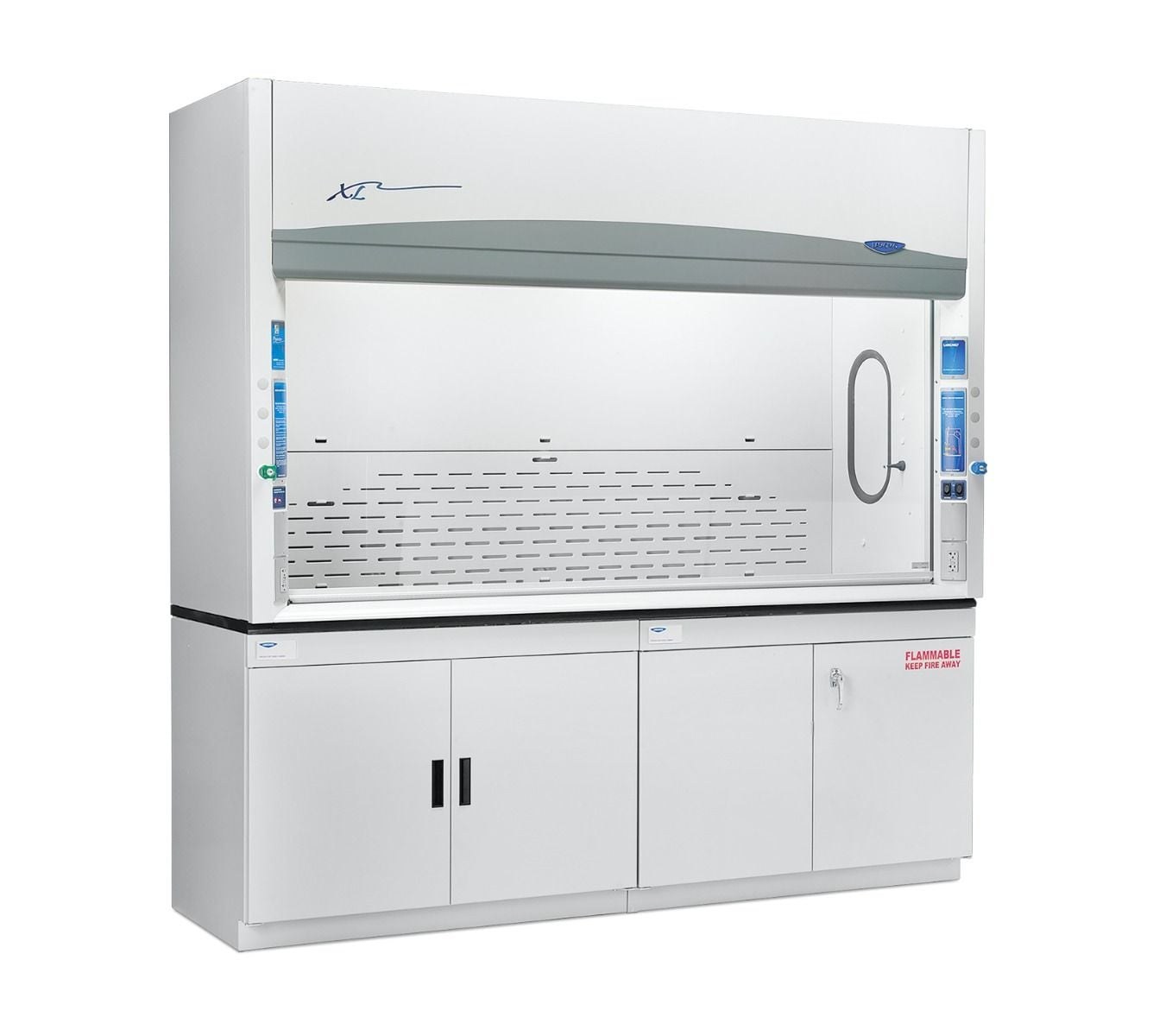
Labconco Protector XL Benchtop Laboratory Hoods
Labconco Protector XL Benchtop Laboratory Hoods — Fume hoods.
The Protector XL is a bypass fume hood with vertical-rising sash, available in 8 ft width and 31.7 in depth, designed for 60–100 fpm face velocity. Its 48 in interior height and 37.5 in sash visibility distinguish it within the series. It serves as a primary containment device for laboratory procedures requiring operator protection and exhaust of hazardous vapors.
Full specifications
| Airflow At 100 Fpm Sash Open | 705 CFM |
| Built-in Blower Airflow | 725 CFM |
| Static pressure at 100 fpm sash open mfr | 0.28 s.p. |
| Built-in blower maximum external static pressure mfr | 0.17 S.P. |
| Hood width mfr | 8 ft |
| Built-in blower motor HP mfr | 1 HP |
Description
Construction and Positioning
- The Protector XL is a bypass-style fume hood with a vertical-rising sash and a 48-inch interior height, providing a 37.5-inch high visibility sash with 28-inch operating travel.
- This 8-foot wide model is part of a series spanning 3 to 16 feet in width, with exterior depths of 31.7, 37.7, or 43.7 inches; the 8-foot width suits applications needing extended workspace while maintaining a standard face velocity.
- The hood ships with baffles loose (upper 16.5 in, middle 23.3 in, lower perforated 17.3 in) and requires field installation of the work surface and connection to a 12-inch nominal (12.75-inch OD) exhaust duct.
Behavior Under Load and Media
- The bypass design maintains containment as the sash is lowered, with airflow requirements varying by sash position: at 100 fpm face velocity with sash fully open, the 8-foot XL requires 1640 CFM at 0.28 in. w.c. static pressure.
- A built-in blower option delivers 1180 CFM at a maximum external static pressure of 0.17 in. w.c. with a 1 HP motor, suitable for ducted installations with low resistance.
- The hood is factory tested per ASHRAE 110-1995 with an as-manufactured rating of <0.05 ppm at 4 L/min, and field certification should verify average face velocity between 60 and 100 fpm.
Installation, Control, and Operation
- Electrical service is single-point: 115 V, 50/60 Hz, 20 A or 230 V, 50/60 Hz, 10 A, with internal wiring for LED light, switches, and duplex outlets terminating at a junction box.
- Service fixtures (up to 8) require 1/4-inch OD copper tubing (brass for natural gas) with a recommended operating pressure of 40 PSI and a maximum of 200 PSI.
- The hood must be sealed to the work surface with silicone sealant and installed on a permanent base cabinet; mobile benches are prohibited. Exhaust ductwork must be supported independently of the hood superstructure.
Integration & Operating Notes
Installation on carts, dollies, or mobile benches is prohibited because movement can disrupt airflow and compromise containment. The supporting structure must be level and capable of carrying the hood weight (400–1600 lbs) plus equipment, and a cross support must be installed under the rear of the work surface before placing the hood.
Each circuit should be a dedicated branch circuit; if combined, the maximum load is the sum of individual outlets plus 2 A unit rating. The building supply must include a switch or circuit breaker in close proximity, marked as the disconnecting device, and the hood must be grounded to MAINS protective earthing using a ring terminal sized for a 10-24 machine screw.
Average face velocity at the sash opening must be verified within this range during certification and periodic testing. Operation below 60 fpm may fail to contain vapors, while velocities above 100 fpm can cause turbulence and escape. The exhaust system must also maintain a transport velocity of 1000–2500 fpm away from the hood.
Recommended operating pressure is 40 PSI; use a pressure regulator to reduce line pressure. Service lines should be 1/4-inch OD copper (brass for natural gas) with an accessible shut-off valve. Natural gas must only be used in fixtures pre-plumbed with brass tubing because sulfur content deteriorates copper.
The manual provides a routine maintenance schedule and service operations. Specific intervals are detailed in Chapter 6. LED T8 bulbs are rated 50,000 hours and are serviceable from outside the hood cavity. Baffles ship loose and must be installed per figures; verify correct placement during maintenance.
Selection & Integration Q&A
Choose the 8-foot width when you need extended workspace for multiple operators or large apparatus while maintaining 60–100 fpm face velocity. Smaller widths (3–6 ft) suit limited space; larger widths (10–16 ft) are for high-throughput labs. The 8-foot model requires 1640 CFM at 100 fpm full open.
The exhaust duct connection is 12-inch nominal (12.75-inch OD). Ductwork must be installed by a qualified HVAC contractor, supported independently of the hood, and sized to maintain 1000–2500 fpm transport velocity. At 100 fpm face velocity with sash fully open, the 8-foot XL requires 1640 CFM at 0.28 in. w.c. static pressure.
The hood must be located away from traffic, doors, windows, fans, and ventilation registers that could disrupt airflow, with room windows closed. It must be permanently installed on a base cabinet and chemically resistant work surface; carts and mobile benches are prohibited. The supporting structure must handle 400–1600 lbs.
Routine maintenance per Chapter 6 includes verifying face velocity (60–100 fpm) and inspecting baffles. Base delivery excludes work surface, base cabinet, exhaust ductwork, service fixtures, and Guardian airflow monitor. Baffles ship loose and must be installed. LED bulbs are rated 50,000 hours and serviceable from outside.