
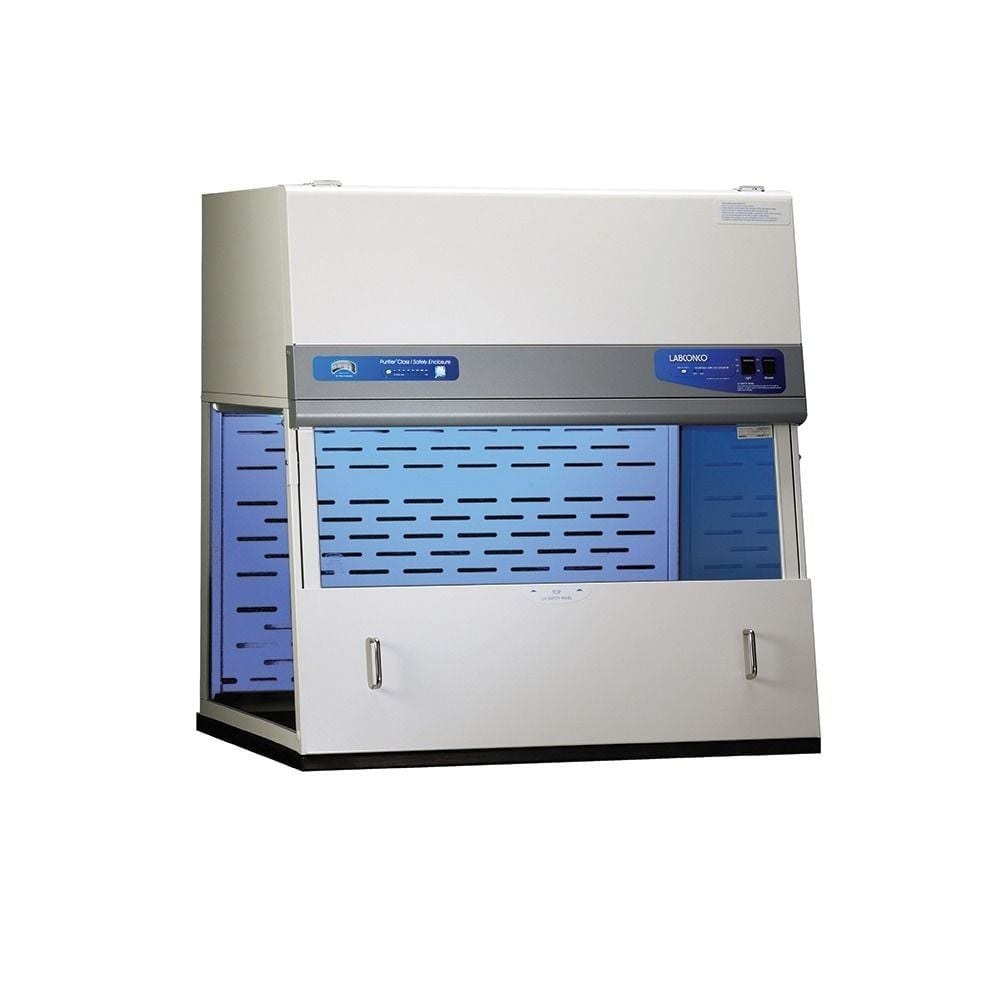
Labconco Purifier Class I Biosafety Enclosures
Labconco Purifier Class I Biosafety Enclosures — Biological safety cabinets.
The Purifier Class I Filtered Enclosure is a benchtop containment unit with an integral motorized impeller that draws room air past the operator and pushes it through a HEPA filter rated at least 99.99% efficient for 0.3-micron particles. It is available in 2', 3' and 4' widths and is distinguished within the series by the availability of a UV lamp for surface decontamination. It is used for containment of toxic, noxious and biohazardous particulates in laboratory procedures.
Full specifications
| Shipping weight mfr | 621 lbs. |
| Current | 12 A |
| Energy Requirements | 150 W |
Description
Construction and positioning
- The enclosure uses aerodynamic air foils, an upper sash foil, an upper dilution air supply, a zoned rear perforated baffle and side-entry air foils to produce horizontal airflow and capture contaminants on the first pass.
- The plenum and HEPA filter are jacketed by negative pressure so leaks are recaptured and refiltered.
- Key construction details include a 10-degree ergonomic slope, 23" internal depth, 1/4" tempered safety glass sash, and a vibration-isolated motorized impeller.
- The UV lamp is found only on the Purifier Class I Enclosure and will not penetrate the plane of the sash and lower airfoil.
Behavior under load and in different modes
- Face velocity for biohazardous operations should be 75-105 fpm; for weighing procedures 60-100 fpm. Set speed control within these ranges; lowest appropriate velocity gives quietest operation.
- At 50 Hz operation, blower maximum airflow is reduced by 17% on 115V models.
- Exhaust volume, noise and static pressure data are tabulated for face velocities of 60, 75, 80, 90, 100 and 105 fpm for each width. For example, the 2' model at 75 fpm delivers 110 CFM, 49-55 dB(A), max 220 ft equivalent 6" duct, 0.19" external static pressure; the 3' model at 75 fpm delivers 165 CFM, 52-56 dB(A), max 65 ft equivalent 6" duct, 0.12" external static pressure; the 4' model at 75 fpm delivers 220 CFM, 54-58 dB(A), max 60 ft equivalent 6" duct, 0.19" external static pressure.
- The upper dilution air supply introduces 5-7% of the required air volume; do not block it.
Installation, connection and operation
- The enclosure must be placed on a level, structurally adequate base cabinet and a smooth, rigid, chemical-resistant work surface at least as wide as the enclosure, with a dished recess for primary spills. The front of the enclosure must align within 0.36" of the front of the work surface. Four mounting screws secure the enclosure; a minimum 1/8" clearance under the screw heads allows the rear and front air-foil flanges to slide into place.
- 115V models connect via the supplied power cord to the IEC inlet on the rear; 230V models ship without a plug and require a locally appropriate plug.
- Thimble exhaust connections are available for ducting the enclosure to a house exhaust system or to a FilterMate Portable Exhauster. The weight of the exhaust ductwork must be supported independently of the enclosure superstructure, and the duct material must match the enclosure, procedures and chemical applications. Thimble exhaust part numbers are 3924400 (2'), 3924401 (3') and 3924402 (4'). If connected to a house exhaust system, an adjustable damper or valve must be installed to control airflow.
- HEPA filters ship installed with the gasket on the downstream side and are leak-checked at Labconco; a second leak check is required before use and at least annually thereafter. Carbon filters are gravity-installed with the gasket side down on the exhaust side of the HEPA filter after removing the upper perforated cover.
- Face velocity is set with the speed control behind the front panel. Face velocity is measured across the sash opening in two rows: 3" down from the upper sash foil and 3" up from the work surface, with readings 6" from the ends and every 12". Four readings are taken for the 2' enclosure, six for the 3' and eight for the 4', then averaged.
- Enclosures were tested per ASHRAE 110-1995 with an as-manufactured rating of less than 0.05 ppm at 4 lpm, and per NSF/ANSI 49 biological containment testing at 75 fpm inflow.
Integration & Operating Notes
Face velocity for biohazardous operations should be 75-105 fpm; for weighing procedures 60-100 fpm. Set speed control within these ranges; lowest appropriate velocity gives quietest operation. Face velocity is measured across the sash opening in two rows: 3" down from the upper sash foil and 3" up from the work surface, with readings 6" from the ends and every 12". Four readings are taken for the 2' enclosure, six for the 3' and eight for the 4', then averaged.
HEPA filters ship installed with the gasket on the downstream side and are leak-checked at Labconco; a second leak check is required before use and at least annually thereafter. Schedule leak testing as part of commissioning and routine maintenance. Chapter 6 covers the routine maintenance schedule, decontamination, determination of when to replace HEPA and carbon filters, HEPA filter leak testing, setting inflow face velocity with the speed control, calibrating and operating the airflow monitor, calculating carbon filter life, initial certification and re-certification, and replacement of fluorescent/UV lamps, motorized impeller and speed control.
Selection & Integration Q&A
Choose the Class I when you need UV surface decontamination, as the UV lamp is available only on this model. For applications requiring only HEPA filtration without UV, the Purifier HEPA Filtered Enclosure is sufficient. The Class I is available in 2', 3' and 4' widths.
Use a thimble exhaust connection (part numbers 3924400 for 2', 3924401 for 3', 3924402 for 4') and install an adjustable damper or valve to control airflow. The ductwork weight must be supported independently of the enclosure, and the duct material must match the enclosure, procedures and chemical applications.
HEPA filter leak check before use and at least annually. Carbon filters (if used) are gravity-installed and must be replaced when exhausted; calculate life per Chapter 6. Thimble exhaust connections, remote blowers, adjustable dampers, UV lamp (Class I only), work surfaces, utility shelves, and Guardian Airflow Monitor are optional accessories not included in base delivery.