
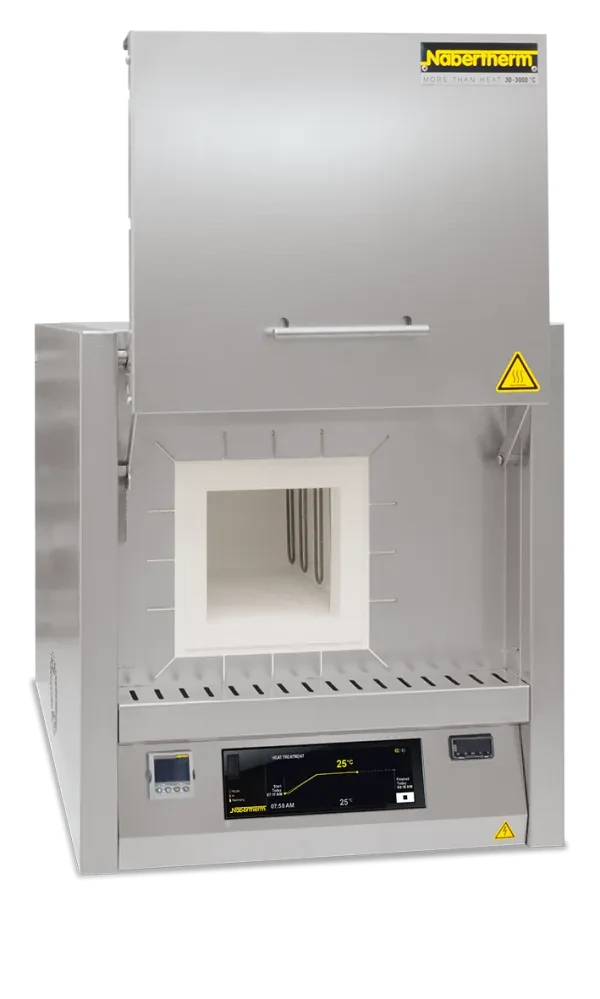
Nabertherm HT 08/17
Nabertherm HT 08/17 — High-temperature furnaces.
The HT 08/17 is a high-temperature chamber furnace with molybdenum disilicide heating elements and fiber insulation, offering an 8-litre chamber (150 × 300 × 150 mm) and a maximum working temperature of 1750 °C. It is the smallest model in the HT ../17 series, distinguished by its compact 8-litre volume and 3-phase connection. It is intended for laboratory-scale high-temperature processes such as sintering, annealing, or melting in a controlled atmosphere.
Nabertherm HT Series — Model Comparison & Selection
| Model | Chamber volume, L | Electrical connection | Weight, kg | Max temperature, °C |
|---|---|---|---|---|
| HT 08/17 Current | 8 | 3-phase2 | 215 | 1750 |
| HT 160/17 | 160 | 3-phase | 760 | 1750 |
Full specifications
| Chamber volume | 8 l |
| Electrical connection | 3-phase2 |
| Connected mfr | 8.5 |
| Inner dimensions (W × D × H) mfr | 150 × 300 × 150 mm |
| Outer dimensions (W × D × H) mfr | 740 × 640 × 1755 mm |
| Weight | 215 kg |
| Max temperature | 1750 °C |
Description
Construction and series positioning
The HT 08/17 is the smallest chamber volume in the HT ../17 series, which also includes the HT 29/17, HT 64/17, and HT 160/17 (larger 17-series models) and the HT 450/16 (a larger model with a lower maximum temperature). The furnace uses molybdenum disilicide (MoSi2) heating elements and fiber insulation, enabling a maximum temperature of 1750 °C. The chamber measures 150 mm wide × 300 mm deep × 150 mm high, giving an 8-litre working volume. The outer dimensions are 740 × 640 × 1755 mm (W × D × H), and the unit weighs 215 kg. Electrical connection is 3-phase, with a connected load of 8.5 (units not specified in the source).
Behavior under load and media
No digitized curve points or detailed performance data (heating rates, uniformity) are available for this model. The maximum temperature of 1750 °C is the primary limit; operation near this limit requires appropriate atmosphere control and element protection. The fiber insulation and MoSi2 elements are suitable for high-temperature processes but may require specific atmosphere conditions to prevent oxidation or contamination.
Installation, connection, and control
The furnace requires a 3-phase electrical supply; the exact voltage and frequency are not specified in the provided facts. The high mass (215 kg) and tall outer dimensions (1755 mm height) necessitate a stable floor installation with adequate overhead clearance. Control and process monitoring are supported by Nabertherm's standard controller series 500 and the MyNabertherm app, as described in the 'Prozesssteuerung englisch' document, which covers controller functions, process data storage, and temperature uniformity according to AMS2750F instrumentation types. Recorder and controller options are available but not included in the base delivery unless specified.
Integration & Operating Notes
The furnace is designed for 3-phase connection, but the exact voltage and frequency are not stated in the provided specifications. The connected load is listed as 8.5 (unit unspecified). Confirm the site supply matches the furnace nameplate to avoid damage or unsafe operation.
Operating above 1750 °C may damage the MoSi2 heating elements and fiber insulation. The furnace should be used with appropriate atmosphere control to prevent element oxidation, especially at high temperatures. No specific atmosphere recommendations are provided in the available documents.
Selection & Integration Q&A
Choose the HT 08/17 when an 8-litre chamber (150×300×150 mm) is sufficient and the 1750 °C maximum temperature is required. The HT 29/17 and HT 64/17 offer larger volumes (29 and 64 litres) but share the same 17-series temperature capability. Select the smallest volume that accommodates your workload to minimize energy use and cycle times.
Nabertherm offers controller series 500 and the MyNabertherm app for process control, data logging, and temperature uniformity documentation per AMS2750F. These are not included in the base furnace and must be ordered separately. Integration requires following the controller manual for wiring and configuration.
No specific maintenance schedule is provided in the available documents. MoSi2 elements may require periodic inspection for oxidation or degradation, especially after high-temperature cycles. Fiber insulation should be checked for cracks or contamination. Consult the furnace manual for detailed maintenance instructions and replacement intervals.