
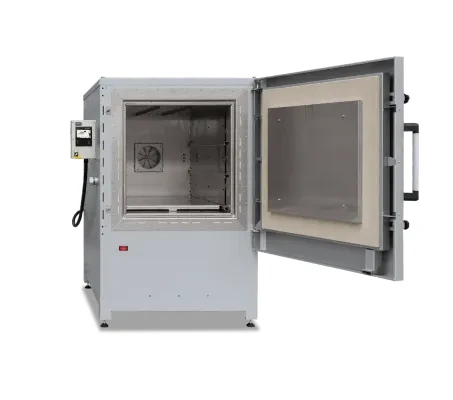
Nabertherm NA 60/65
Nabertherm NA 60/65 — Forced Convection Furnaces.
The NA 60/65 is a 60-litre forced-convection chamber furnace with a 650 °C maximum working temperature, electrically heated and connected to a 3-phase supply. Within the NA series it is the smallest 650 °C modification, distinguished from the NA 60/85 by its lower temperature ceiling and from the larger NA 120/65 by chamber volume. It serves batch heat-treatment and drying processes that require circulating-air uniformity rather than high-temperature capability.
Nabertherm NA Series — Model Comparison & Selection
Full specifications
| Chamber volume | 60 l |
| Chamber volume | 60 l |
| Chamber volume | 60 l |
| Chamber volume | 60 l |
| Electrical connection | 3-phase |
| Electrical connection | 3-phase |
| Electrical connection | 3-phase |
| Electrical connection | 3-phase |
| Heating mfr | 9 |
| Heat-up time3 mfr | 90 |
| Cool-down time3 from Tmax mfr | 30 |
| Inner dimensions (W × D × H) mfr | 350 × 500 × 350 mm |
| Outer dimensions (W × D × H) mfr | 930 × 1310 × 1435 mm |
| Weight | 240 kg |
| Weight | 240 kg |
| Weight | 240 kg |
| Weight | 240 kg |
| Max temperature | 650 °C |
| Max temperature | 650 °C |
| Max temperature | 650 °C |
| Max temperature | 650 °C |
Description
Construction and series positioning
- Chamber volume 60 l with inner dimensions 350 × 500 × 350 mm (W × D × H); outer envelope 930 × 1310 × 1435 mm, unit weight 240 kg.
- Electrically heated, 3-phase connection; maximum chamber temperature 650 °C.
- Within the NA forced-convection family this is the smallest 650 °C unit: the NA 60/85 shares the 60-litre chamber but raises the ceiling to 850 °C, while the NA 120/65 doubles the volume at the same 650 °C limit. Choose the NA 60/65 when the load fits a 60-litre chamber and the process never exceeds 650 °C.
Thermal behaviour
- Factory data give a 9 kW heating capacity and a 90-minute heat-up time to maximum temperature.
- Cool-down from Tmax is listed twice in the factory data (210 and 30), so no single cool-down figure is asserted here; the actual cooling rate depends on the forced-convection configuration and load.
- No digitized curve points were supplied, so no temperature-uniformity or load-response curve is reproduced.
Control and operation
- The attached controller documentation covers the Nabertherm 500-series controllers and the MyNabertherm app, including process-data storage and AMS2750F instrumentation types; the furnace is operated through this controller family.
- The fiber-optics catalog section confirms the NAT/NA forced-convection chamber furnace range extends to 900 °C, with LS safety-technology variants (EN 1539) offered on TR and KTR models, not on the NA line.
- No installation, connection or maintenance specifics for this model are printed in the supplied document digests.
Integration & Operating Notes
The furnace is a 3-phase, 9 kW electrically heated unit. The supply, protective device and cable cross-section must be selected for the actual connected load and the site's voltage, and the final connection data should be taken from the unit's nameplate rather than assumed from the series.
The 650 °C maximum is the defining limit of this modification; the sibling NA 60/85 exists precisely for processes above it. Running the NA 60/65 beyond 650 °C is outside its design envelope and risks damage to the heating and insulation system.
Selection & Integration Q&A
Pick the NA 60/65 when the batch fits a 60-litre chamber (350 × 500 × 350 mm) and the process stays at or below 650 °C. The NA 60/85 offers the same volume with an 850 °C ceiling; the NA 120/65 offers a larger chamber at 650 °C.
A 3-phase supply sized for the 9 kW heating load, plus a controller from the Nabertherm 500 series (with MyNabertherm app functions and optional AMS2750F instrumentation types). Recorder and instrumentation options are ordered separately and are not part of the base furnace.
The supplied document digests contain no maintenance schedule or consumables list for this model. Controller options, recorders and instrumentation packages are separate items; service intervals and spare parts must be taken from the unit's operating manual, which was not included in the supplied digests.