
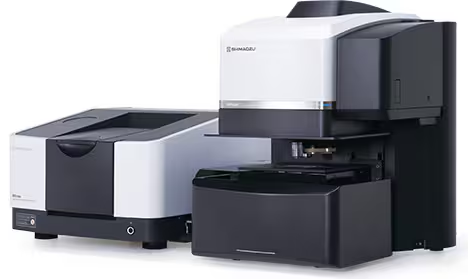
Shimadzu Airsight
Shimadzu Airsight — Laboratory balances.
The Shimadzu AIRsight is a combined infrared and Raman microscope system built around a germanium ATR objective (P/N 206-32600-41) and a 532 nm Raman laser, delivering 4 cm⁻¹ wavenumber resolution for both IR and Raman and a minimum spatial resolution of 3 µm. It is configured with either a TEC MCT or DLATGS detector and supports microplastic analysis from a few to several tens of micrometres in diameter, including 1 µm polystyrene beads by Raman. The instrument is intended for materials and particle identification in laboratory microscopy workflows where co-located IR and Raman data are required from the same sample area.
Full specifications
| Wavenumber resolution (IR and Raman) mfr | 4 cm-1 (IR and Raman) |
| Spatial resolution (Minimum) mfr | 3 μm (Minimum) |
| Laser wavelength (Raman) mfr | 532 nm (Raman) |
| Raman spectral range mfr | 1750–750 cm-1 |
| Detector type mfr | TEC MCT (IR) |
| ATR cell fiber diameter (C II cell) mfr | 13 mm (C II cell) |
| Microplastic measurement size range (diameter) mfr | a few to several tens μm (diameter) |
| Microbead Raman measurement diameter (polystyrene) mfr | 1 μm (polystyrene) |
| DLC I(D)/I(G) ratio (CH4_center) mfr | 0.32 (CH4_center) |
| DLC I(D)/I(G) ratio (CH4_periphery) mfr | 0.32 (CH4_periphery) |
| DLC I(D)/I(G) ratio (C2H2_center) mfr | 0.34 (C2H2_center) |
| DLC I(D)/I(G) ratio (C2H2_periphery) mfr | 0.34 (C2H2_periphery) |
| DLC FWHM(G) (CH4_center) mfr | 182.17 (CH4_center) |
| DLC FWHM(G) (CH4_periphery) mfr | 181.40 (CH4_periphery) |
| DLC FWHM(G) (C2H2_center) mfr | 190.85 (C2H2_center) |
| DLC FWHM(G) (C2H2_periphery) mfr | 190.25 (C2H2_periphery) |
| DLC log(N(G)/I(G)) (CH4_center) mfr | -0.29 (CH4_center) |
| DLC log(N(G)/I(G)) (CH4_periphery) mfr | -0.28 (CH4_periphery) |
| DLC log(N(G)/I(G)) (C2H2_center) mfr | -0.44 (C2H2_center) |
| DLC log(N(G)/I(G)) (C2H2_periphery) mfr | -0.44 (C2H2_periphery) |
| Microplastic IR sample length (major axis) mfr | 115 μm (major axis) |
| Microplastic IR sample width (minor axis) mfr | 53 μm (minor axis) |
| ATR objective prism material mfr | Ge (P/N 206-32600-41) |
Description
Construction and positioning
- The AIRsight is a dual-modality microscope: IR and Raman share a common optical path and the same 4 cm⁻¹ wavenumber resolution.
- The standard ATR objective uses a germanium (Ge) prism, P/N 206-32600-41; the C II cell has a 13 mm fibre diameter.
- Raman excitation is a 532 nm laser with a spectral range of 1750–750 cm⁻¹.
- Detector choice defines the configuration: TEC MCT for IR, DLATGS for room-temperature operation.
- No sibling models are listed for this series, so the AIRsight is specified as a single combined platform rather than a family of variants.
Behaviour across sample types
- Spatial resolution is 3 µm minimum, allowing measurement of microplastics in the few-to-several-tens-of-micrometres diameter range.
- Raman sensitivity extends to 1 µm polystyrene beads, while IR sampling of larger microplastic particles is illustrated by a 115 µm × 53 µm (major × minor axis) sample.
- The DLC reference data show I(D)/I(G) ratios of 0.32 (CH₄ centre and periphery) and 0.34 (C₂H₂ centre and periphery), with FWHM(G) between 181.40 and 190.85 and log(N(G)/I(G)) from −0.29 to −0.44, indicating the system resolves subtle band-shape differences between centre and periphery positions.
Installation and operation
- The system is supplied as a microscope configuration paired with either an IRXross or IRTracer-100 FTIR spectrometer, per the c103-e139 document.
- Sadtler spectral libraries are referenced as an accessory for spectral identification.
- The available documents are marketing and configuration leaflets without electrical, environmental or maintenance sections; installation and control details must therefore be taken from the instrument's own manual, which is not part of the supplied digests.
Integration & Operating Notes
The AIRsight is documented in two configurations, IRXross + AIRsight and IRTracer-100 + AIRsight, and with either a TEC MCT or a DLATGS room-temperature detector. The detector and spectrometer pairing must be decided before order because they determine the IR sensitivity and cooling requirements of the installed system.
The 532 nm Raman channel covers 1750–750 cm⁻¹, so bands below 750 cm⁻¹ are outside the Raman range and must be obtained by the IR channel. Method development should assign low-wavenumber features to IR rather than expecting Raman data there.
The ATR objective uses a germanium prism identified as P/N 206-32600-41. Because the prism is the contact element, its condition governs IR data quality; replacement and handling should be planned against this part number rather than as a generic objective service.
Selection & Integration Q&A
Choose the AIRsight when the same sample area must be measured by both IR and Raman at 4 cm⁻¹ resolution and 3 µm minimum spatial resolution. No sibling variants are listed, so the main selection decision is the detector (TEC MCT vs DLATGS) and the host spectrometer (IRXross or IRTracer-100).
The AIRsight is configured with either an IRXross or an IRTracer-100 FTIR spectrometer, one detector type (TEC MCT or DLATGS), the Ge ATR objective P/N 206-32600-41, and optionally Sadtler spectral libraries. These are ordered as a matched set rather than added later.
Raman covers 1750–750 cm⁻¹ at 532 nm, so lower-wavenumber bands need the IR channel. Spatial resolution is 3 µm minimum; microplastics are quoted from a few to several tens of micrometres in diameter, and 1 µm polystyrene beads are measurable by Raman.
The base delivery is the microscope with its Ge ATR objective and the chosen detector and spectrometer. Sadtler spectral libraries are an accessory listed separately. The supplied documents contain no electrical, environmental or maintenance schedules, so service intervals and cabling must be confirmed against the instrument manual.