
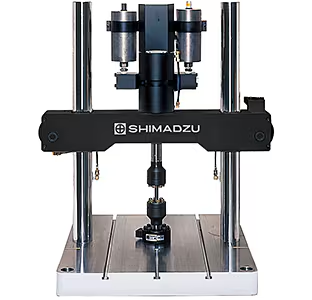
Shimadzu EHF U Series
Shimadzu EHF U Series — Testing machines.
The Shimadzu EHF U Series is a servo-hydraulic fatigue and durability testing machine built for dynamic and static testing of materials and components. As part of the EHF series, the U designation indicates a floor-standing configuration with a high-stiffness load frame. It is used in materials research and quality control for characterizing mechanical properties under cyclic loading.
Full specifications
Description
Construction and positioning
- The EHF U Series is a floor-standing servo-hydraulic testing machine with a rigid load frame designed for high-force dynamic testing.
- It belongs to the Shimadzu EHF series; the 'U' suffix denotes the floor-standing variant, distinguishing it from table-top models in the same series.
- The load frame is constructed for minimal deflection under load, ensuring accurate displacement measurement and test repeatability.
Behavior under load
- The servo-hydraulic actuator provides closed-loop control of load, displacement, or strain, enabling both static and dynamic testing.
- Typical applications include fatigue testing, fracture toughness, and tensile/compression tests on metals, composites, and ceramics.
- The system supports a range of load capacities; exact ratings depend on the specific configuration and are detailed in the model-specific documentation.
Installation and operation
- The machine requires a stable, vibration-isolated foundation and a hydraulic power supply for actuator operation.
- Control is via a digital controller with dedicated software for test parameter setup, data acquisition, and analysis.
- Safety interlocks and limit switches are integrated to prevent overload and ensure operator safety.
Integration & Operating Notes
The load frame must be installed on a rigid, level foundation capable of withstanding dynamic forces without vibration transmission. Shimadzu specifies maximum allowable floor vibration and flatness tolerances; exceeding these can compromise test accuracy and damage the frame.
The hydraulic power unit draws significant current during operation and must be connected to a dedicated circuit with appropriate circuit breakers. Voltage fluctuations beyond ±10% can affect actuator performance and controller stability.
Hydraulic oil degradation can cause actuator malfunction and inaccurate test results. Replace the oil every 2000 operating hours or annually, whichever comes first, and inspect filters for contamination. Use only the specified oil grade.
Selection & Integration Q&A
Choose the U Series when testing requires high load capacity (typically above 100 kN) or large specimen dimensions that demand a floor-standing frame with greater stiffness and actuator stroke. Table-top models are suitable for lower forces and smaller specimens.
The hydraulic power unit must be sized to match the actuator's flow and pressure requirements, typically 21 MPa. The controller must support closed-loop control with compatible transducer inputs and provide analog/digital I/O for interlocks. Ensure proper grounding and shielding to avoid signal interference.
Install on a rigid, level floor with vibration isolation; ambient temperature 10–35°C, humidity 20–80% RH non-condensing. Avoid direct sunlight and corrosive gases. The frame must be anchored to prevent movement during dynamic testing.
The base package excludes hydraulic oil, test fixtures, load cells, extensometers, and the hydraulic power unit (if not specified). Regular maintenance includes oil changes every 2000 hours, filter replacement, and calibration of transducers annually. Optional accessories include environmental chambers and specialized grips.