
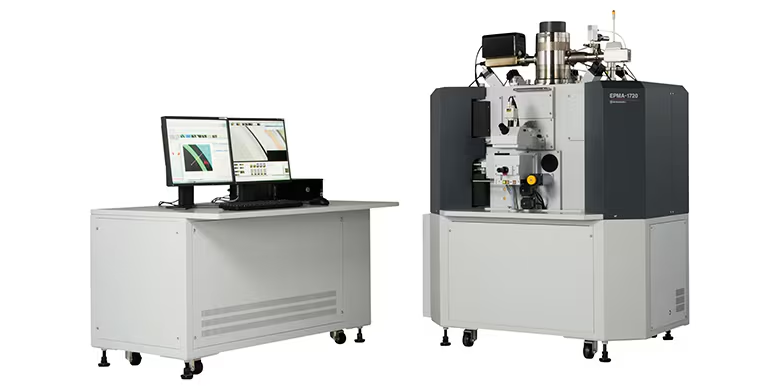
Shimadzu EPMA-1720
Shimadzu EPMA-1720 — Elemental analyzers.
The EPMA-1720 is a wavelength-dispersive electron probe microanalyzer with a 52.5° X-ray take-off angle and up to five 4-inch spectrometers, delivering >30% higher sensitivity than prior configurations. It uses a thermionic electron source (CeB6 in the HT variant) and is intended for quantitative elemental mapping and phase analysis of solid geological, metallurgical, and materials samples.
Full specifications
| X-ray take-off angle (EPMA-1720 Series) mfr | 52.5 ° (EPMA-1720 Series) |
| Number of spectrometers (EPMA-1720, 4-inch spectrometers) mfr | up to five (EPMA-1720, 4-inch spectrometers) |
| Spectrometer crystal size mfr | 4 inch (EPMA-1720) |
| Sensitivity increase (EPMA-1720 Series) mfr | more than 30 % (EPMA-1720 Series) |
| Electron source (EPMA-1720HT) mfr | CeB6 (EPMA-1720HT) |
| Sample current (example setting) mfr | 10 nA (example setting) |
Description
Construction and series positioning
- The EPMA-1720 is a fixed-geometry, wavelength-dispersive EPMA: electron column, optical microscope, and up to five 4-inch Rowland-circle spectrometers share a 52.5° take-off angle.
- The base EPMA-1720 uses a conventional thermionic source; the EPMA-1720HT variant substitutes a CeB6 cathode. No other sibling models are listed in the supplied facts.
- The 4-inch spectrometer crystal size and five-spectrometer capacity are the defining hardware of this modification; sensitivity is stated as >30% higher than the reference configuration.
Behavior under load and in operation
- No digitized curve points or measured detection-limit tables were supplied. The only quantitative operating example is a 10 nA sample current setting, which is typical for mapping and minor-element work.
- Because the take-off angle is fixed at 52.5°, quantitative analysis relies on matrix-matched standards and the built-in ZAF/φ(ρz) correction; no variable take-off geometry is available.
Installation, connection, and control
- The supplied brochure digest references detailed specifications on page 30 but does not include them; electrical, vacuum, cooling, and control-interface requirements are therefore not verifiable from the provided facts.
- The application note (P110) demonstrates element mapping and phase analysis of volcanic rock, confirming the instrument's use for spatially resolved major- and minor-element imaging of heterogeneous solids.
Integration & Operating Notes
All wavelength-dispersive measurements are made at a single 52.5° take-off angle; analysts cannot vary this geometry to optimize for light elements or thin films, so method development must use standards and correction models matched to this fixed configuration.
Selection & Integration Q&A
Choose the base EPMA-1720 when a conventional thermionic source is acceptable and CeB6 brightness/lifetime is not required. Select the EPMA-1720HT when the CeB6 cathode's higher brightness and longer service interval justify the variant; both share the 52.5° take-off angle and up to five 4-inch spectrometers.
Confirm vacuum-pumping capacity and floor space for up to five 4-inch spectrometers, and obtain the page-30 specification sheet for electrical supply and control-interface details, since the supplied brochure digest does not list them.
The supplied facts do not state duty-cycle, ambient temperature, humidity, or cooling requirements; these are referenced to page 30 of the brochure, which was not provided. Confirm them with Shimadzu before committing to continuous mapping campaigns.
The EPMA-1720HT requires periodic CeB6 cathode replacement; the base EPMA-1720 uses a different thermionic source. Spectrometer crystals, electron-source filaments, and vacuum consumables are not listed in the supplied facts and must be quoted separately.