
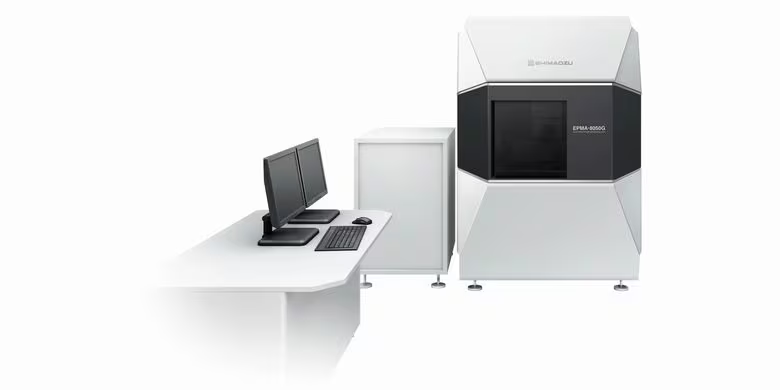
Shimadzu EPMA-8050G
Shimadzu EPMA-8050G — Elemental analyzers.
The Shimadzu EPMA-8050G is a field-emission electron probe microanalyzer (EPMA) for non-destructive elemental analysis of solid specimens at the micrometer scale. It combines wavelength-dispersive X-ray spectrometry (WDS) with a Schottky emission electron column, enabling quantitative elemental mapping and point analysis. It is used in materials science, geology, and quality control where spatially resolved composition is required.
Full specifications
Description
Construction and positioning
- The EPMA-8050G is a dedicated electron probe microanalyzer built around a field-emission electron gun and multiple wavelength-dispersive spectrometers (WDS).
- It is a standalone instrument in Shimadzu's EPMA line; no sibling variants are listed in the verified data, so selection is based on the need for WDS-based quantitative microanalysis rather than energy-dispersive (EDS) alone.
- The instrument is intended for solid, polished specimens; it is not a bulk elemental analyzer for powders or liquids without suitable preparation.
Behavior under load and in operation
- Quantitative analysis relies on WDS spectrometers, which provide higher spectral resolution and lower detection limits than EDS for many elements.
- The field-emission source supports high spatial resolution and stable probe current for trace-element work.
- No digitized curve points or factory performance curves were supplied; operating ranges and detection limits must be taken from the instrument's specification sheet.
Installation, connection, and control
- No PDF digests were provided, so installation, utility, and control details cannot be stated here. Refer to the official Shimadzu EPMA-8050G instruction manual for electrical, cooling, and vacuum requirements.
- The instrument typically requires a stable power supply, cooling water, and a vibration-isolated floor; confirm all utility specifications with the manufacturer before site preparation.
Integration & Operating Notes
Because no manual digest was supplied, the exact floor loading, vibration isolation, and clearance requirements are not stated here. Obtain the official site-preparation guide from Shimadzu before committing lab space, as EPMA instruments are sensitive to vibration and temperature drift.
The verified data contain no electrical specifications. Field-emission columns and WDS electronics are sensitive to power quality; the actual voltage, phase, current, and grounding requirements must be taken from the Shimadzu manual and verified by a qualified electrician before installation.
EPMA systems require stable cooling water and vacuum pumping. The verified data do not specify flow, temperature, or pressure; these must be confirmed from the manufacturer's utility requirements to avoid overheating or vacuum faults during long acquisitions.
No maintenance intervals are given in the verified data. Field-emission sources, WDS crystals, and vacuum pumps have defined service lives; the engineer should obtain the recommended maintenance schedule and spare-parts list from Shimadzu to avoid unplanned downtime.
Selection & Integration Q&A
The verified data list no sibling models, so a direct comparison cannot be made. Choose the EPMA-8050G when WDS-based quantitative microanalysis with a field-emission source is required; confirm against Shimadzu's current EPMA lineup for any model with different spectrometer count or source type.
No interface or utility specifications were supplied. The engineer must obtain from Shimadzu the required power supply, cooling water, vacuum, and any controller/network interfaces, and verify that existing lab infrastructure meets them before installation.
The verified data contain no environmental or mounting specifications. EPMA instruments generally require a vibration-isolated floor and stable temperature; the exact limits must be taken from Shimadzu's site-preparation guide, which was not included in the supplied digests.
No maintenance schedule or consumables list is present in the verified data. The base delivery scope and required accessories (e.g., standards, crystals, pumps) must be confirmed with Shimadzu; the instruction manual should define service intervals and spare parts.