
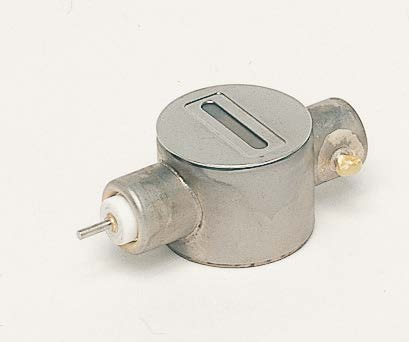
Shimadzu Factory LAB MXF 2400
Shimadzu Factory LAB MXF 2400 — Elemental analyzers.
The Shimadzu MXF-2400 is a multi-channel X-ray fluorescence spectrometer with a fixed monochromator for simultaneous determination of up to 36 elements and an optional scanning monochromator for sequential analysis of up to 48 elements. It covers the elemental range from beryllium (4Be) to uranium (92U) using a 4 kW thin-window X-ray tube, enabling rapid multi-element analysis in about two minutes for 36 elements. This model is designed for high-throughput elemental analysis in industrial and laboratory settings where simultaneous detection of light to heavy elements is required.
Full specifications
| Measurement range | 4Be, 5B, 6C to 92U |
| Number of elements determined simultaneously (fixed monochromator) mfr | up to 36 elements (fixed monochromator) |
| Number of elements determined sequentially (optional scanning monochromator) mfr | up to 48 elements (optional scanning monochromator) |
| Analysis time (about 36 elements) mfr | two minutes (about 36 elements) |
| Detection limit (high sensitivity analysis) mfr | a few ppm (high sensitivity analysis) |
| Power requirements (T-100 Disk Type Vibration Mill) mfr | 3-phase 200 V ±10 %, 50/60 Hz, 5 A (T-100 Disk Type Vibration Mill) |
| Dimensions (T-100 Disk Type Vibration Mill) mfr | 435 mm dia. × 558 mm high mm (T-100 Disk Type Vibration Mill) |
| Power requirements (TI-100 Vibration Mill) mfr | Single-phase 100 V ±10 %, 50/60 Hz, 2 A (TI-100 Vibration Mill) |
| Inner volume (TI-100 Vibration Mill) mfr | 10 mL × 2 mL (TI-100 Vibration Mill) |
| Dimensions (TI-100 Vibration Mill) mfr | W580 × D620 × H400 mm (TI-100 Vibration Mill) |
| Weight (T-100 Disk Type Vibration Mill) mfr | 120 kg (T-100 Disk Type Vibration Mill) |
| Weight (TI-100 Vibration Mill) mfr | 70 kg (TI-100 Vibration Mill) |
| X-ray tube power (Thin Window) mfr | 4 kW (Thin Window) |
Description
Construction and Positioning
The MXF-2400 is a wavelength-dispersive XRF spectrometer built around a fixed monochromator that allows simultaneous measurement of up to 36 elements. An optional scanning monochromator extends sequential analysis to 48 elements. This configuration distinguishes it from sequential-only or smaller simultaneous systems, making it suitable for routine multi-element screening where speed and coverage are critical. The 4 kW thin-window X-ray tube provides high excitation efficiency, particularly for light elements such as beryllium and boron.
Behavior Under Load and Media
With the fixed monochromator, the system acquires data for up to 36 elements in approximately two minutes, enabling high sample throughput. Detection limits reach a few ppm under high-sensitivity analysis conditions. The measurement range spans from 4Be to 92U, covering both light and heavy elements without requiring multiple instrument configurations. The thin-window tube enhances sensitivity for low-atomic-number elements, though it may require careful handling to avoid window damage from particulates or improper sample preparation.
Installation, Connection, and Operation
Specific installation details are not provided in the available documentation. However, the system requires a stable power supply and appropriate cooling for the X-ray tube. Sample preparation is critical; the T-100 disk type vibration mill (3-phase 200 V, 5 A, 120 kg) and TI-100 vibration mill (single-phase 100 V, 2 A, 70 kg) are available for grinding samples to the required fineness. The spectrometer is controlled via a dedicated workstation, though I/O specifics are not detailed in the digest. Operation should follow standard XRF safety protocols for radiation shielding and tube maintenance.
Integration & Operating Notes
The spectrometer should be placed on a rigid, vibration-free bench to avoid misalignment of optical components. Ensure adequate clearance for ventilation and service access, as the unit's dimensions and weight are not specified but typical for multi-channel XRF systems.
The 4 kW thin-window X-ray tube demands a dedicated power circuit capable of delivering the required voltage and current without fluctuation. Voltage sags or surges can affect tube performance and lifespan. Verify facility power quality before installation.
For accurate results, samples should be ground to a fine, uniform powder using a vibration mill such as the T-100 or TI-100. Contamination from grinding media or improper sample handling can skew elemental analysis, especially for light elements.
Periodic calibration with certified reference materials ensures accuracy. The X-ray tube and detector require scheduled maintenance as per the service manual. Keep a log of tube usage and replace consumables like filters and window films according to the maintenance schedule.
Selection & Integration Q&A
Choose the fixed monochromator MXF-2400 when you need rapid simultaneous analysis of up to 36 elements in about two minutes, ideal for high-throughput screening. A sequential system is better for flexible, infrequent analysis of varied element sets.
The 4 kW thin-window tube requires a stable power supply and efficient cooling. Ensure the facility provides adequate voltage and current, and install a chiller or heat exchanger as specified in the manual to prevent overheating.
Yes, but it requires a stable bench, clean environment, and proper radiation shielding. Avoid areas with excessive dust or vibration. Ambient temperature should be controlled to within the manufacturer's specified range for optimal performance.
Sample preparation requires a vibration mill such as the T-100 or TI-100, which are not included with the spectrometer. Additionally, sample cups, reference standards, and vacuum pump oil are typically separate purchases.