
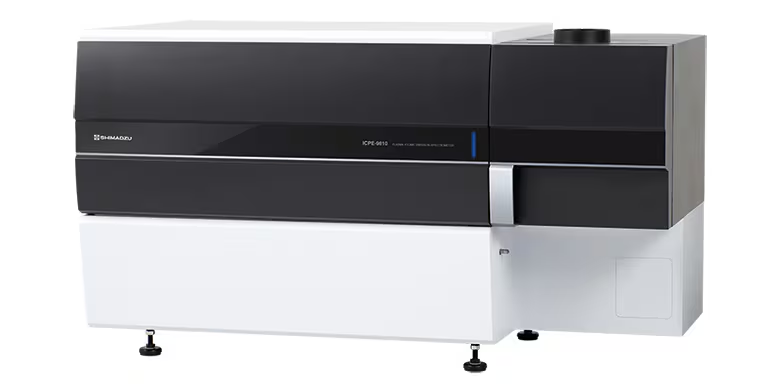
Shimadzu ICPE-9800 Series
Shimadzu ICPE-9800 Series — Elemental analyzers.
The ICPE-9800 Series is an inductively coupled plasma optical emission spectrometer (ICP-OES) configured with a mini-torch and either axial-only (ICPE-9810) or axial/radial (ICPE-9820) plasma viewing. It covers 167–800 nm with an Echelle CCD detector, achieving ppb-level detection limits and a 5–6 digit dynamic range. The 27 MHz, 1.6 kW RF supply sustains the plasma for multi-element trace analysis in environmental, metallurgical, and petrochemical laboratories.
Full specifications
| Wavelength range | 167 to 800 nm |
| Spectrometer / detector mfr | Echelle semiconductor detector (CCD) |
| High-frequency power supply mfr | 27 MHz |
Description
Construction and series positioning
- The ICPE-9800 Series uses a mini-torch ICP source with a 27 MHz, 1.6 kW max high-frequency power supply, reducing argon consumption and enabling rapid plasma ignition. - Two viewing configurations exist: the ICPE-9810 provides axial view only for maximum sensitivity along the plasma axis; the ICPE-9820 adds radial view, allowing selection between axial (trace levels) and radial (matrix-heavy or high-concentration samples) observation without changing hardware. - The optical system is an Echelle spectrometer with a semiconductor CCD detector covering 167–800 nm, capturing the full wavelength range simultaneously for fast multi-element acquisition. ### Behavior under load and in different modes
- Axial view concentrates emission from the entire plasma length onto the detector, yielding ppb-level detection limits; radial view reduces self-absorption and matrix effects for major-component analysis. - The 5–6 digit measurement range allows a single dilution-free run to cover trace to percent-level concentrations when combined with the dual-view capability of the ICPE-9820. - The 1.6 kW RF supply provides sufficient energy for complete sample atomization and excitation across aqueous and organic matrices; power can be adjusted to optimize plasma robustness for volatile or high-matrix samples. ### Installation, connection, and operation
- The instrument requires a 1.6 kW electrical supply (actual site power to be confirmed against the installation manual) and a continuous argon supply for plasma generation, nebulization, and purge. - The mini-torch design reduces argon consumption compared to conventional torches, but exhaust ventilation and argon interlocking remain mandatory for safe operation. - Control and data acquisition are performed via Shimadzu’s ICPE solution software, which manages wavelength calibration, plasma ignition sequences, and automatic viewing-mode switching on the ICPE-9820. - No PDF digests were provided; installation and operation specifics should be verified against the official instruction manual.
Integration & Operating Notes
The 27 MHz, 1.6 kW max high-frequency generator draws significant current during plasma ignition and steady-state operation. Verify that the laboratory circuit can deliver the required voltage and current without sharing with other high-draw instruments, and allow for inrush current at startup to avoid breaker trips.
Plasma stability and detection limits depend on a uninterrupted argon flow at the specified purity (typically ≥99.999%). Install a two-stage regulator with sufficient capacity and a backup supply or manifold to prevent plasma extinction during a run, which would require a full restart and recalibration.
The instrument must be placed on a sturdy bench with adequate clearance for the mini-torch and sample introduction system. Plasma operation generates ozone and heat; connect the exhaust port to a laboratory fume hood or external ventilation system to prevent ozone buildup and thermal drift.
The ICPE-9800 Series will not ignite the plasma unless argon pressure and exhaust flow are confirmed by internal sensors. Ensure that the argon supply and exhaust connections are established before powering up; bypassing these interlocks is not permitted and may damage the torch or detector.
The mini-torch and nebulizer are consumable components that require periodic inspection and cleaning to maintain detection limits. Establish a maintenance schedule based on sample load (e.g., weekly for high-throughput labs) and keep spare torches, nebulizers, and peristaltic pump tubing on hand, as these are not included in the base delivery.
Selection & Integration Q&A
Choose the ICPE-9810 if your work is exclusively trace-level analysis in clean matrices and you want the highest axial sensitivity at lower cost. Choose the ICPE-9820 if you routinely analyze high-matrix samples or need to measure major and trace elements in the same run without dilution, as its radial view reduces matrix effects.
The ICPE-9800 Series requires a continuous argon supply of ≥99.999% purity at a pressure and flow rate specified in the manual (typically 0.5–0.7 MPa). The sample introduction system accepts standard peristaltic pump tubing and a concentric nebulizer; ensure that the argon line is equipped with a two-stage regulator and that the exhaust is vented to a fume hood.
The base delivery includes the spectrometer, software, and basic installation kit. Not included: argon regulator and gas lines, exhaust ducting, peristaltic pump tubing, nebulizers, spray chambers, and replacement mini-torches. Shimadzu offers a consumables kit (part number varies by region) that includes these items; establish a spares inventory based on your sample throughput.