
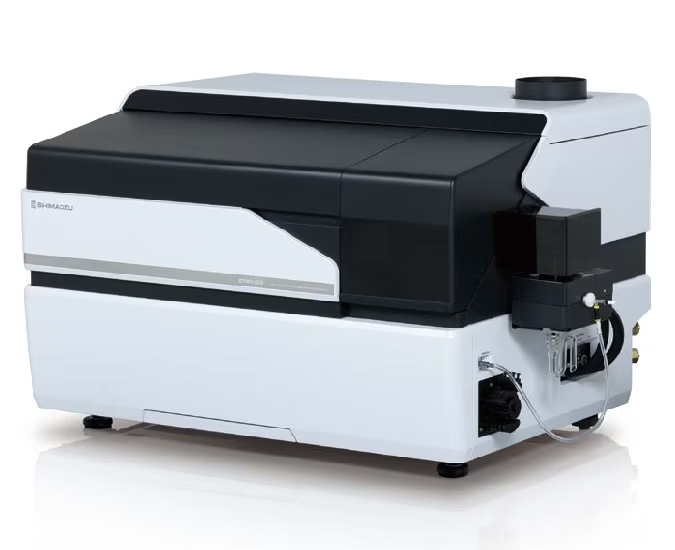
Shimadzu ICPMS-2030
Shimadzu ICPMS-2030 — Elemental analyzers.
The Shimadzu ICPMS-2030 is a quadrupole inductively coupled plasma mass spectrometer with a 27 MHz, 1.4 kW high-frequency plasma source, a mini torch, coaxial nebulizer, and electronically cooled cyclone spray chamber. Its octopole collision cell and 5–260 m/z range support trace multi-element analysis in environmental, clinical, and industrial laboratories. This configuration is the base model for routine ultratrace elemental determination.
Full specifications
| Wavelength range | 200 to 900 nm (UV-VIS measurement, p.18) |
| Scan speed mfr | Medium (UV-VIS measurement, p.18) |
| Average count mfr | 512 (SALD-7500nano, p.13) |
| Water level mfr | Middle stage (SALD-7500nano, p.13) |
| Average fiber diameter mfr | 16 nm (after 3rd treatment, p.5) |
| Average fiber diameter mfr | 14 nm (after 4th treatment, p.5) |
| Average fiber diameter mfr | 12 nm (after 5th treatment, p.5) |
| Sampling pitch mfr | 1.0 nm (UV-VIS measurement, p.18) |
Description
Construction and architecture
- Quadrupole mass analyzer with octopole collision cell for interference management. - Plasma ion source: 27 MHz RF generator (max 1.4 kW), mini torch, coaxial nebulizer, and electronically cooled cyclone spray chamber. - Mass number range 5–260 m/z, covering Li through U and beyond. ### Behavior under load and in different media
- The electronically cooled cyclone chamber stabilizes aerosol temperature, reducing solvent load and matrix effects. - The octopole collision cell enables collision/reaction gas modes to suppress polyatomic interferences; no curve points or mode-specific performance data were supplied. - The mini torch reduces argon consumption relative to full-size torches; exact gas flows are not stated in the supplied facts. ### Installation, connection, and control
- No PDF digests were provided, so installation, utility, and control specifics cannot be detailed beyond the RF supply rating and source configuration. - The 27 MHz, 1.4 kW RF supply requires appropriate facility power and cooling; exact electrical and cooling requirements are not given in the supplied facts.
Integration & Operating Notes
The high-frequency power supply operates at 27 MHz with a maximum output of 1.4 kW. Facility electrical service, grounding, and cooling must be sized for this RF load; exceeding the rated output or operating without adequate cooling risks generator damage and unstable plasma.
The coaxial nebulizer feeds the electronically cooled cyclone spray chamber and mini torch. Sample uptake rate, solvent volatility, and dissolved-solids load must be kept within the torch and chamber tolerance; high matrix or high-organic samples may require dilution or additional gas flows not specified in the supplied facts.
The octopole collision cell can be operated with collision/reaction gases to reduce polyatomic interferences. Method development must define cell gas and mode per element; no automatic interlock or sequencing details were supplied in the available documentation.
The supplied facts contain no service intervals, error codes, or consumable part numbers. Torch, nebulizer, and interface cones are typical wear items for this instrument class, but replacement intervals must be taken from the manufacturer's manual, which was not provided.
Selection & Integration Q&A
The 27 MHz, 1.4 kW RF supply requires facility power and cooling sized to that load. Sample introduction uses a coaxial nebulizer, cooled cyclone chamber, and mini torch; replacement parts must match these exact configurations. No controller or autosampler compatibility data were supplied.
The supplied facts give no mounting, environmental, or duty-cycle limits. The 1.4 kW RF generator and cooled spray chamber imply continuous cooling and stable laboratory conditions are needed, but exact ambient temperature, humidity, and duty ratings must be obtained from the manual.
No consumables, cables, or accessory list was provided. Torch, nebulizer, and interface cones are typical wear parts for this instrument class, but part numbers and service intervals are absent from the supplied facts and must be confirmed with the manufacturer.
Dimensional Drawings & Technical Documentation
Dimensional drawings
Click drawing to inspect vector dimensions