
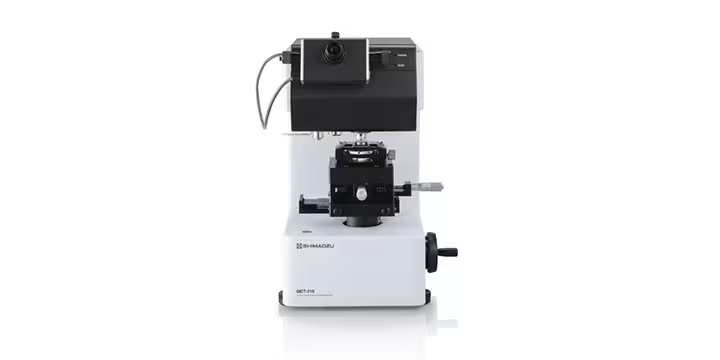
Shimadzu MCT Series
Shimadzu MCT Series — Hardness testers.
The MCT Series is a compression testing system using electromagnetic force loading with a differential-transformer displacement sensor, designed for micro-scale compression tests on particles and fibers. It offers two loading ranges (9.8–4903 mN and 9.8–1961 mN) and supports compression, load-unload, and cycle test modes. Its optical monitor and motorized stage enable precise sample positioning and observation during testing.
Full specifications
| Digital camera | 1/2.9-inch color camera (210, 211) |
| Eyepiece | 10× (210, 211) |
| Field of view | Vertical: Approx. 90 μm; Horizontal: App (210, 211) |
| Horizontal positioning motor | Stepping motor (210, 211) |
| Illumination method | Epi-illumination (210, 211) |
| Light source lamp | LED 3W / 3V (210, 211) |
| Loading method | Electromagnetic force |
| Lower compression plate | SKS flat plate, 25 mm dia. (210, 211) |
| Max objective lens attachments | 10×, 50× (20×, 40×, 100× with option) (510, 511) 210, 211: 10×, 40× |
| Measurement method | 0 to 100 μm (510, 210) 511, 211: 0 to 10 μm · 210, 211: Particle area / area Equivalent Diameter |
| Minimum increment | 0.001 μm (510, 210) 511, 211: 0.0001 μm |
| Continuous test count | Max. 100 points |
| Test force accuracy | ±1 % |
| Test mode | Compression test, load-unload test (210, 211) |
| Upper pressure indenter | Flat indenter (50 μm dia.) |
| Vertical positioning range | Approx. 20 mm (210, 211) |
| Loading range (max test force, manual model) mfr | 1961 mN (max test force, manual model) |
| Min. increment (with a 40× objective lens) mfr | Approx. 0.2 μm (with a 40× objective lens) |
| Area mfr | Approx. W125 × D125 mm (210, 211) |
| Horizontal positioning range (both X and Y directions) mfr | 50 mm (both X and Y directions) |
Description
Construction and Positioning
- The MCT Series is a dedicated micro-compression tester built around an electromagnetic loading unit and a differential-transformer displacement sensor, with a flat diamond indenter (50 µm diameter) as standard. - Sample positioning is handled by a motorized X-Y stage (25 mm travel, 0.01 mm resolution) and a vertical stage with approximately 60 mm range, allowing precise placement of small particles or fibers. - An optical monitor with 100× and 500× total magnification (optional 200×, 400×, 1000×) and a switchable light path supports observation and photography of the test area. ### Behavior Under Load
- The system can apply test forces from 9.8 mN up to 4903 mN (or 1961 mN in the lower range), with displacement measured over 0–100 µm or 0–10 µm ranges. - Three test modes are available: compression test, load-unload test, and cycle test, enabling characterization of elastic and plastic behavior of small samples. - Data processing includes calculation of compressive strength, display of test force and displacement data, and plotting of force-displacement curves. ### Installation and Operation
- The unit requires a single-phase AC power supply (100–115 V or 230 V, 50/60 Hz) with a grounded 3-pin connector (ground resistance ≤100 Ω). - Operating environment must be maintained at 20–60% relative humidity (no condensation) and within specified temperature conditions (1.0 °C tolerance). - The optical head uses a collimation method with direct connection between encoder and control handle, synchronizing movement of two indexes for precise alignment.
Integration & Operating Notes
The 3-pin power connector's grounding pin must be connected to a ground with resistance of 100 Ω or less. Poor grounding can introduce electrical noise into the sensitive displacement and load measurements, compromising test accuracy and potentially damaging the instrument.
Operating the MCT Series outside the 20–60% relative humidity range or with condensation may cause drift in the differential-transformer displacement sensor and affect the optical components. Ensure the laboratory environment is controlled accordingly.
Selection & Integration Q&A
Choose the MCT Series when you need compression testing of individual particles or fibers with force up to 4903 mN and displacement resolution in the micrometer range. It is not a conventional indentation hardness tester; it is specialized for micro-compression and load-unload/cycle tests on small samples.
The system requires single-phase 100–115 V AC or 230 V AC (±10%), 50/60 Hz, with power consumption of 100 W. The 3-pin connector's ground pin must be connected to a ground resistance of 100 Ω or less to ensure measurement stability.
Operate the MCT Series at 20–60% relative humidity without condensation and within the specified temperature range (1.0 °C tolerance). Avoid direct sunlight, drafts, and vibration sources that could affect the sensitive displacement measurement.
The base unit includes a flat diamond indenter (50 µm) and standard 10× and 50× objective lenses. Optional items include a 500 µm flat indenter, diamond pressure plate, and additional objective lenses (20×, 40×, 100×) for higher magnification. No sample preparation tools or calibration standards are mentioned as standard.