
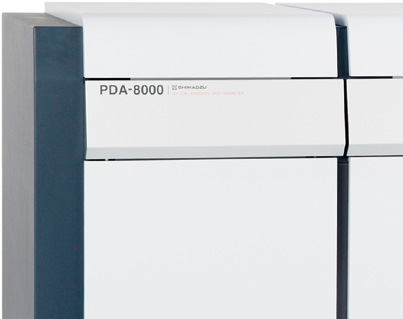
Shimadzu PDA-8000
Shimadzu PDA-8000 — Elemental analyzers.
The Shimadzu PDA 8000 is a Paschen-Runge optical emission spectrometer with a 1000 mm focal length, configured for elemental analysis of solid metals including iron and steel, copper, and aluminum alloys. Its diffraction grating is selected for either ferrous or non-ferrous wavelength coverage, distinguishing it within the series by application focus. It serves as a bench-top analyzer for impurity and alloying element determination in metallurgical process and quality control.
Full specifications
| Optical system mfr | Paschen–Runge mount (PDA-8000) |
| Excitation unit mfr | REM power supply (PDA-8000) |
| No. of processing channels mfr | 64 channels max. (PDA-8000) |
| Weight | Approx. 600 kg (PDA-8000) |
| Focal length mfr | 1000 mm (PDA-8000) |
| Ambient temperature change rate mfr | ±5 °C/hour max. °C/hour (PDA-8000) |
| Humidity mfr | 70 % max. % (PDA-8000) |
Description
Construction and series positioning
The PDA 8000 uses a Paschen-Runge mounting with a 1000 mm focal length, a classic Rowland-circle geometry that provides high spectral resolution and simultaneous multi-element detection. Unlike sibling variants that may be optimized for a single matrix, this model is offered with a diffraction grating chosen for either ferrous or non-ferrous applications, allowing the same base architecture to serve steel mills or aluminum/copper foundries. ### Behavior under load and media
No digitized curve points or dynamic performance data were supplied. The instrument is intended for solid metal samples, and the wavelength range is described as suitable for the selected application (ferrous or non-ferrous). The high-resolution specification supports separation of closely spaced emission lines, which is critical for trace and impurity element analysis in complex alloy matrices. ### Installation, connection, and control
No PDF digests were provided, so installation, connection, and control specifics cannot be detailed. The instrument is a laboratory analyzer and would typically require a stable bench, electrical supply, and possibly argon supply for spark excitation, but these are not confirmed in the facts.
Integration & Operating Notes
Optical emission spectrometers are sensitive to mechanical vibration and thermal gradients; the 1000 mm focal length optical bench must be isolated from nearby presses or sample preparation equipment to avoid drift in wavelength calibration. No specific floor loading or leveling data is provided in the facts.
The diffraction grating is selected at order for either ferrous or non-ferrous applications; using a ferrous-optimized configuration on aluminum or copper alloys will compromise sensitivity and line selection. The application must be defined before purchase to ensure the correct wavelength range and detector coverage.
Selection & Integration Q&A
Choose the PDA 8000 when your lab analyzes solid metals and you need a 1000 mm Paschen-Runge spectrometer with a grating optimized for either ferrous (steel) or non-ferrous (Al, Cu) alloys. Sibling models may offer different focal lengths or detector types; select this one if high resolution and energy savings are priorities and your matrix is fixed.
The PDA 8000 is an optical emission spectrometer, implying spark or arc excitation, but the facts do not specify the source type or power. Solid metal samples must be prepared with a flat, clean surface. The integrator should confirm the required argon supply and sample stand interface from the manual.