
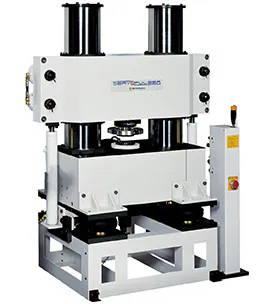
Shimadzu Testing Machine FOR Rubber Vibration Isolators
Shimadzu Testing Machine FOR Rubber Vibration Isolators — Testing machines.
The Shimadzu Testing Machine for Rubber Vibration Isolators is a dedicated electrodynamic test system with a 10 kN maximum test force and ±10 mm maximum displacement, purpose-built for characterizing rubber vibration isolators. Its 5–300 Hz cycle speed range and amplitude characteristics (e.g., ±2 mm at 50 Hz, ±0.18 mm at 300 Hz) define its operating envelope. It is used to determine dynamic stiffness and damping properties of elastomeric isolators under sinusoidal excitation.
Full specifications
Description
- The system combines a 10 kN force actuator with a ±10 mm displacement capability, enabling both static and dynamic characterization of elastomeric components. - It is positioned within Shimadzu's testing machine portfolio as a specialized solution for vibration isolation components, rather than a general-purpose universal tester. ### Behavior under load and frequency
- The machine operates from 5 Hz to 300 Hz, with amplitude decreasing as frequency increases: ±2 mm at 50 Hz, ±0.9 mm at 100 Hz, ±0.36 mm at 200 Hz, and ±0.18 mm at 300 Hz. - This amplitude–frequency characteristic reflects the physical limits of the electrodynamic actuator and must be respected to avoid over-travel or force saturation. - Maximum test force is 10 kN (10,000 N), which caps the static and dynamic loads that can be applied, particularly at low frequencies where amplitudes are largest. ### Installation, connection, and control
- No PDF digests or manual excerpts were provided, so installation, connection, and control specifics cannot be detailed here. - The machine is expected to require a stable, vibration-isolated foundation and appropriate power supply, but these are not confirmed by the supplied facts.
Integration & Operating Notes
Operating beyond the stated amplitude at a given frequency (e.g., >±2 mm at 50 Hz or >±0.18 mm at 300 Hz) may cause actuator over-travel, excessive force, or damage to the test machine and specimen. The envelope must be programmed into the test profile.
The 10 kN force limit applies to both static and dynamic testing. Exceeding it, even momentarily during transients or resonance, can overload the force transducer and actuator, leading to invalid results or equipment damage.
Although not specified in the supplied facts, dynamic testing machines typically require a massive, vibration-isolated foundation to prevent external vibrations from affecting measurements and to avoid transmitting reaction forces to the building. Verify site requirements with Shimadzu.
Selection & Integration Q&A
Choose this dedicated machine when you need dynamic characterization (5–300 Hz) with controlled amplitude and up to 10 kN force. A universal tester lacks the high-frequency actuator and amplitude control required for isolator dynamic stiffness and damping measurements.