
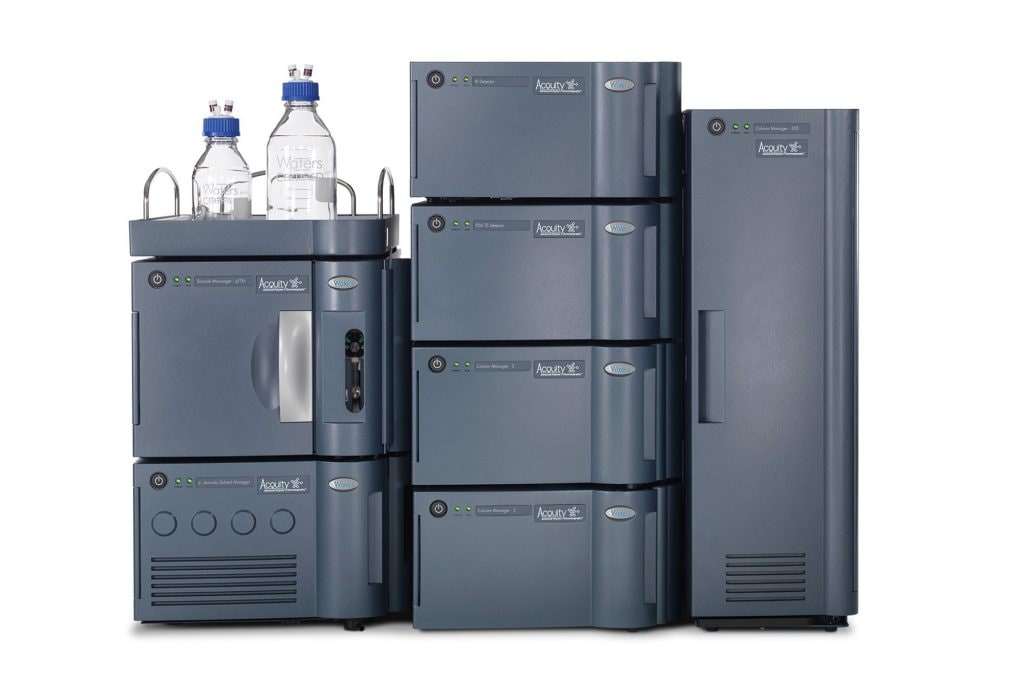
Waters ACQUITY Advanced Polymer Chromatography Analysis System
Waters ACQUITY Advanced Polymer Chromatography Analysis System — Chromatographs with Flow rate 2.2 milliliter/minute, Max pressure 103.4 megapascal.
The ACQUITY Advanced Polymer Chromatography (APC) Analysis System is a dedicated ultra-performance liquid chromatography (UPLC) configuration optimized for size-exclusion and other polymer separations. It combines a low-dwell-volume binary solvent manager (≤400 μL total system dwell) with a high-pressure fluidic path (15,000 psi) and a single-zone column manager (4–90 °C), enabling high-resolution polymer analysis at flow rates up to 2.2 mL/min. The system is intended for integration into analytical laboratories performing polymer molecular weight distribution and related characterizations.
Full specifications
| Flow rate | 2.2 mL/min |
| Max pressure | 15000 psi |
| Column temperature | 90.0 °C |
| Injection volume | 50.0 μL |
| Dwell volume (total system) mfr | ≤400 μL (includes standard 100 μL mixer) |
| Gradient delay volume mfr | ≤300 μL (includes standard 100 μL mixer) |
| Operating flow range mfr | 0.010 to 2.20 mL/min in 0.001 mL increments |
| Injection volume range mfr | 0.5 to 50.0 μL as standard; 0.1 to 250.0 μL with |
| Sample compartment temperature range mfr | 4.0 °C to 40.0 °C |
| Temperature range (Single Zone Column Manager) mfr | Controlled 4.0 °C to 90.0 °C |
| Temperature range (30 cm Single Zone Column Manager) mfr | Settable 20 °C to 90 °C; Controllable (ambient + |
| pH range mfr | 2 to 12 |
Description
System Architecture and Positioning
- The APC Analysis System is a complete, integrated UPLC system comprising a binary solvent manager, sample manager, column manager, and detector (detector type not specified in the provided facts). - It is distinguished from standard ACQUITY UPLC systems by its low dwell volume (≤400 μL total, ≤300 μL gradient delay) and extended pH range (2–12), which are critical for reproducible polymer separations. - The system supports flow rates from 0.010 to 2.20 mL/min in 0.001 mL increments, with a maximum pressure of 15,000 psi (≈103.4 MPa). - The single-zone column manager provides temperature control from 4.0 °C to 90.0 °C (settable 20–90 °C for the 30 cm version, with controllable range from ambient +5 °C to 90 °C). - Sample compartment temperature is maintained between 4.0 °C and 40.0 °C. ### Behavior Under Load and in Different Modes
- The system is designed for high-pressure operation up to 15,000 psi; however, actual achievable pressure depends on column permeability and flow rate. At the maximum flow rate of 2.2 mL/min, pressure drop across the column must be monitored to avoid exceeding the limit. - The low dwell volume ensures rapid gradient response, which is essential for reproducible retention times in polymer separations. The standard 100 μL mixer is included; alternative mixers may affect dwell volume and should be validated. - Injection volume range is 0.5–50.0 μL as standard, with an optional extension loop enabling 0.1–250.0 μL. This flexibility accommodates both analytical and semi-preparative polymer injections. - The pH range of 2–12 allows use of a wide variety of aqueous and organic mobile phases, but compatibility with the sample and column must be verified. ### Installation, Connection, and Control
- The system requires a stable laboratory environment with appropriate electrical supply (voltage and power not specified in the provided facts) and a source of compressed gas if applicable (not specified). - Fluidic connections must be made with high-pressure fittings rated for 15,000 psi; the use of incorrect fittings may lead to leaks or system damage. - Control is typically via Waters Empower software (not explicitly stated in the facts, but standard for ACQUITY systems); the system includes communication interfaces (details not provided). - The column manager requires a coolant supply if operating below ambient; the sample compartment requires temperature control within 4–40 °C. - Installation should account for the total dwell volume and gradient delay to ensure method transferability.
Integration & Operating Notes
Operating above the maximum pressure rating of 15,000 psi (103.4 MPa) can cause seal failure, tubing rupture, or column damage. Always verify that the column and flow rate combination does not exceed this limit, especially when using high-viscosity solvents or small-particle columns.
The system's fluidic path is compatible with pH 2–12. Using mobile phases outside this range may degrade seals, injector components, and column hardware, leading to leaks and unreliable results. Verify pH of aqueous buffers and organic modifiers before use.
The column manager must reach and stabilize at the set temperature (4–90 °C) before sample injection to avoid retention time drift. Allow sufficient equilibration time, especially when changing temperatures, and verify with a system suitability test.
To maintain performance and prevent leaks, replace pump seals and check valves according to the maintenance schedule in the instruction manual (typically every 3–6 months depending on usage). Use only Waters-approved spare parts to ensure proper fit and function.
The system should be placed on a stable, level laboratory bench capable of supporting its weight (not specified). Allow at least 10 cm clearance around vents for proper ventilation. Avoid direct sunlight and heat sources.
Selection & Integration Q&A
Choose the APC system when low dwell volume (≤400 μL) and extended pH range (2–12) are critical for reproducible polymer separations. Standard UPLC systems have higher dwell volumes and may not support pH extremes, leading to method transfer issues.
The detector must be compatible with the system's high-pressure fluidics (up to 15,000 psi) and low dwell volume. Use high-pressure fittings rated for 15,000 psi and ensure the detector's flow cell volume does not significantly increase system dwell volume. Consult Waters for approved detectors.
The base system includes standard fittings and a 100 μL mixer. Optional extension loop for 250 μL injections, alternative mixers, replacement pump seals, check valves, and solvent lines are not included. Regular maintenance kits are available separately.
Dimensional Drawings & Technical Documentation
Dimensional drawings
Click drawing to inspect vector dimensions