
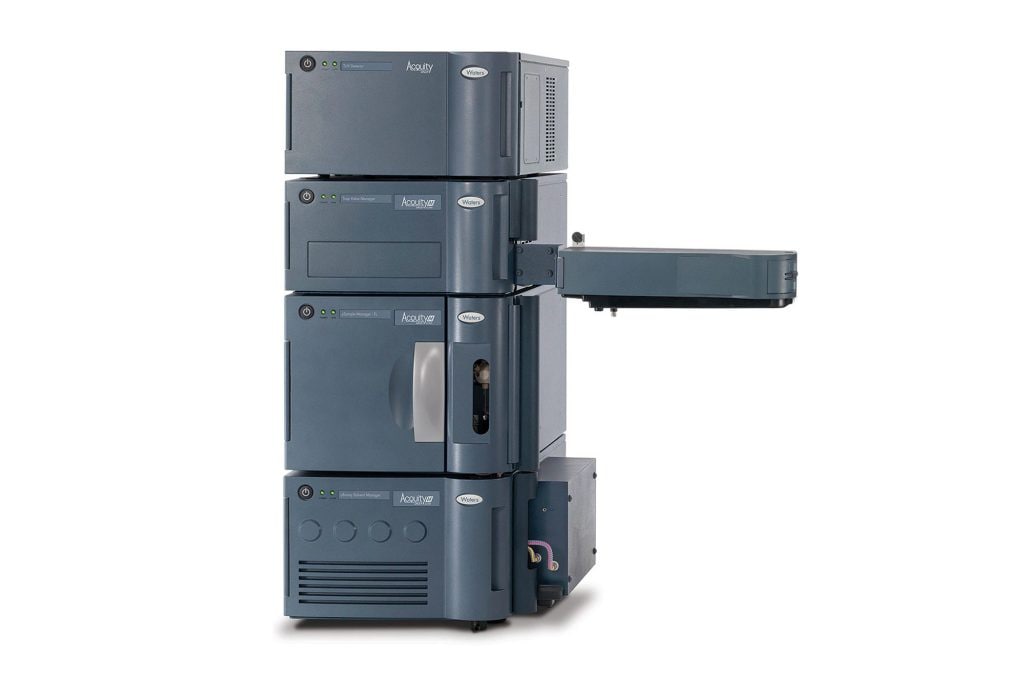
Waters ACQUITY UPLC M-Class System For LC Analysis
Waters ACQUITY UPLC M-Class System For LC Analysis — Chromatographs with Flow rate 2×10⁻⁷ milliliter/minute, Max pressure 103.4 megapascal.
The ACQUITY UPLC M-Class System is a binary, non-ferrous flow-path UPLC configured for nano- to micro-scale LC analysis, operating from 200 nL/min to 100 µL/min without flow splitting and up to 15,000 psi. It accommodates a single column from 75 µm to 4.6 mm ID and up to 250 mm length, with injection volumes from 0.1 to 100 µL. This modification is distinguished by its wide flow-rate range and high-pressure capability, serving as the primary separation engine in sensitive LC-MS or optical-detection workflows.
Full specifications
| Flow rate | 0.2 nL/min |
| Max pressure | 15000 psi |
| Injection volume | 0.1 µL |
| Operating flow rate range mfr | 200 nL/min to 100 μL/min without flow splitting |
| Sample flow path mfr | Non-ferrous |
| Sample compartment mfr | 4–40 ̊C |
| Pump options mfr | Binary |
| Column capacity mfr | Single column, 75 μm to 4.6 mm internal diameter |
| Maximum sample capacity mfr | Up to 21 plates (with Sample Organizer) |
| Detector options mfr | PDA Detector, TUV Detector, Mass Spectrometers |
| External control mfr | MassLynx Software |
| Height | 69.7 cm |
| Width | 34.3 cm |
| Depth mfr | 71.2 cm (28.0 in.) |
| pH range mfr | 2 to 10 |
Description
Construction and positioning
- The system integrates a binary pump, autosampler with 0.1–100 µL injection range, and a single-column compartment (4–40 °C) in a benchtop chassis measuring 34.3 cm wide, 69.7 cm high, and 71.2 cm deep. - The non-ferrous sample flow path minimizes metal-sensitive analyte interactions, while the absence of column tracking and single-column capacity position this model for method-development and targeted analysis rather than high-throughput screening. ### Behavior under load and in different media
- The pump delivers stable flow from 200 nL/min to 100 µL/min without flow splitting, supporting both capillary and analytical-scale separations on the same platform. - Maximum pressure of 15,000 psi (≈103.4 MPa) enables use of small-particle columns (e.g., sub-2 µm) at high linear velocities; the pH range of 2–10 accommodates a broad set of mobile-phase chemistries. - The sample compartment maintains 4–40 °C, ensuring thermally labile samples remain stable during extended sequences. - Operation is managed through MassLynx software, which coordinates pump, autosampler, and column compartment; the absence of column tracking means column identity and usage must be managed manually. - The non-ferrous flow path and wide pH range require careful selection of mobile-phase additives to avoid corrosion or excessive wear.
Integration & Operating Notes
Operating above the maximum pressure of 15,000 psi (≈103.4 MPa) risks rupture of fittings, column hardware, or pump seals. Ensure method pressures are monitored and that the column and tubing are rated for the intended pressure; use appropriate pressure relief settings in MassLynx.
The non-ferrous flow path and column hardware are compatible only with mobile phases in the pH 2–10 range. Outside this range, corrosion or degradation of components may occur, leading to leaks, increased background, or loss of performance. Verify pH of aqueous and organic modifiers before use.
The system does not have an integrated control interface; all pump, autosampler, and column-compartment functions are driven by MassLynx software. Ensure a compatible workstation with MassLynx is available and configured with the correct instrument drivers before installation. Loss of communication will halt operation.
Because the system lacks automatic column tracking, the operator must record injection counts, pressure history, and mobile-phase exposure for each column to determine when replacement is due. Without this log, column lifetime cannot be predicted, risking sudden performance loss.
Selection & Integration Q&A
Choose this model when you need a single platform covering 200 nL/min to 100 µL/min without flow splitting, up to 15,000 psi, and a non-ferrous flow path for metal-sensitive analytes. It suits method development and targeted LC-MS with one column (75 µm–4.6 mm ID). For higher throughput or multiple columns, consider other configurations.
Dimensional Drawings & Technical Documentation
Dimensional drawings
Click drawing to inspect vector dimensions