
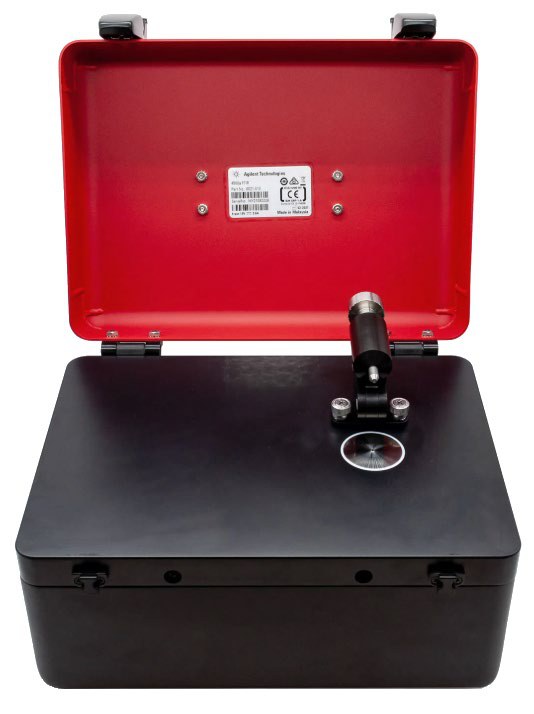
Agilent Technologies 4500 Series FTIR
Agilent Technologies 4500 Series FTIR — Molecular spectroscopy.
The Agilent 4500 Series FTIR is a portable mid-IR spectrometer family whose 4500t configuration uses a fixed 100 µm TumblIR transmission accessory for lubrication and liquid analysis. It runs up to 4 hours on an internal 99.6 Wh lithium-ion pack and requires a 5-minute warmup before reliable analysis. The 4500t is distinguished from the 4500a ATR and 4500 DialPath siblings by its pre-aligned liquid transmission path for oil condition monitoring.
Full specifications
| Atr Sample Press Force | 15 pounds |
| Dimensions | 21.6 cm |
| Firmware Load Time | 30 seconds |
| Single Reflection Atr Active Area | 200 µm |
| Single Reflection Atr Sampling Surface Diameter | 1 mm |
| Triple Reflection Atr Active Area | 200 µm |
| Triple Reflection Atr Sampling Surface Diameter | 2 mm |
| Tumblir Bottom Window Diameter | 2 mm |
| Tumblir Pathlength | 100 micrometers |
| Warmup Period | 5 minutes |
| Warmup period before performance validation mfr | 30 minutes |
| Performance test resolution mfr | 4 |
| Performance test collection time mfr | one minute minute |
| Performance test duration mfr | 2 test |
| Minimum number of performance tests mfr | 10 tests |
| Stability test regions mfr | 3000 |
| Laser calibration reference mfr | 1921 |
| Warmup period before reliable analysis mfr | 5 minutes |
| Warmup before performance validation tests mfr | 30 minutes |
| Power button hold time mfr | two seconds seconds |
| System OFF mfr | Red Red |
| System startup mfr | Red/green Red/green |
| System ON mfr | Green Green |
| Firmware update mfr | Red/green Red/green |
| ATR sample press assumed sample thickness mfr | 0.03 in |
| Single Reflection Atr Depth Of Penetration | 2 micron |
| Triple Reflection Atr Effective Penetration Depth | 6 micron |
| Weight | 6.8 kg |
| Battery capacity | 9220 mAh |
| Battery Life Under Continuous Use | 3.5 hours |
| Battery Operating Time | 4 hours |
| AC power supply mfr | 110 AC |
| Battery nominal voltage mfr | 10.8 V |
| Battery energy mfr | 99.60 Wh |
| Battery size mfr | 149 mm |
| Battery weight mfr | 505 g |
| Battery operating voltage mfr | 8.55...12.55 V |
| Battery charge voltage mfr | 12.40 V |
| Battery cutoff voltage mfr | 8.55 V |
| Maximum discharge current (continuous) mfr | 10 A |
| Maximum charge current mfr | 6.2 A |
| Low battery mfr | Green Green |
| Critically low battery mfr | Red Red |
| Dead battery mfr | No LED illumination illumination |
| AC input voltage mfr | 110 volt |
| Maximum discharge current continuous mfr | 10 A |
| ATR sample pH range mfr | 1...14 |
| ZnSe window pH range mfr | 4...9 |
| Recommended sample pH range mfr | 5...9 |
| ATR crystal pH range mfr | 1...14 |
| Recommended sample pH range for ZnSe mfr | 5...9 |
| Signal-to-noise test regions mfr | 2500 |
Description
Construction and series positioning
- The 4500 Series is a portable mid-IR spectrometer measuring 21.6 × 29.2 × 19.1 cm and weighing 6.8 kg, with a weather-resistant enclosure for outdoor use.
- The 4500t variant carries the TumblIR liquid transmission accessory with a fixed, factory-aligned 100 µm pathlength; the 4500a uses a diamond ATR (single- or triple-reflection DuraDisk) and the 4500 DialPath offers three factory-set pathlengths.
- No alignment is required because systems are factory-tested; the 4500t is intended for lubrication and liquid samples, not solids or powders.
Behavior under load and media limits
- The TumblIR ZnSe windows are chemically resistant only from pH 4 to 9, and samples measured should be pH 5 to 9; strong acids or bases must not contact the windows.
- Solid or powder samples such as tablets or hard graphite lubricant must not be used on the TumblIR because they damage the ZnSe windows or modify the pre-set pathlength.
- Internal battery power provides up to 4 hours of operation; the 4500t battery life under continuous use is approximately 3.5 hours.
Installation, control and operation
- The power button must be held for two seconds; the LED blinks red/green during firmware loading and turns solid green when ready. A 5-minute warmup is required before reliable analysis, and at least 30 minutes before performance validation.
- The power cord must be connected to the instrument first, then to the outlet, and a UL-approved surge protection strip must be used.
- The MicroLab PC software provides a Diagnostics page with optimal, marginal and critical ranges for energy, battery life, source current, laser signal, detector temperature and CPU temperature.
- The recommended analysis sequence for the TumblIR is: clean windows, collect background, collect sample spectrum; a background should be collected before every sample.
Integration & Operating Notes
The lithium-ion pack must not be charged in sub-zero or hot field conditions; allow the pack to reach the charge temperature range before connecting AC power. Discharging is permitted from -20 to 60 °C. The pack has a nominal 10.8 V, 99.60 Wh, 9220 mAh rating and a 10 A maximum continuous discharge current, so replacement packs must match these ratings.
ZnSe windows are chemically resistant only from pH 4 to 9, and only samples with pH between 5 and 9 should be measured on the TumblIR. Verify sample pH before loading; strong acids or heavily basic materials must not contact the windows. Solid or powder samples damage the ZnSe windows or modify the pre-set 100 µm pathlength and must not be used.
The momentary power button must be held for two seconds to turn the system on or off; the LED blinks red/green during firmware loading (less than 30 seconds) and turns solid green when ready. Operators must wait for solid green before starting analysis. The power button LED shows solid red when the battery is charging with the instrument off.
The signal-to-noise, stability and laser frequency calibration tests require at least 30 minutes of warmup. The signal-to-noise test uses 4 cm-1 resolution and one minute collection time at 2500 cm-1 and 1000 cm-1, and at least 10 tests should be collected. Tests can be run quarterly, bi-annually or annually. Laser calibration should only be set after consultation with an Agilent technical support engineer.
The instrument must be placed on a flat, stable surface away from hot surfaces and electromagnetic interference. The shipment must be allowed to reach room temperature before opening to avoid condensation. The 4500 Series FTIR is not intrinsically safe and must only be used in atmospheres tested for flammable materials.
Only soft cotton cloth or cotton swabs should be used on the TumblIR ZnSe windows; abrasive materials such as Kimwipes can scratch the windows. Cotton swabs dipped in acetone are recommended for the DialPath accessory. A visual inspection of the ZnSe window for haze or film must be performed before collecting the background.
Selection & Integration Q&A
Pick the 4500t for lubrication and liquid transmission work at a fixed 100 µm pathlength. Choose the 4500a single-reflection ATR for higher-absorbing solids, powders, rubber, polymers or limited sample quantity, and the triple-reflection ATR for lower-absorbing liquids and pastes. Choose the 4500 DialPath when three selectable factory-set pathlengths are needed.
Connect the supplied power cord to the instrument first, then to the AC outlet, and use a UL-approved surge protection strip. The internal RRC lithium-ion pack is 10.8 V nominal, 99.60 Wh, 9220 mAh with a 10 A maximum continuous discharge current. Replacement packs must match these ratings. Charging is permitted only from 0 to 45 °C.
The 4500t is not intrinsically safe and must only be used in atmospheres tested for flammable materials. Place it on a flat, stable surface away from hot surfaces and electromagnetic interference. Battery runtime is up to 4 hours, with approximately 3.5 hours under continuous use on the 4500t. Allow the shipment to reach room temperature before opening to avoid condensation.
Run the performance validation tests (signal-to-noise, stability, laser frequency calibration) quarterly, bi-annually or annually after at least 30 minutes warmup; collect at least 10 signal-to-noise tests. Check diagnostic values daily or weekly. Consumables not in base delivery include soft cotton cloth or swabs and solvents such as acetone, methanol, ethanol or isopropyl alcohol for cleaning; Kimwipes are abrasive and must not be used on ZnSe.