
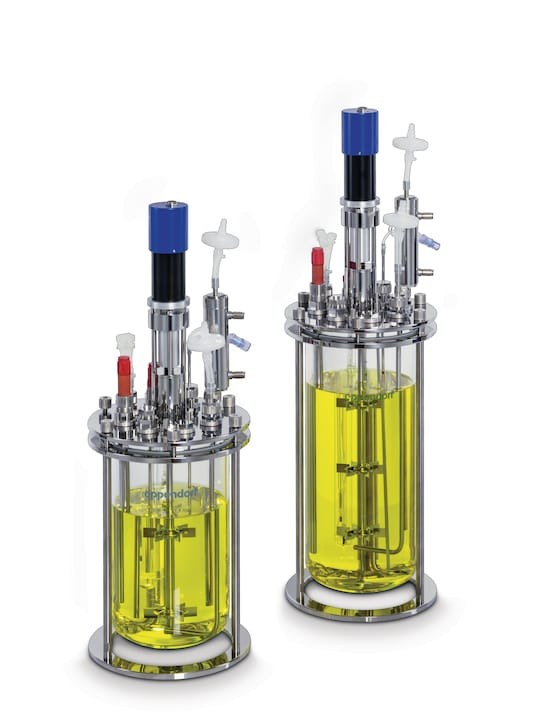
Eppendorf SciVario ® twin Benchtop Bioreactors for Microbiology
Eppendorf SciVario ® twin Benchtop Bioreactors for Microbiology — Bioreactors & fermenters.
The SciVario® twin is a benchtop bioreactor control system for parallel operation of two bioreactors, glass or single-use, with working volumes from 60 mL to 40 L. This microbiology configuration pairs the twin controller with an autoclavable 2.5 L glass vessel (model 76DR03F) featuring a 17-port stainless steel head plate. It is used for parallel fermentation runs requiring independent control of two cultures.
Full specifications
Description
Construction and positioning
- The SciVario twin is a modular control unit built around a bay-drawer architecture, allowing drive and I/O modules to be exchanged.
- This microbiology package is defined by the 2.5 L autoclavable glass vessel (model 76DR03F) with a single-wall 3 L bioreactor DR03 and a 17-port stainless steel head plate.
- The controller supports two bioreactors simultaneously; the vessel kit described here is one of the two positions.
- Drive variants available for the series are FI30, MD30, MD40, TB200 and TB200 high; the specific drive fitted to this package is not stated in the supplied facts.
Working range and media
- The control system covers a working volume range of 60 mL to 40 L across the series; this package's vessel is 2.5 L working volume.
- Both glass and single-use bioreactors can be connected to the same controller, but this configuration is the autoclavable glass variant.
- No digitized curve points or performance maps were supplied, so behavior under load cannot be quantified here.
Installation and operation
- The vessel is autoclavable; sterilization is performed separately before installation on the controller.
- The 17-port head plate provides access for sensors, sampling, gas lines and additions; port assignments are not detailed in the supplied digests.
- The modular bay-drawer system allows the controller to be reconfigured for different drive or I/O needs.
Integration & Operating Notes
The 2.5 L glass vessel is autoclavable, not in-situ sterilizable. Sterilization must be completed as a separate step before the vessel is mounted on the controller; operating without prior autoclaving risks contamination of the culture.
The stainless steel head plate provides 17 ports. The allocation of these ports to sensors, sampling, gas inlet/outlet and addition lines is not specified in the supplied document; confirm port assignments against the vessel kit documentation before planning the run.
The SciVario twin controls two bioreactors simultaneously, glass or single-use. Each position requires its own vessel and sensor set; the controller's bay-drawer modules define the available drive and I/O configuration, which must be matched to the vessel type used.
Series drive variants are FI30, MD30, MD40, TB200 and TB200 high. The supplied facts do not state which drive is fitted to this microbiology package; verify the drive against the 2.5 L vessel's agitation requirements before ordering or commissioning.
Selection & Integration Q&A
Choose this package for autoclavable glass fermentation at 2.5 L working volume. The controller itself spans 60 mL to 40 L and accepts single-use bioreactors, so select a single-use configuration when disposable vessels are required, or a larger glass vessel when higher working volume is needed.
Confirm the fitted drive variant (FI30, MD30, MD40, TB200 or TB200 high) matches the agitation needs of the 2.5 L vessel, and map the 17 head-plate ports to sensors, gas lines and additions. The supplied documents do not specify the drive or port assignments for this package.
The vessel is autoclavable and must be sterilized separately before mounting on the controller; it is not in-situ sterilizable. The controller is a benchtop unit with a modular bay-drawer system, so bench space and module access must be planned for two bioreactor positions.
The supplied documents do not list a maintenance schedule, service intervals, or consumables included in delivery. Plan for vessel autoclaving before each run and confirm spare head-plate ports, sensor fittings and drive modules against the vessel kit documentation, as these are not detailed in the available facts.