
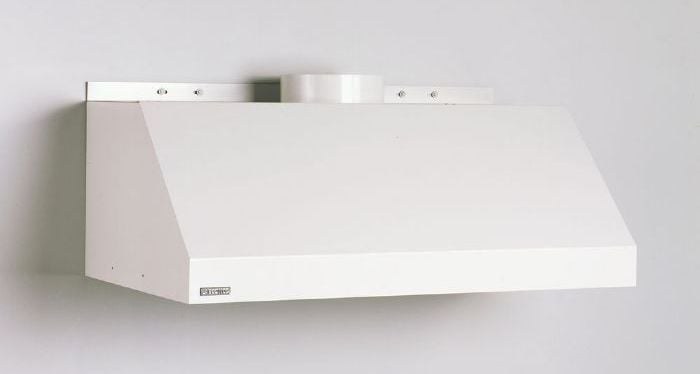
Labconco Canopy Hoods
Labconco Canopy Hoods — Fume hoods.
The Labconco Canopy Hood is a wall-mounted, epoxy-coated capture canopy with an integral baffle, supplied in 4-foot (4799000) and 6-foot (7099000) configurations. It is a special-purpose hood for heat, steam, or odor-generating apparatus such as tissue processors, steam baths, and open Kjeldahls, and is rated on a theoretical face 1 ft below the hood.
Full specifications
| Airflow | 785 CFM |
| Width | 4 ft |
| Sash stop height mfr | 18.0 in |
| Work surface depth mfr | 1.25 in |
| Overall width (A) mfr | 72.0 in |
| Dimension B mfr | 67.5 in |
| Dimension C mfr | 32.5 in |
| Dimension D mfr | 36.0 in |
| Electrical requirements mfr | 208 A |
Description
Construction and series positioning
- Epoxy-coated steel superstructure with an integral baffle that raises slot velocities and perimeter capture; baffle support brackets are stainless steel, the only non-epoxy parts.
- Two sizes only: 4-foot (4799000 / 47990) and 6-foot (7099000 / 70990). This is a canopy, not an enclosed fume hood — there is no sash enclosure, only an 18.0 in sash stop height and a 1.25 in work surface depth detail.
- No electrical components are part of the base unit; the hood is a passive capture structure that depends entirely on the facility exhaust system.
Behavior under load
- Performance is defined by static pressure loss at airflow, not by a single CFM rating: the 4-foot unit must not exceed 0.64 in at 907 CFM or 1.25 in at 1,360 CFM; the 6-foot unit must not exceed 0.90 in at 1,289 CFM or 1.65 in at 1,934 CFM. The matched airflow figure of 785 CFM (1,333.7 m³/h) applies to the 4-foot width and should be read together with those pressure limits when sizing the blower.
- Capture efficiency is referenced to a theoretical face 1 ft below the hood. Efficiency falls when apparatus sits below that plane and rises as apparatus enters inside the 1-ft face, so the working height of the apparatus is a performance variable, not a fixed property of the hood.
Installation and operation
- Recommended mounting: back against a wall, front supported from the ceiling by 3/8 in threaded rod; wire or cable may be substituted where rod is impractical.
- No controls, sensors, or interlocks are supplied — airflow verification and alarm logic must come from the exhaust system.
- Not supplied with explosion-proof components; flammable or explosive atmospheres require a certified explosion-proof configuration installed to applicable electrical codes.
Integration & Operating Notes
The hood is not self-supporting at the front: the back bears on the wall and the front hangs from 3/8 in threaded rod anchored to the ceiling, with wire or cable permitted as a substitute. Structural planning must include ceiling anchor points rated for the hood and any apparatus below it.
Face velocity and static pressure performance are based on a theoretical hood face 1 ft below the hood. Apparatus placed lower than that plane loses capture efficiency, while apparatus brought inside the 1-ft face improves it, so bench and apparatus height must be fixed before the exhaust is balanced.
The standard Canopy Hood ships without explosion-proof electrical components. Flammable or explosive atmospheres require an explosion-proof configuration fitted and installed per all pertinent electrical codes; the base unit must not be placed in a classified location.
The carton contains the hood assembly and the instruction manual only. Check for transit damage before discarding packaging so that freight claims can be raised; no blower, ductwork, or mounting hardware is included in the shipment.
Selection & Integration Q&A
Pick the 4-foot (4799000) when the apparatus footprint fits its 4 ft width and the exhaust can deliver 907–1,360 CFM at up to 0.64–1.25 in static loss. Move to the 6-foot (7099000) for larger or multiple apparatus, which needs 1,289–1,934 CFM at 0.90–1.65 in.
The hood is passive, so the blower must be sized against the published static pressure limits at airflow: for the 4-foot unit, no more than 0.64 in at 907 CFM and 1.25 in at 1,360 CFM. Ductwork and fan curves must meet these points, since the hood provides no fan or damper.
Mount the back against a wall and support the front from the ceiling with 3/8 in threaded rod (wire or cable acceptable). Keep apparatus within 1 ft of the hood face for rated capture, and do not install in flammable or explosive atmospheres without an explosion-proof configuration.
The shipment contains only the hood assembly and the instruction manual. Exhaust blower, ductwork, ceiling anchors and 3/8 in threaded rod, and any electrical or alarm components are not included and must be specified separately; there is no scheduled maintenance interval stated in the manual.