
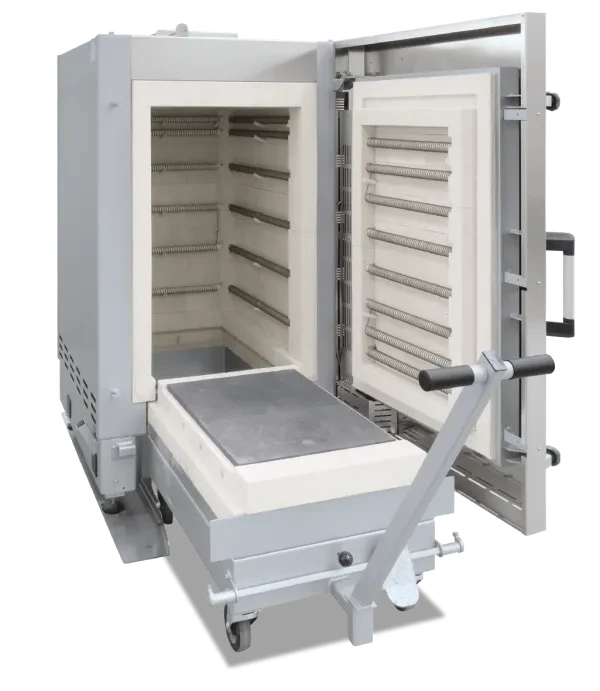
Nabertherm NW 440
Nabertherm NW 440 — Prozesse Unter Schutzgasen.
The NW 440 is a 450-litre chamber furnace with a 600 × 750 × 1000 mm working volume and a maximum temperature of 1300 °C, the largest of the listed NW 200 and NW 300 siblings. It is a 3-phase unit weighing 850 kg, intended for heat-treatment processes under protective gas where the larger chamber is required.
Full specifications
| Chamber volume | 450 l |
| Chamber volume | 450 l |
| Chamber volume | 450 l |
| Electrical connection | 3-phase |
| Electrical connection | 3-phase |
| Electrical connection | 3-phase |
| Heating power | 30 watt |
| Heating power | 30 watt |
| Nominal power | 30 kW |
| Inner dimensions (W × D × H) mfr | 470 × 580 × 550 mm |
| Outer dimensions (W × D × H) mfr | 1070 × 1410 × 1830 mm |
| Weight | 850 kg |
| Weight | 850 kg |
| Weight | 850 kg |
| Charging mfr | On a bogie |
| Max temperature | 1300 °C |
| Max temperature | 1300 °C |
| Max temperature | 1300 °C |
| Article no. mfr | 631001337 |
Description
Construction and series positioning
- The NW 440 is the largest of the three listed chamber furnaces, with a 450 l chamber (600 mm wide × 750 mm deep × 1000 mm high) against the smaller NW 200 and NW 300 siblings.
- Outer dimensions are 1070 × 1410 × 1830 mm (W × D × H); the 850 kg weight and 1830 mm height require floor-level access and a suitably rated installation base.
- The series is described as chamber furnaces with drawer bottom or bogie; the NW 440 is a stationary chamber unit, not a bogie variant.
Thermal behaviour
- Maximum temperature is 1300 °C. No heating-curve or uniformity data is available for this model; the curve_points set is empty, so no heat-up rate or recovery behaviour is stated here.
- The matched electrical entry lists 3-phase connection and a heating power of 30 W. That power figure is inconsistent with a 450 l furnace at 1300 °C and is therefore not used as a rating in this card; verify the connected load from the nameplate before sizing the supply.
Control and process media
- The category path places the model under processes under protective gas. The attached controller digest covers the Nabertherm 500 series and MyNabertherm app, including process-data storage and AMS2750F instrumentation types, but it does not print model-specific wiring or gas-train details for the NW 440.
- No certificates or application notes are supplied for this model; compliance and gas-safety documentation must be requested separately.
Integration & Operating Notes
The matched specification lists 30 W heating power for a 450 l, 1300 °C chamber, which is not physically consistent. Do not size cables, contactors or fuses from that figure; read the actual connected load and current per phase from the unit nameplate and the wiring diagram supplied with the furnace.
The model is categorized under processes under protective gas, but no gas-flow, purge-pressure or atmosphere-composition data is supplied in the verified facts. Specify the gas supply, purge sequence and exhaust path as a separate engineering item and confirm them with the furnace manufacturer before commissioning.
The attached process-control digest covers the 500 series controllers and MyNabertherm app, including process-data storage and AMS2750F instrumentation types, but it prints no model-specific terminal assignments. Obtain the NW 440 wiring and interface drawing to map thermocouple, interlock and recorder signals.
Selection & Integration Q&A
Pick the NW 440 when the workload needs the 450 l chamber (600 × 750 × 1000 mm) and the 1300 °C ceiling; the NW 200 and NW 300 offer smaller chambers. Choose a smaller sibling when batch size fits and floor space or the 850 kg installation weight is the constraint.
A 3-phase supply sized from the nameplate connected load (the matched 30 W figure is not usable), plus a controller from the documented 500 series or MyNabertherm app if process-data storage or AMS2750F instrumentation is required. Gas-train components for protective-gas operation are separate.
The verified facts list no included accessories, cables, recorder or gas-train hardware, and no maintenance intervals. Controller, recorder and protective-gas equipment must be ordered separately, and a service schedule for elements and insulation should be agreed with the manufacturer at commissioning.