
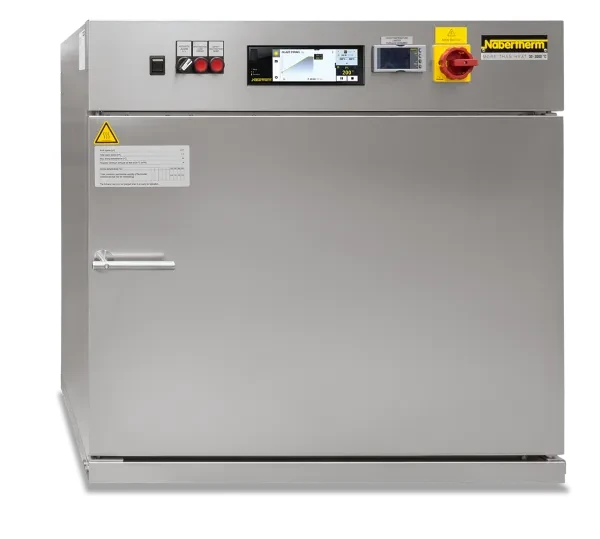
Nabertherm TR 120 LS
Nabertherm TR 120 LS — Prozesse Unter Luft.
The TR 120 LS is a 120-litre forced-convection oven with LS safety technology per EN 1539, rated to 260 °C and drawing 6.7 kW from a 3-phase supply. Its 650 × 390 × 500 mm chamber and 35-unit exhaust flow distinguish it from non-LS TR siblings for solvent-laden drying processes.
Full specifications
| Chamber volume | 120 l |
| Chamber volume | 120 l |
| Chamber volume | 120 l |
| Electrical connection | 3-phase |
| Electrical connection | 3-phase |
| Electrical connection | 3-phase |
| Nominal power | 6.7 kW |
| Exhaust air flow rate mfr | 35 |
| Inner dimensions (W × D × H) mfr | 650 × 390 × 500 mm |
| Outer dimensions (W × D × H) mfr | 900 × 820 × 870 mm |
| Weight | 140 kg |
| Weight | 140 kg |
| Weight | 140 kg |
| Max temperature | 260 °C |
| Max temperature | 260 °C |
| Max temperature | 260 °C |
Description
Construction and series positioning
- Chamber volume 120 l; inner dimensions 650 × 390 × 500 mm (W × D × H); outer dimensions 900 × 820 × 870 mm; weight 140 kg.
- The LS designation marks safety technology per EN 1539, intended for processes releasing flammable solvents; the base TR series reaches up to 300 °C, while this LS variant is limited to 260 °C.
- Electrical connection is 3-phase with 6.7 kW nominal power.
Process behaviour and solvent limits
- Maximum solvent charge is temperature-dependent: 13.6 g at the lowest listed temperature, falling to 7.8 g, 4.9 g, 3.8 g and 3.7 g at successively higher temperatures. The exact temperature labels are not printed in the verified facts, so the charge must be read from the unit's rating plate or manual table before each process.
- Exhaust air flow rate is 35 (unit not stated in the facts).
- No digitized curve points are available; behaviour under load cannot be characterized beyond the stated limits.
Control and documentation
- The controller documentation covers the 500 series and MyNabertherm app, process-data storage, and AMS2750F instrumentation types, but no furnace-specific settings are printed.
- The fiber-optics catalog confirms LS variants exist for TR and KTR models; no TR 120 LS-specific installation instructions are included in the supplied digests.
Integration & Operating Notes
The maximum solvent mass falls from 13.6 g to 3.7 g as temperature rises across the listed points. Exceeding the applicable limit for the set temperature defeats the EN 1539 safety concept. Because the temperature labels are not printed in the verified facts, the operator must obtain the full table from the manual before charging any solvent.
The LS safety configuration limits maximum temperature to 260 °C, below the 300 °C ceiling of the standard TR series. Processes requiring higher temperatures need a non-LS TR model or a different series; the controller setpoint must be kept within the 260 °C limit.
Selection & Integration Q&A
Choose the LS when the process releases flammable solvents and must comply with EN 1539; accept the 260 °C ceiling instead of the standard TR series' 300 °C. For solvent-free drying above 260 °C, a non-LS TR model is the correct choice.
The oven draws 6.7 kW from a 3-phase supply; the feeder, protective device and isolator must be rated for that load. The verified facts state no voltage or current, so the rating plate and the manual's electrical section must be consulted before ordering cable and switchgear.
The exhaust air flow rate of 35 is the reference for solvent discharge; ducting restrictions or a poorly ventilated room reduce it and invalidate the EN 1539 margin. The solvent charge must also be matched to the set temperature using the full limit table, which is not printed in the verified facts.
The exhaust path and the posted solvent limit table need periodic verification; the 500-series controller and MyNabertherm app support process-data storage for documentation. Cables, switchgear and any recorder or AMS2750F instrumentation are not part of the base delivery and must be specified separately.