
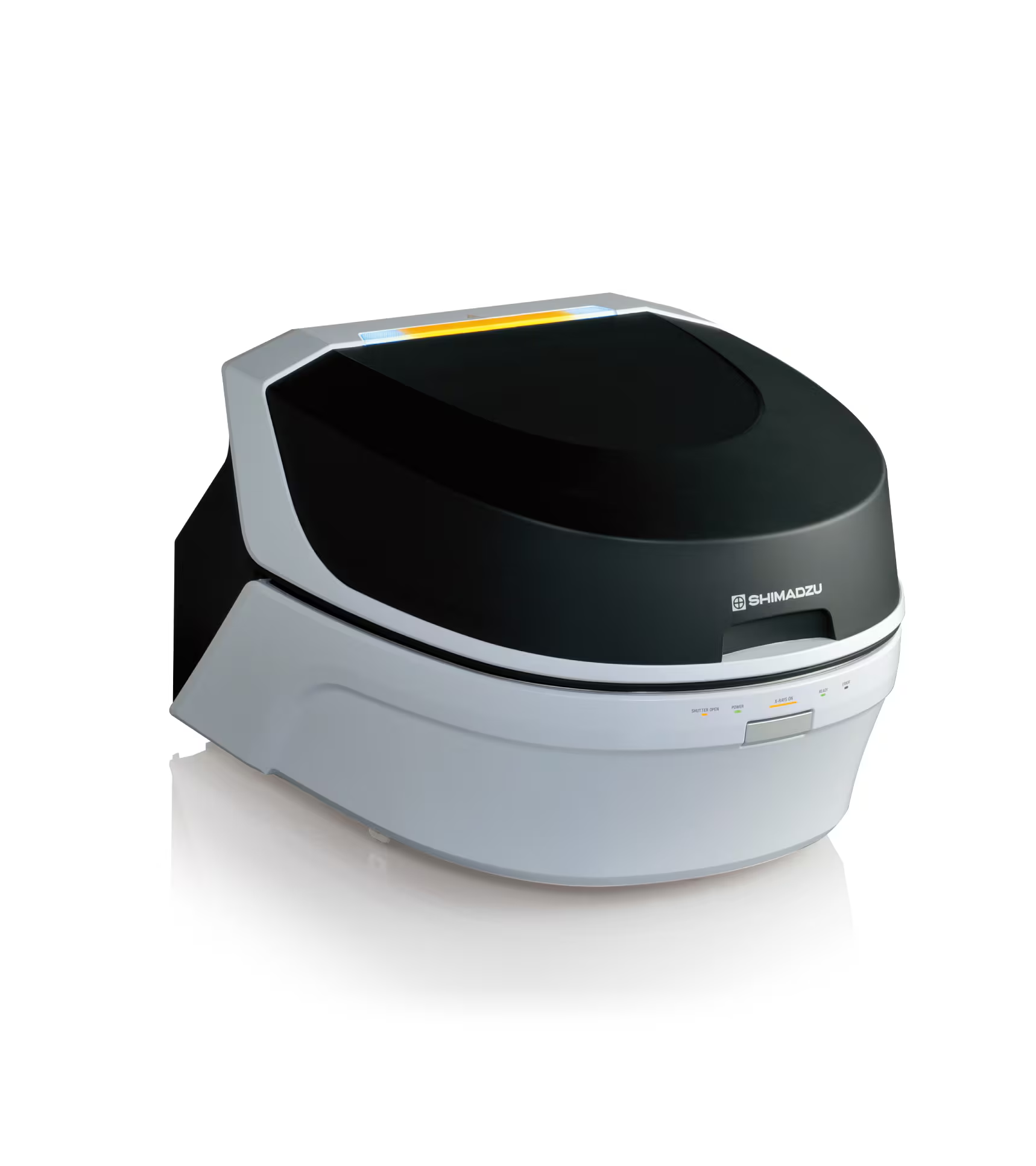
Shimadzu EDX-7000/8000/8100
Shimadzu EDX-7000/8000/8100 — Elemental analyzers.
The Shimadzu EDX-7000/8000/8100 is a series of energy-dispersive X-ray fluorescence (EDXRF) elemental analyzers. These instruments are used for non-destructive elemental analysis of solid, powder, and liquid samples, with the 8000/8100 models offering enhanced sensitivity and mapping capabilities. They are typically employed in quality control, environmental monitoring, and materials research.
Full specifications
Description
Construction and Architecture
- The EDX-7000/8000/8100 series are benchtop EDXRF spectrometers featuring an X-ray tube, a primary beam filter, a sample chamber, and a silicon drift detector (SDD).
- The 7000 model is the base configuration, while the 8000 and 8100 models include additional features such as a higher-power X-ray tube and a larger sample chamber for automated sample handling.
- The 8100 model further includes a mapping function for elemental distribution analysis.
Behavior Under Load and in Different Modes
- The instruments operate under vacuum or helium purge to reduce atmospheric absorption of low-energy X-rays, enabling detection of light elements (e.g., Na, Mg).
- The X-ray tube power is typically 50 W for the 7000 and 100 W for the 8000/8100, allowing for shorter measurement times or improved detection limits.
- The SDD detector provides high count rates and energy resolution, typically around 135 eV at Mn Kα.
Installation, Connection, Control, and Operation
- The instruments require a stable power supply (100-240 V AC, 50/60 Hz) and a source of compressed air or nitrogen for the vacuum/purge system.
- Control and data acquisition are performed via a dedicated PC running Shimadzu's PCEDX software, connected through a USB or Ethernet interface.
- The sample chamber can accommodate samples up to 300 mm x 300 mm (for 8000/8100) and offers automated sample changers for high-throughput analysis.
Integration & Operating Notes
The X-ray generator and vacuum pumps are sensitive to voltage fluctuations and harmonics. Ensure the supply meets the specified tolerances (e.g., ±10% voltage, <5% THD) to avoid measurement drift or equipment damage. An uninterruptible power supply (UPS) is recommended for critical applications.
The instrument is equipped with a safety interlock that automatically closes the X-ray shutter when the sample chamber door is opened. Do not bypass this interlock; ensure the door is fully closed before initiating X-ray exposure. The interlock status is monitored by the software and will prevent operation if triggered.
For optimal results, samples should be homogeneous and flat, with a thickness sufficient to be infinitely thick for the analyte of interest (typically >1 mm for most elements). Powder samples should be pressed into pellets or placed in sample cups with thin film windows. Liquid samples require special holders and may need to be analyzed under helium purge.
Selection & Integration Q&A
Choose the EDX-7000 for routine elemental analysis with moderate sensitivity requirements and smaller sample sizes. The 8000 offers higher X-ray power (100 W vs 50 W) for better detection limits and faster measurements, while the 8100 adds elemental mapping for heterogeneous samples. Select based on required sensitivity, sample throughput, and need for spatial resolution.
The instrument requires a vacuum pump (oil-sealed or dry) capable of achieving <10 Pa, and a purge gas (helium or nitrogen) with purity ≥99.999% for light element analysis. The gas supply should be regulated to 0.1-0.2 MPa and connected via a 6 mm OD tube. Ensure proper exhaust ventilation for the vacuum pump.
Operate the instrument at 15-30°C and 20-80% relative humidity (non-condensing). Avoid rapid temperature fluctuations (±2°C per hour) to prevent drift. The instrument should be installed away from direct sunlight, corrosive gases, and strong magnetic fields. Allow at least 30 cm clearance around the unit for ventilation.
The base package includes the spectrometer, PCEDX software, and a standard sample holder. Not included: vacuum pump oil (for oil-sealed pumps), helium/nitrogen gas regulators, sample cups and thin-film windows, pressed pellet dies, and a UPS. A regular maintenance kit (part number 123-45678) containing X-ray window films and O-rings is recommended for annual service.