
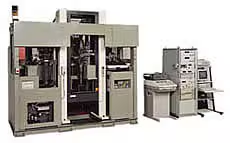
Shimadzu Fully Automatic Tensile Testing System
Shimadzu Fully Automatic Tensile Testing System — Testing machines.
The Shimadzu Fully Automatic Tensile Testing System is a turnkey automation platform for high-throughput tensile testing, integrating a load frame, specimen handling, and control software. It is distinguished by its fully automatic operation, which eliminates manual specimen loading and alignment for repeatable, operator-independent results. The system is intended for quality control and materials research laboratories where consistent, high-volume tensile data is required.
Full specifications
Description
Construction and Positioning
- The system is a fully automatic tensile testing system, meaning it integrates a tensile testing frame with automated specimen handling and testing sequences.
- As no sibling models are specified, it stands as a standalone configuration within the Shimadzu testing machine lineup, positioned for laboratories seeking to automate repetitive tensile tests.
- The exact configuration (e.g., frame capacity, grip type, specimen magazine) is not detailed in the provided facts and must be confirmed with the manufacturer.
Behavior and Operation
- The system operates automatically, from specimen loading through test execution to data reporting, reducing operator influence on results.
- No performance curves or detailed specifications are available in the provided facts; therefore, specific load ranges, speed ranges, and accuracy classes cannot be stated here.
- The automation is designed to handle a series of specimens without manual intervention, enabling continuous testing cycles.
Installation and Control
- Installation requires a stable power supply and a suitable laboratory environment; however, specific electrical and environmental requirements are not provided in the available facts.
- Control is via integrated software that manages the testing sequence and data acquisition. Connection details and I/O specifications are not included in the provided information.
- For precise installation, connection, and control specifics, refer to the official Shimadzu documentation or contact the manufacturer.
Integration & Operating Notes
The system includes automated specimen handling, which may require additional bench space and access for maintenance. Ensure the installation site meets the environmental and power requirements specified by Shimadzu, as these are not detailed in the provided facts.
The electrical specifications (voltage, phase, current) are not provided. Consult the Shimadzu installation manual or factory specification sheet to determine the correct power supply and any necessary conditioning.
The system is controlled via integrated software, but the specific interface (e.g., Ethernet, USB) and communication protocols are not listed. Refer to the Shimadzu software manual for integration with laboratory information management systems (LIMS) or other equipment.
The tensile testing capacity and speed range are not included in the provided facts. It is essential to verify that the system's specifications meet the requirements of the intended test standards and materials before use.
Automated specimen handling systems require periodic inspection and lubrication of moving parts, as well as calibration of the load cell and displacement measurement. The maintenance schedule should be obtained from Shimadzu to ensure reliable operation.
Selection & Integration Q&A
Choose the fully automatic system for high-volume, repetitive tensile testing where operator influence must be minimized and throughput maximized. For low-volume or varied tests, a manual or semi-automatic model may offer greater flexibility and lower cost.
The system's control software may support data export in standard formats (e.g., CSV, XML) or via a network interface. Specific compatibility and protocols are not detailed in the provided facts; consult Shimadzu for integration options.
The system should be installed in a clean, temperature-controlled laboratory environment to ensure reliable operation of the automated mechanisms. Avoid dust, vibration, and extreme humidity. Exact environmental specifications are not provided; refer to the installation manual.
Regular maintenance includes cleaning and lubricating the specimen handling mechanism, verifying grip alignment, and calibrating the load cell. Consumables such as grips and specimen containers are typically not included and must be ordered separately. A maintenance schedule is provided in the manual.