
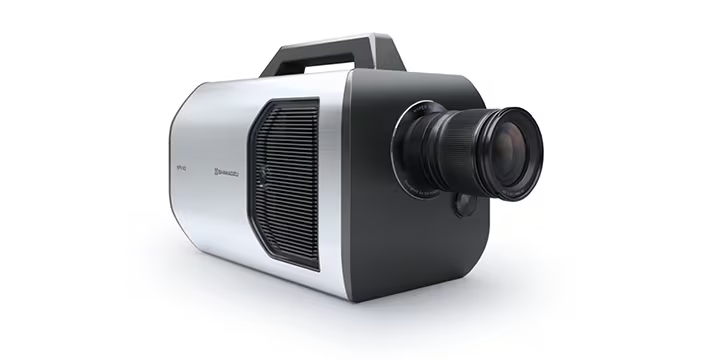
Shimadzu Hyper Vision HPV X3
Shimadzu Hyper Vision HPV X3 — Testing machines.
The Hyper Vision HPV X3 is a high-speed video camera with a Nikon F-mount and a 30 × 23 mm FTCMOS3 sensor, capturing up to 256 frames at 20 Mfps with a fixed ~25 ns exposure. It records at 628 × 480 pixels (monochrome, 10-bit) and supports internal, external, and continuous triggering, with 5 ns time resolution on trigger inputs. Designed for transient event analysis in industrial testing, it synchronizes with a second camera for stereo or dual-view recording.
Full specifications
| Image sensor resolution mfr | 300,000 pixels (HPV-X3, new FTCMOS3 sensor) |
| Image sensor resolution (previous sensor) mfr | 100,000 pixels (old sensor, comparison) |
| Maximum recording speed mfr | 20 Mfps (HPV-X3, burst method) |
| Frame synchronization capacity mfr | 256 frames (HPV-X3, external input) |
| Exposure timing accuracy mfr | 5 nsec (HPV-X3, external timing signal) |
| Timing accuracy (previous model) mfr | 10 nsec (improved from 10 nsec to 5 nsec) |
Description
Construction and positioning
- The HPV X3 is a standalone high-speed camera head with a Nikon F-mount lens interface and a large-format FTCMOS3 sensor (approx. 30 × 23 mm, 48 µm pixels). - The monochrome 10-bit sensor and dedicated 10-bit data format prioritize light sensitivity and dynamic range over color, suiting high-frame-rate imaging where illumination is limited. ### Behavior under load and in different modes
- At the maximum 20 Mfps, exposure is fixed at approximately 25 ns and recording capacity is 256 frames; at lower speeds (60 fps to 10 Mfps), the camera trades frame rate for longer exposure and potentially different recording durations. - Three recording modes are available: internal trigger (camera initiates), external trigger (event-driven via TRIG/STANDBY inputs), and continuous trigger (repetitive capture). - Trigger point can be set to any frame from the second onward, allowing pre-trigger buffering so events before the trigger are retained. - Two cameras can be synchronized for simultaneous recording, and a frame synchronization (F.SYNC) signal with 5 ns resolution supports precise timing alignment. ### Installation, connection, and control
- The camera connects via a single 1000Base-T Ethernet port for control and data transfer; an external monitor output is provided for local viewing. - External trigger inputs (TRIG, STANDBY) accept TTL 5 V or contact closure, with selectable polarity and 5 ns time resolution. - Optional outputs (two channels) can signal exposure start or trigger detection for integration with other equipment. - Data can be stored in a dedicated 10-bit format or exported as BMP, AVI, JPEG, or TIFF (8-bit and 16-bit).
Integration & Operating Notes
The TRIG and STANDBY inputs are specified for TTL level (5 V) or contact closure. Applying 24 V industrial signals directly will damage the input circuitry; use level shifting or opto-isolation. Polarity is selectable, so verify configuration before connecting.
When synchronizing two cameras, the F.SYNC signal (TTL 5 V, 5 ns resolution) must be distributed with matched cable lengths to avoid skew. Both cameras must be set to the same frame rate and trigger mode; otherwise, frame alignment may be lost.
The single Ethernet port supports 1000Base-T. Using a slower network or a non-dedicated switch may limit transfer speed and increase download time for 256-frame recordings. A direct connection or isolated VLAN is recommended.
Selection & Integration Q&A
Choose the HPV X3 when you need 20 Mfps capture at 628 × 480 monochrome with a large 30 × 23 mm sensor and Nikon F-mount flexibility. If color imaging or higher resolution at lower frame rates is required, consider other models; the X3 prioritizes frame rate and light sensitivity.
External trigger inputs (TRIG, STANDBY) accept TTL 5 V or contact closure with selectable polarity and 5 ns resolution. For dual-camera sync, distribute F.SYNC (TTL 5 V) with matched cables and configure both cameras identically. Optional outputs can signal exposure or trigger events to other devices.