
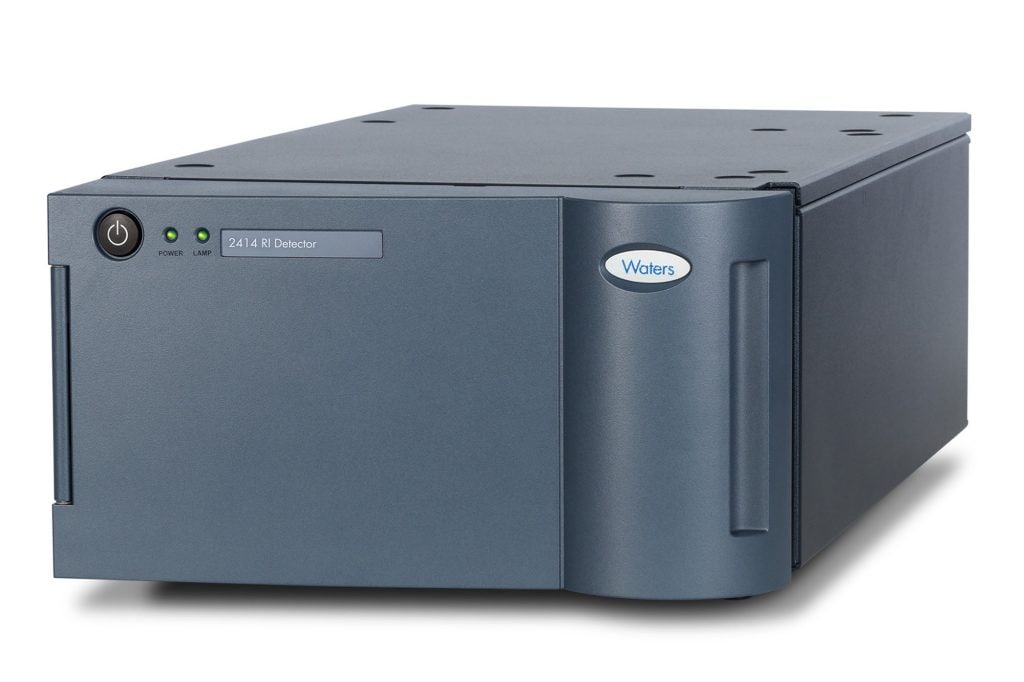
Waters 2414 Refractive Index Detector (RID)
Waters 2414 Refractive Index Detector (RID) — Chromatography detectors.
The Waters 2414 Refractive Index Detector is a dual-angle, thermostatted RI detector with a 10 µL fused-quartz flow cell and an 870 nm LED source. It covers an RI range of 1.00–1.75 RIU and a measurement range down to 7.0 × 10⁻⁹ RIU, with noise of ±1.5 × 10⁻⁹ RIU under standard conditions. It serves as a concentration detector for HPLC of non-UV-absorbing analytes such as sugars, lipids, and polymers.
Full specifications
| Detector type | Refractive Index Detector (RID) |
| Flow rate | 10.0 mL/min |
| Refractive index range mfr | 1.00 to 1.75 RIU |
| Measurement range mfr | 5.0 x 10⁻⁴ RIU to 7.0 x 10⁻⁹ RIU |
| Linear dynamic range mfr | ≤5.0% over ±5.0 x 10⁻⁴ RIU |
| Drift mfr | 2.0 x 10⁻⁷ RIU/hour |
| Filter time constant mfr | 0.0 to 5.0 s (Hamming); 0.0 to 10.0 s (RC) |
| Attenuation settings mfr | 1 to 500 x 10-6 RIU; 1 to 1024 maximum in emulat |
| Temperature control mfr | Internal oven: 30 to 55 °C (86 to 131 °F), ±0.5 |
| Flow cell mfr | Fused quartz |
| Flow cell volume mfr | 10 μL |
| Flow cell pressure limit mfr | ≤100 psi |
| Light source mfr | LED 870 nm |
| Wetted materials mfr | 316 stainless-steel, PTFE, PEEK, quartz |
| Power requirements mfr | 100 to 240 VAC |
| Inputs mfr | Seven event inputs |
| Outputs mfr | Three outputs (2 analog and 1 event) |
| Dimensions mfr | Width: 34.3 cm (13.5 inches); Height: 20.8 cm (8 |
| Operating temperature range mfr | 15 to 40 °C (59 to 104 °F) |
| Weight | 16.3 kg |
| Power consumption | 145 VA |
| Line frequency mfr | 50 to 60 Hz |
| Noise | ±1.5 x 10⁻⁹ RIU (2 s FTC Hamming 1.0 mL/min, 100% H2O); ±3.0 x 10⁻⁹ RIU 410/2410 emulation mode (1 s FTC (RC) 1.0 mL/min, 100% H2O) |
| Operating humidity range mfr | 20% to 80%, non-condensing |
| Audible noise mfr | <58 dBA |
Description
Construction and positioning
- The 2414 is a standalone refractive index detector using an 870 nm LED and a 10 µL fused-quartz flow cell. Wetted materials are 316 stainless steel, PTFE, PEEK, and quartz. - It provides an internal oven for the flow cell (30–55 °C, ±0.5 °C) and can control one external column heater (ambient to 150 °C, ±1.0 °C). ### Performance and modes
- RI range: 1.00–1.75 RIU; measurement range: 5.0 × 10⁻⁴ to 7.0 × 10⁻⁹ RIU; linear dynamic range ≤5.0% over ±5.0 × 10⁻⁴ RIU. - Noise: ±1.5 × 10⁻⁹ RIU (2 s FTC Hamming, 1.0 mL/min, 100% H₂O); ±3.0 × 10⁻⁹ RIU in 410/2410 emulation mode (1 s FTC RC). - Drift: 2.0 × 10⁻⁷ RIU/hour. Filter time constant: 0.0–5.0 s (Hamming) or 0.0–10.0 s (RC). Attenuation: 1–500 × 10⁻⁶ RIU; up to 1024 in emulation mode. - Maximum flow rate: 10.0 mL/min; flow cell pressure limit: ≤100 psi. ### Installation and operation
- Power: 100–240 VAC, 50–60 Hz, 145 VA. Dimensions: 34.3 × 20.8 × 61.0 cm (W × H × D); weight 16.3 kg. - Operating environment: 15–40 °C, 20–80% RH non-condensing; audible noise <58 dBA. - Interfaces: seven event inputs, three outputs (2 analog, 1 event).
Integration & Operating Notes
Exceeding 100 psi at the flow cell can rupture the fused-quartz cell or cause leakage. Install a backpressure regulator downstream if the system pressure upstream of the detector can rise above this limit, and verify that the column and tubing do not impose excessive pressure.
Seven event inputs and three outputs (2 analog, 1 event) allow integration with autosamplers or fraction collectors. Define the polarity and timing in the control method to avoid unintended starts or stops.
RI detection is sensitive to temperature fluctuations; operate within the specified range and avoid drafts or direct sunlight. Condensing humidity can affect optics and electronics.
To prevent salt precipitation or sample residue, flush the 10 µL flow cell with HPLC-grade water or a compatible solvent before shutdown. Do not exceed 100 psi during flushing.
Selection & Integration Q&A
Choose the 2414 for analytes with little or no UV absorbance, such as sugars, lipids, or polymers. It measures bulk refractive index changes and is compatible with aqueous and organic mobile phases. UV detectors offer lower detection limits for chromophoric compounds.
The 2414 accepts flow rates up to 10.0 mL/min and has a 10 µL flow cell with 316 stainless-steel, PTFE, PEEK, and quartz wetted parts. Ensure the system pressure at the detector does not exceed 100 psi; use appropriate tubing and fittings (e.g., 1/16" OD) and a backpressure regulator if needed.
The operating temperature range is 15–40 °C and humidity 20–80% non-condensing. RI detection is temperature-sensitive; the internal oven controls the flow cell to ±0.5 °C, but ambient fluctuations outside the specified range may degrade baseline stability.
Dimensional Drawings & Technical Documentation
Dimensional drawings
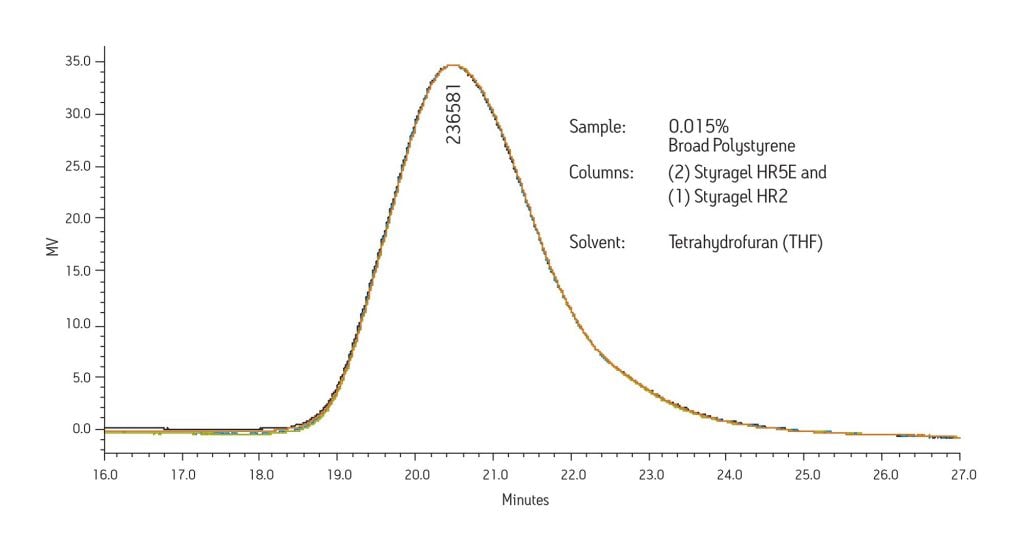
Click drawing to inspect vector dimensions