
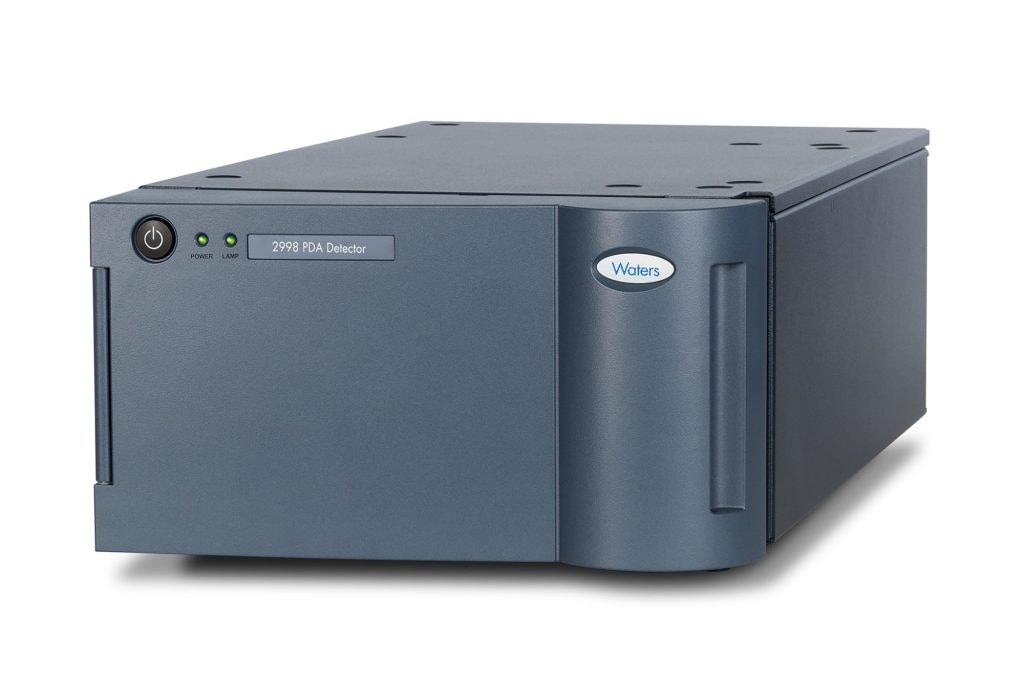
Waters 2998 PDA (Photodiode Array) Detector
Waters 2998 PDA (Photodiode Array) Detector — Chromatography detectors.
The Waters 2998 PDA Detector is a photodiode array detector with a 512-element array and 1.2 nm digital resolution, covering 190 nm upward via a deuterium arc lamp. Its patented TaperSlit flow cell (10 mm path, 8.4 µL) supports up to 1000 psi, distinguishing it for high-resolution spectral acquisition in HPLC systems.
Full specifications
| Detector type | Photodiode Array (PDA) Detector |
| Wavelength range | 190 nm |
| Wavelength accuracy mfr | ±1 nm (via patented Erbium filter) |
| Wavelength repeatability mfr | ±0.1 nm |
| Bandwidth mfr | 1.2 nm |
| Photodiodes mfr | 512 |
| Digital resolution mfr | 1.2 nm/pixel |
| Linearity range mfr | ≤5% at 2.0 AU, propylparaben, 257 nm, dry analyt |
| Drift mfr | ≤1.0 x 10 -3 AU/hour, 254 nm, 2 points/s, 1.0 s, |
| Sampling rate mfr | Up to 80 points/s |
| Light source mfr | Deuterium arc lamp |
| Flow cell design mfr | Patented TaperSlit |
| Flow cell volume mfr | 8.4 μL (analytical flow cell) |
| Pressure limit mfr | 1000 psi (analytical flow cell) |
| Wetted materials mfr | Alliance HPLC/ACQUITY Arc: 316 stainless-steel, |
| Path length mfr | 10 mm (analytical flow cell) |
| Noise | ≤10 x 10 -6 AU peak to peak, 254 nm, 2 points/s, 1.0 s, 30 s segments, bandwidth 3.6 nm (3-pixel bunch), dry analytical flow cell |
| Light source warranty mfr | 2000 hours or one year (whichever comes first) |
Description
Construction and positioning
- The 2998 PDA uses a deuterium arc lamp and a 512-photodiode array with 1.2 nm/pixel digital resolution, providing full-spectrum detection from 190 nm. - Wavelength accuracy is maintained at ±1 nm using a patented erbium filter, with repeatability of ±0.1 nm. - The analytical flow cell features a patented TaperSlit design with 10 mm path length and 8.4 µL volume, rated to 1000 psi. - Wetted materials depend on the HPLC system: 316 stainless steel, fused silica, PEEK, and fluoropolymer for Alliance HPLC/ACQUITY Arc; fluoropolymer, fused silica, MP35N, PEEK, and titanium for ACQUITY Arc Bio. ### Performance under load
- Noise is ≤10 × 10⁻⁶ AU peak-to-peak at 254 nm (2 points/s, 1.0 s, 30 s segments, 3.6 nm bandwidth, dry analytical flow cell). - Drift is ≤1.0 × 10⁻³ AU/hour under the same conditions. - Linearity is within 5% at 2.0 AU (propylparaben, 257 nm, dry analytical flow cell). - Sampling rate reaches up to 80 points/s, enabling high-speed spectral acquisition. - The light source warranty is 2000 hours or one year, whichever comes first, indicating the deuterium lamp is a consumable requiring periodic replacement.
Integration & Operating Notes
Exceeding 1000 psi may rupture the TaperSlit flow cell, causing leaks and invalid results. Ensure system backpressure is monitored and kept below this limit during method development and operation.
The light source warranty is limited to 2000 hours or one year, whichever comes first. Plan lamp replacement accordingly to maintain performance and avoid downtime; lamp degradation affects noise and drift specifications.
For Alliance HPLC/ACQUITY Arc, wetted materials include 316 stainless steel, fused silica, PEEK, and fluoropolymer. For ACQUITY Arc Bio, they include fluoropolymer, fused silica, MP35N, PEEK, and titanium. Ensure mobile phase and sample compatibility with these materials to prevent corrosion or adsorption.
Selection & Integration Q&A
Choose the 2998 PDA for full-spectrum UV/Vis detection with 512 photodiodes and 1.2 nm resolution, ideal for method development and peak purity. For single-wavelength monitoring, a UV/Vis detector may suffice; for mass confirmation, consider an MS detector.
The analytical flow cell is rated to 1000 psi and uses wetted materials matched to your system: 316 stainless steel, PEEK, etc., for Alliance/ACQUITY Arc; or MP35N, titanium, etc., for ACQUITY Arc Bio. Ensure mobile phases are compatible to avoid corrosion.