
No photo available yet
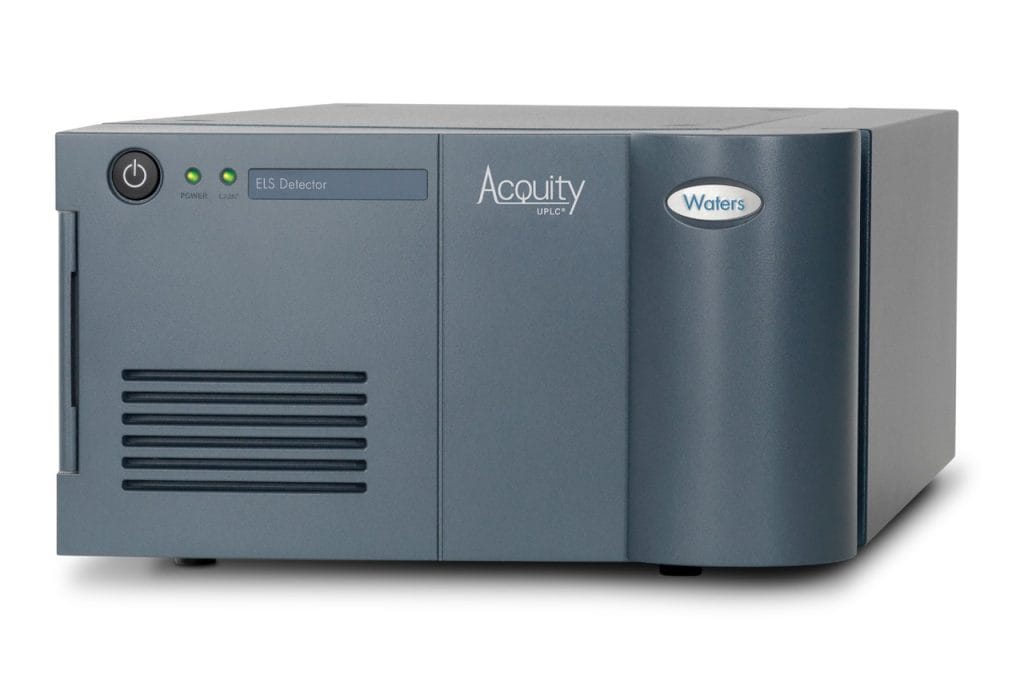
Waters ACQUITY UPLC ELS Detector
Waters ACQUITY UPLC ELS Detector — Chromatography detectors.
The ACQUITY UPLC ELS Detector is a photomultiplier‑tube‑based evaporative light scattering detector with a front‑mounted, snap‑in nebulizer and a heated optics bench held at 50 °C. It supports flow rates up to 2 mL/min and a dynamic range of 0.1–2000 light scattering units full scale, with 0.1 °C temperature control and 0.1 s filter increments. It is used in UPLC systems for sensitive, universal detection of non‑volatile and semi‑volatile analytes.
Full specifications
| Detector type | Photomultiplier tube |
| Flow rate | 2 mL/min |
| Nebulizer mfr | Front mounted, snap-in design |
| Gas mfr | Nitrogen, to be supplied, at least 65 psi |
| Temperature range drift tube mfr | 0.1 °C increments, feedback accuracy to 0.1 °C |
| Filter setting mfr | Hamming, 0 to 5.0 seconds in 0.1 second incremen |
| Optics mfr | Heated optics bench (constant 50 °C) |
| Light source mfr | Tungsten halogen polychromatic, front mounted, p |
| Range mfr | 0.1 to 2000 light scattering units full scale |
| Width mfr | 34.3 cm (13.5 inches) |
| Height mfr | 21.6 cm (8.5 inches) |
| Depth mfr | 51.8 cm (20.4 inches) |
| Voltage range mfr | 0 to 1250 VDC |
Description
Construction and positioning
- Photomultiplier tube detection with a heated optics bench maintained at a constant 50 °C for signal stability. - Front‑mounted, pre‑aligned tungsten halogen light source and snap‑in nebulizer simplify maintenance and alignment. - Nitrogen gas supply required at ≥65 psi; no internal gas generator. - Compact footprint: 34.3 cm (W) × 21.6 cm (H) × 51.8 cm (D). ### Behavior under load
- Flow rate up to 2 mL/min; suitable for analytical‑scale UPLC without post‑column splitting. - Drift tube temperature adjustable in 0.1 °C increments with feedback accuracy to 0.1 °C, enabling fine control of evaporation. - Nebulizer chamber heater 0–100 % and cooler on/off for thermal management. - Filter setting (Hamming) from 0 to 5.0 s in 0.1 s increments to balance noise and peak shape. - Voltage range 0–1250 VDC for PMT gain; range 0.1–2000 light scattering units full scale. ### Installation and operation
- Requires nitrogen supply at ≥65 psi; gas quality and pressure stability directly affect baseline noise. - Front‑mounted nebulizer and light source are user‑installable, reducing service downtime.
Integration & Operating Notes
The detector requires nitrogen at a minimum of 65 psi. Lower pressure or moisture/oil contamination will cause incomplete nebulization, baseline noise, and potential damage to the optics. Install a suitable regulator, filter, and gauge before the instrument.
The photomultiplier tube operates up to 1250 VDC. Ensure the instrument is connected to a stable, grounded power source free of surges; voltage fluctuations can affect gain stability and detector sensitivity.
Allow the drift tube and optics bench to reach set temperatures (optics at 50 °C) and verify nitrogen pressure before injecting samples. Starting acquisition before thermal equilibrium can cause baseline drift and invalid results.
The front‑mounted, snap‑in nebulizer and pre‑aligned light source are designed for user installation. Follow the site’s preventive maintenance schedule for cleaning or replacement; no special tools are required for these items.
Selection & Integration Q&A
Choose ELS for analytes lacking chromophores or fluorophores, or for universal detection of non‑volatile compounds. UV/fluorescence offer higher sensitivity for specific chromophores but require derivatization for many analytes.
The detector needs nitrogen at ≥65 psi. Ensure a regulated, dry supply with adequate flow capacity; pressure drops during operation can cause nebulization instability and baseline noise, affecting detection limits.
The base delivery does not include nitrogen gas supply components (regulator, filter, tubing) or replacement nebulizer/light source. These must be ordered separately; the nebulizer and light source are user‑installable.
Dimensional Drawings & Technical Documentation
Dimensional drawings
Click drawing to inspect vector dimensions