
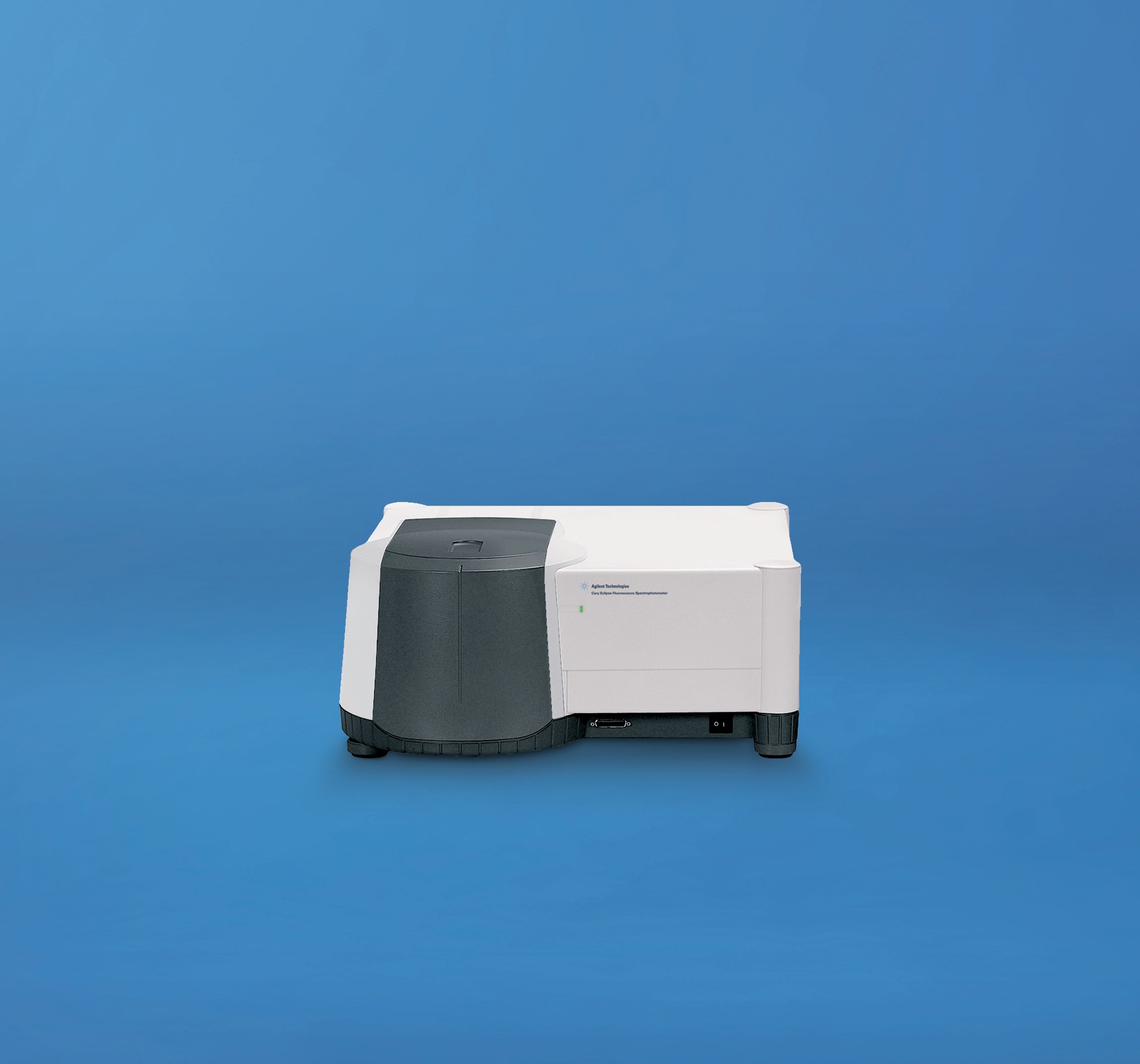
Agilent Technologies Fluorescence Spectrometer, Fluorometer, Cary Eclipse
Agilent Technologies Fluorescence Spectrometer, Fluorometer, Cary Eclipse — Molecular spectroscopy.
The Cary Eclipse is a benchtop fluorescence spectrophotometer using a xenon flash lamp and a red-sensitive photomultiplier extended to 900 nm. It supports fluorescence, phosphorescence, chemiluminescence and bioluminescence modes, with kinetics data collection at 80 points/s and scan speeds to 24000 nm/min. It is used for trace molecular analysis in laboratory spectroscopy workflows.
Full specifications
| Kinetics Data Collection Rate | 80 points/s |
| Minimum Reduced-volume Cuvette Volume | 5 µL |
| Red-sensitive Photomultiplier Sensitivity Extension | 900 nm |
| Scan speed | 24000 nm/min |
| Typical Lamp Life | 10 years |
| Wavelength range scan time mfr | 3 s |
| Xenon flash lamp lifetime mfr | 3 flashes |
| Bench footprint mfr | 600 mm |
Description
Construction and positioning
- Benchtop instrument with a 24-inch footprint, built around a xenon flash lamp source and a red-sensitive photomultiplier detector whose sensitivity extends to 900 nm.
- No sibling models are listed for this series, so the Cary Eclipse stands as the single documented configuration in the supplied facts.
- The flash-lamp architecture is distinct from continuous-wave lamp designs; the brochure cites a typical lamp life of 10 years.
Measurement behavior
- Four collection modes are documented: fluorescence, phosphorescence, chemiluminescence and bioluminescence.
- Kinetics data collection reaches 80 points/s, supporting time-resolved intensity tracking.
- Scan speed reaches 24000 nm/min; a full wavelength-range scan is listed at 3 s.
- Minimum reduced-volume cuvette volume is 5 µL, allowing small-sample measurements.
Installation and operation
- The supplied brochure digest contains no sections or actionable engineering facts on installation, connection, control or operation; those details must be taken from the instrument manual, which was not provided in digest form.
Integration & Operating Notes
The photomultiplier sensitivity extension is specified to 900 nm; measurements planned beyond this wavelength are outside the documented detector range and require a different instrument configuration. Confirm the emission wavelength of the analyte before committing the method.
The typical lamp life is stated as 10 years, which differs from the extra-spec entry listing '3 flashes' for xenon flash lamp lifetime. Because these two figures conflict, neither should be used for a replacement-interval plan without clarification from the manufacturer.
The minimum reduced-volume cuvette volume is 5 µL. Samples prepared below this volume cannot be reliably measured in the reduced-volume configuration, so dilution or a larger cuvette must be planned when sample quantity is limited.
Time-resolved kinetics data collection is limited to 80 points/s. For fast reactions, the sampling interval implied by this rate must be checked against the reaction half-life; slower chemistry is unaffected. No controller or interface details are given in the supplied digests.
Selection & Integration Q&A
No sibling models are documented in the supplied facts, so the Cary Eclipse is the only listed configuration. Choose it when you need fluorescence, phosphorescence, chemiluminescence or bioluminescence modes with detection to 900 nm and 5 µL reduced-volume capability.
The supplied brochure digest contains no actionable facts on cabling, controllers, power supply or cuvette holders. These must be confirmed from the full instrument manual, which was not provided in digest form; do not assume included accessories from the base specification.
Lamp life is stated inconsistently (10 years typical vs '3 flashes'), so no replacement interval can be set from these facts. Consumables and accessories included in base delivery are not documented in the supplied digests and must be confirmed with the manufacturer.