
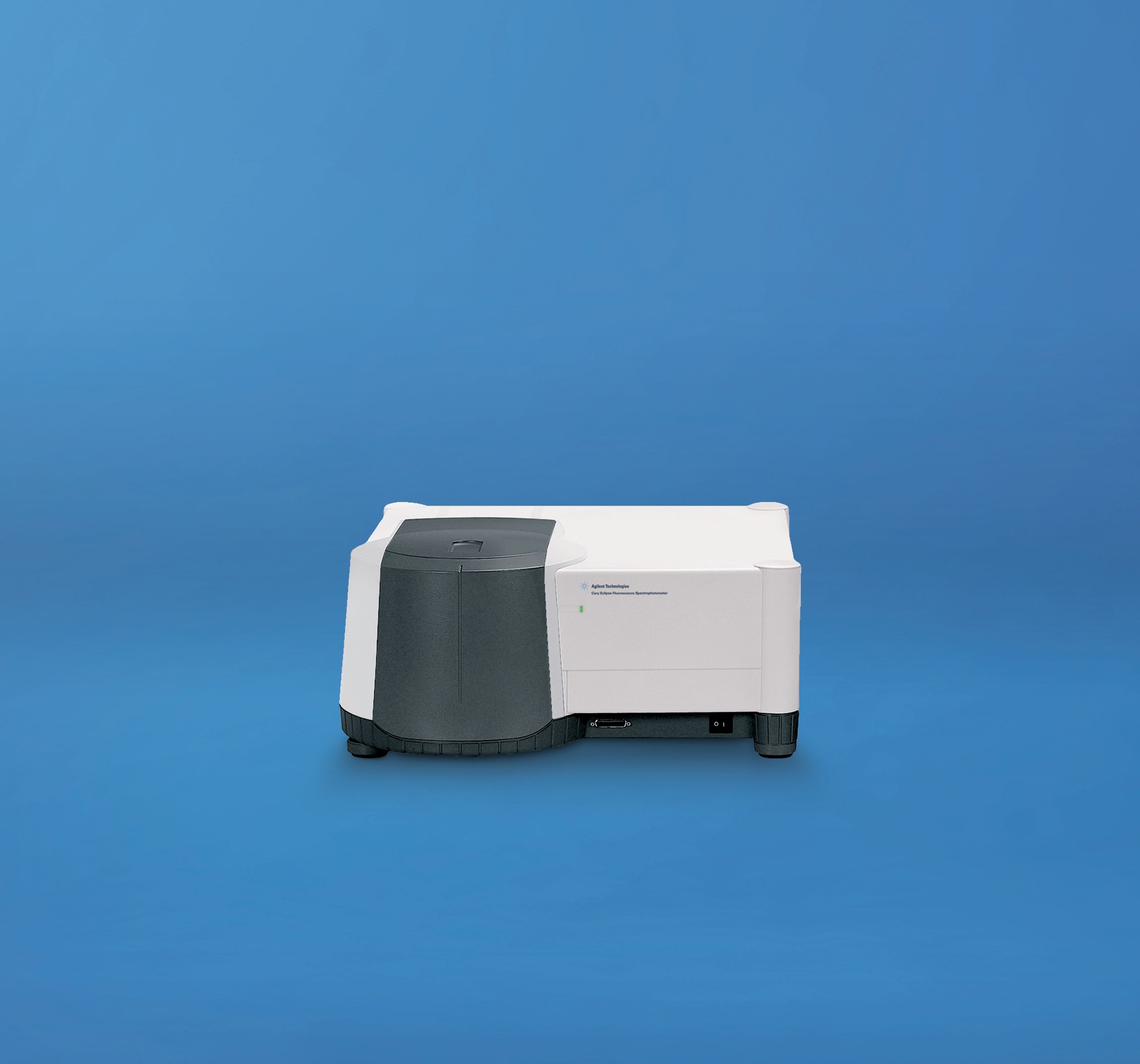
Agilent Technologies Cary Fluorescence Instrumentation
Agilent Technologies Cary Fluorescence Instrumentation — Molecular spectroscopy.
The Cary Eclipse is a benchtop fluorescence spectrophotometer with a 24-inch footprint, offering scan speeds to 24,000 nm/min and kinetics collection at 80 points/s. It supports fluorescence, phosphorescence, chemiluminescence and bioluminescence modes, with a red-sensitive PMT extended to 900 nm. It is used for trace-level molecular spectroscopy in analytical laboratories.
Full specifications
| Kinetics Data Collection Rate | 80 points/s |
| Minimum Reduced-volume Cuvette Volume | 5 µL |
| Red-sensitive Photomultiplier Sensitivity Extension | 900 nm |
| Scan speed | 24000 nm/min |
| Typical Lamp Life | 10 years |
| Wavelength range scan time mfr | 3 s |
| Xenon flash lamp lifetime mfr | 3 flashes |
| Bench footprint mfr | 600 mm |
Description
Construction and series positioning
- Benchtop fluorescence spectrophotometer with a 24-inch bench footprint; the document digest covers the Cary Eclipse family without ordering codes or size variants.
- Sibling models in the supplied list (4200 FlexScan handheld FTIR, 4300 handheld FTIR, 4500 portable FTIR, 5500 compact FTIR) are FTIR instruments; the Cary Eclipse is the fluorescence/phosphorescence/chemiluminescence platform in this comparison set.
- No certificates or applications are listed in the verified facts.
Measurement behavior
- Scan speed is specified at 24,000 nm/min; a separate extra spec lists a 3 s wavelength-range scan time. These are distinct fields and are not reconciled here.
- Kinetics data collection is specified at 80 points/s.
- The red-sensitive photomultiplier sensitivity extension reaches 900 nm.
- Minimum reduced-volume cuvette volume is 5 µL.
- Collection modes named in the brochure digest: fluorescence, phosphorescence, chemiluminescence and bioluminescence.
Lamps and operation
- Typical lamp life is listed as 10 years; a separate extra spec lists Xenon flash lamp lifetime as 3 flashes. These two lamp-life fields are contradictory in kind and are not combined or reconciled here.
- No installation, connection, control or I/O facts are present in the supplied digests; those details cannot be stated.
Integration & Operating Notes
Emission wavelengths beyond the 900 nm extension of the red-sensitive photomultiplier are outside the stated sensitivity range; method development should keep emission collection within the documented range rather than assuming response at longer wavelengths.
The minimum reduced-volume cuvette volume is 5 µL; sample cells smaller than this are not covered by the verified specification, so low-volume methods should be designed at or above this volume.
Selection & Integration Q&A
Choose the Cary Eclipse when the measurement is fluorescence, phosphorescence, chemiluminescence or bioluminescence, with scan speeds to 24,000 nm/min and kinetics at 80 points/s. The 4200/4300/4500/5500 siblings are FTIR instruments for infrared molecular spectroscopy, not fluorescence.
Reduced-volume cuvettes must hold at least 5 µL. Emission collection is specified to 900 nm via the red-sensitive PMT extension; methods requiring response beyond that are outside the stated range. No lamp, power or interface requirements are given in the supplied facts.
No maintenance schedule, service interval, cable or consumable list is present in the verified facts or the brochure digest. Lamp replacement cannot be scheduled because the two lamp-life fields conflict; confirm lamp type, spares and accessories with the supplier.