
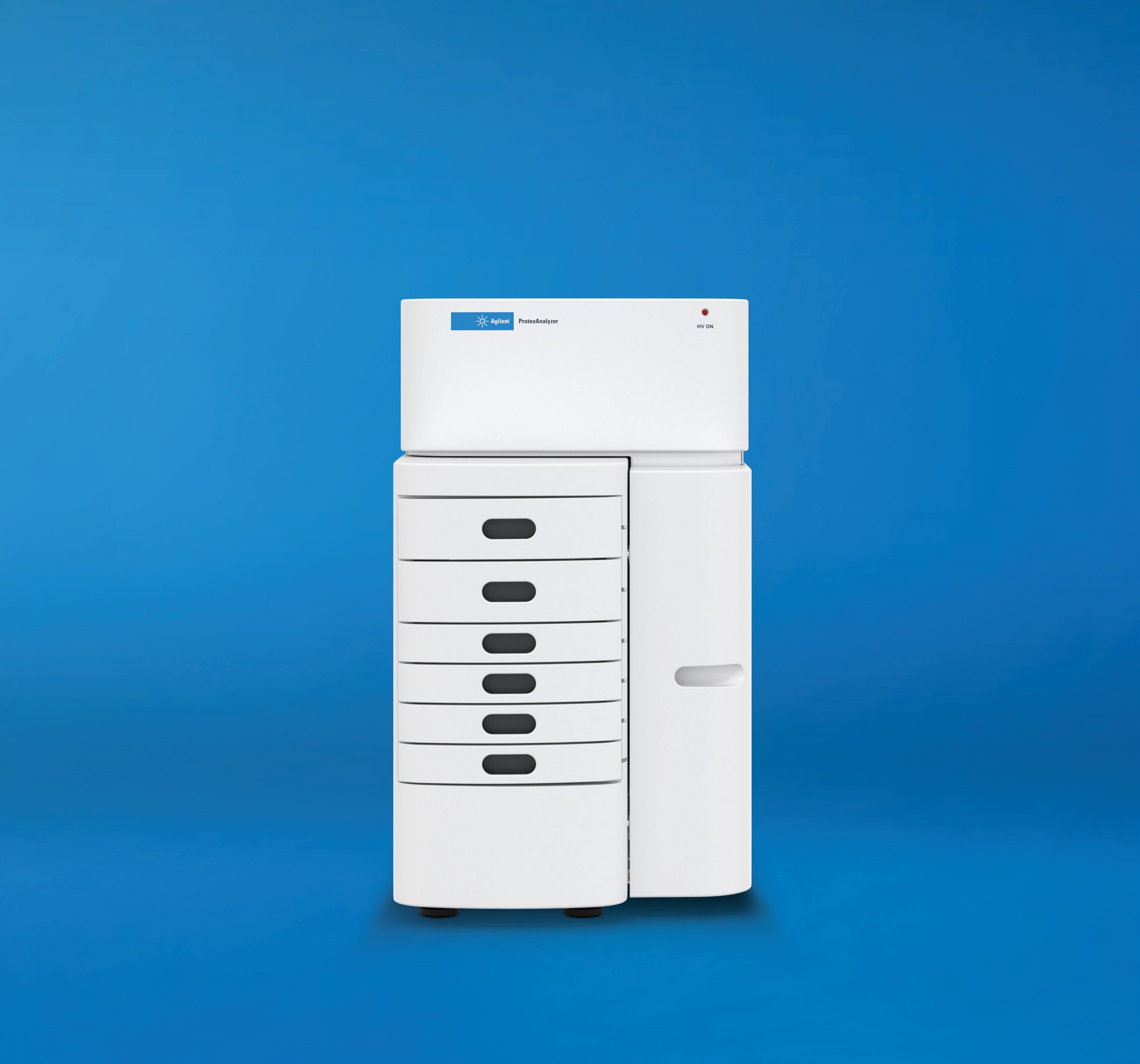
Agilent Technologies Automated CE-SDS Protein Analysis, ProteoAnalyzer
Agilent Technologies Automated CE-SDS Protein Analysis, ProteoAnalyzer — Automated electrophoresis.
The Agilent ProteoAnalyzer is an automated parallel capillary electrophoresis system for CE-SDS analysis of denatured proteins across a 10–240 kDa sizing range, processing 12 samples simultaneously from a 96-well plate with a 30-minute run time. It is distinguished within the Automated Electrophoresis series by its CCD-camera detection and broad 2–2,000 ng/µL quantitative range, positioning it for high-throughput protein sizing and quantification rather than the Femto Pulse system's trace-level nucleic acid work.
Agilent Technologies Automated Electrophoresis Series — Model Comparison & Selection
| Model | Analysis time, min | Analysis time for 12 samples, minutes | Human liver crude cell lysate concentration, ng/µL | Kit stability, months | Lower marker size, kDa | Maximum extended warranty, years |
|---|---|---|---|---|---|---|
| Automated CE-SDS Protein Analysis, ProteoAnalyzer Current | — | 30 | 2000 | 4 | 6 | — |
| Femto Pulse Systems | 30 | — | — | — | — | 5 |
Full specifications
| Analysis Time For 12 Samples | 30 minutes |
| Human Liver Crude Cell Lysate Concentration | 2000 ng/µL |
| Kit Stability | 4 months |
| Lower Marker Size | 6 kDa |
| Run Time | 30 min |
| Total Run Time | 30 minutes |
| Typical Sizing Accuracy (lm And Um) | 10 % |
| Typical Sizing Accuracy (lm Only) | 15 % |
| Typical Sizing Accuracy (% Sizing Error) | 15 % |
| Protein size range mfr | 10...240 kDa |
| Samples analyzed in parallel mfr | 12 samples |
| Dynamic range mfr | 3 log |
| Detector mfr | CCD camera camera |
| Separation technique mfr | CE-SDS SDS |
| Sample plate format mfr | 96 plate |
| Sizing precision mfr | 8 % CV |
| Quantitative range mfr | 2...2,000 ng/μL |
| Quantification reproducibility mfr | 15 % CV |
| Samples per run mfr | 11 |
| Sample volume required mfr | 1 μL |
| Samples analyzed simultaneously per run mfr | 12 samples |
| Detection concentration range mfr | 2...2,000 ng/μL |
| Average size, BSA mfr | 67.99...69.84 kDa |
| Average size, CAII mfr | 27.17...27.87 kDa |
| Upper marker precision benefit mfr | 200 kDa |
| Sample buffer mfr | 1 PBS |
| CAII extinction coefficient mfr | 0.575 |
| Sensitivity (signal/noise > 3) mfr | 1 ng/μL |
Description
Construction and series positioning
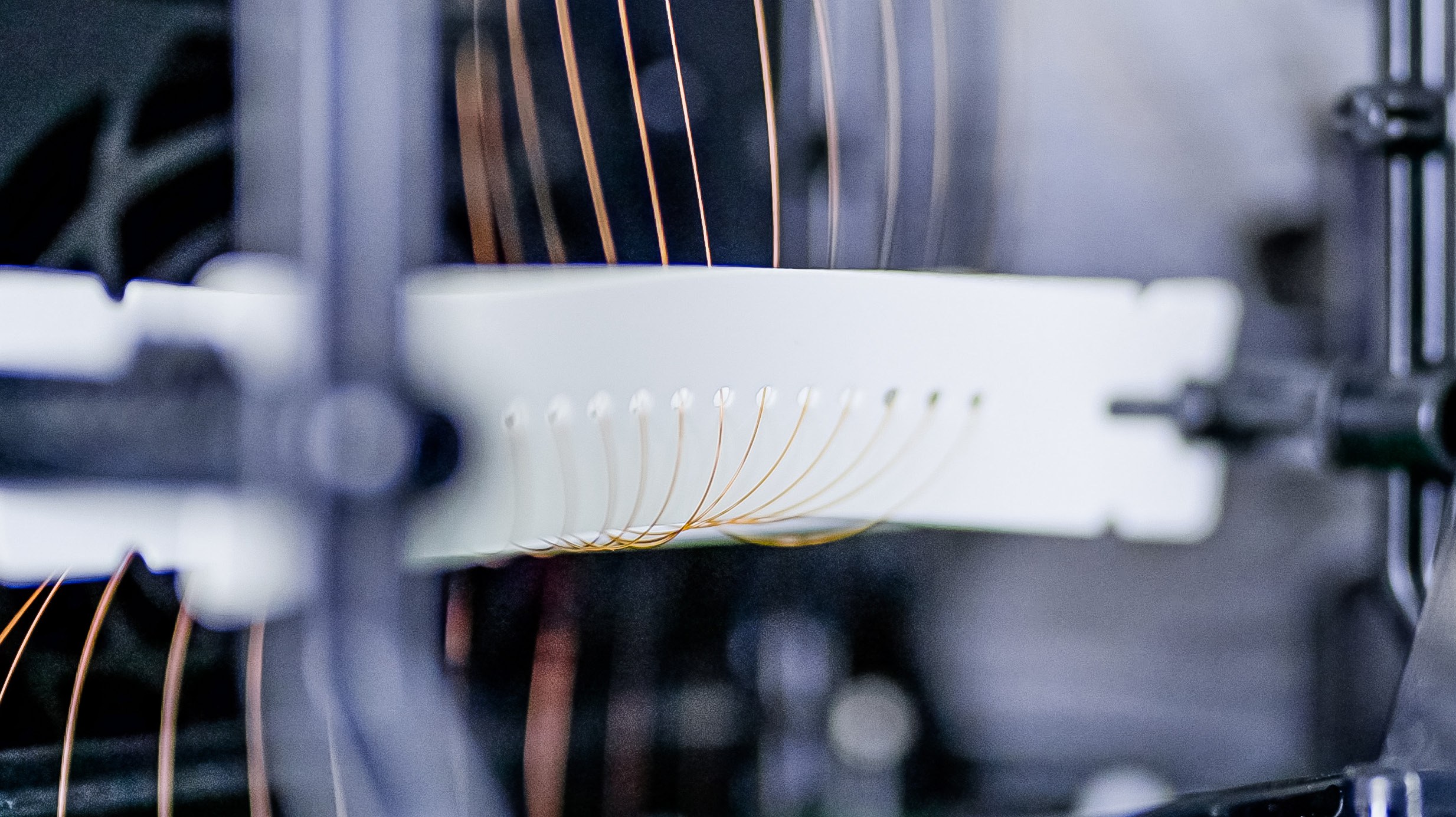
- The ProteoAnalyzer is a benchtop automated parallel CE-SDS instrument using a capillary array and CCD camera detector; it is supplied as a system bundle including instrument, capillary array, software, computer, and installation/introduction.
- Within the Automated Electrophoresis series it sits alongside the Femto Pulse Systems; the ProteoAnalyzer is the dedicated denaturing-protein (CE-SDS) platform, sized for 10–240 kDa proteins rather than trace nucleic acid analysis.
- Sample input is a 96-well plate, with 12 samples analyzed in parallel per run (11 samples per run in one factory listing), and only 1 µL sample volume required.
Performance behavior
- Sizing range is 10–240 kDa with a lower marker at 6 kDa; typical sizing accuracy is 10% when both lower and upper markers are used and 15% with the lower marker only, so marker mode selection directly affects sizing error.
- Quantification spans 2–2,000 ng/µL (3-log dynamic range) with 1 ng/µL sensitivity at signal/noise > 3; quantification reproducibility is 15% CV and sizing precision 8% CV.
- The system handles crude lysates up to 2,000 ng/µL (human liver crude cell lysate example) and resolves proteins with typical resolution of 10.
- Run time is 30 minutes for 12 samples; the Protein Broad Range P240 kit (p/n 5191-6640) has a stated stability of 4 months.
Operation and control
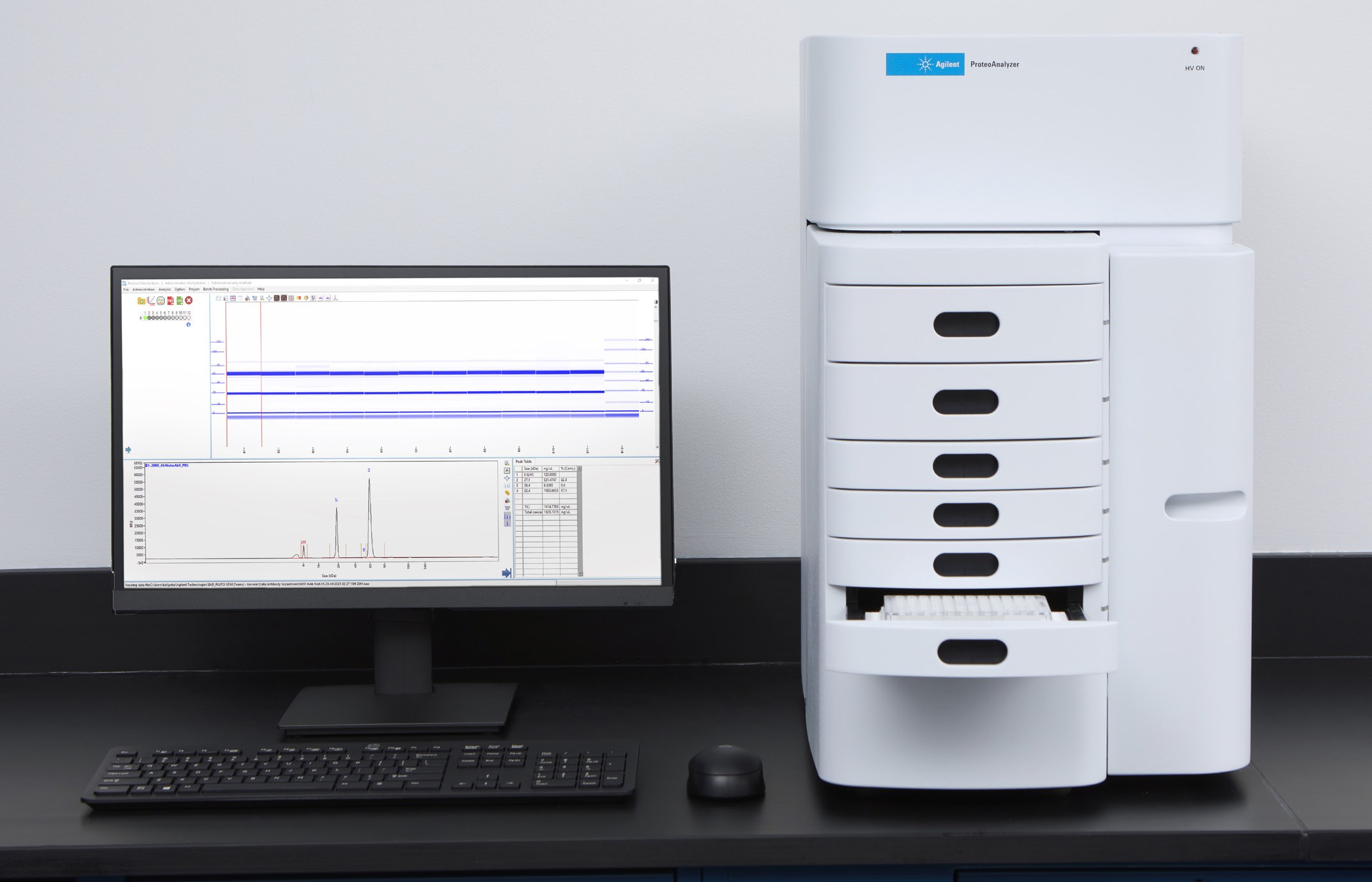
- Operation is automated from a 96-well plate through the bundled software and computer; the capillary array is part of the delivered system and is a consumable/service item.
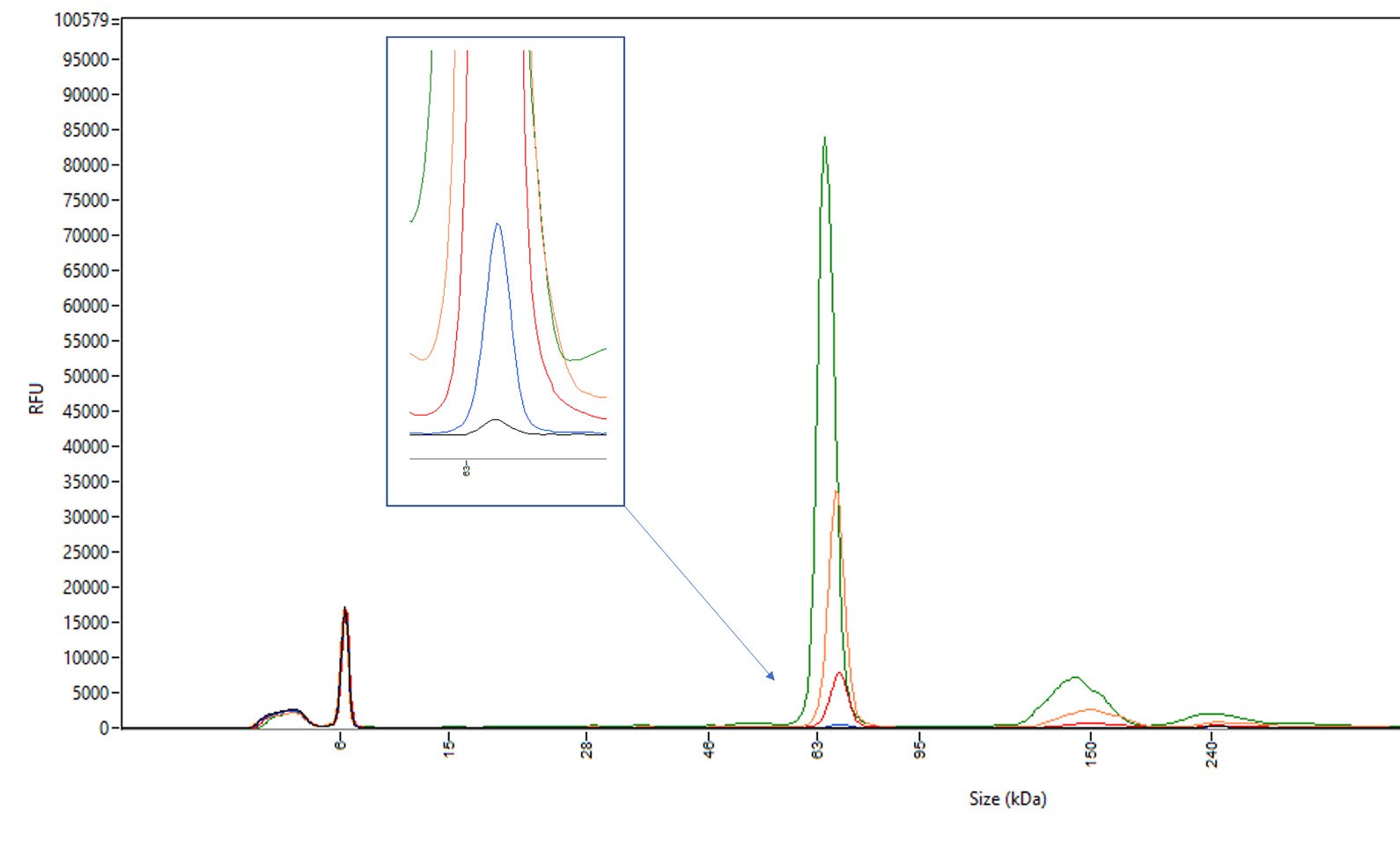
- The P240 kit defines two marker modes (LM only and LM plus UM), and the upper marker (200 kDa) improves sizing precision; BSA sizes 67.99–69.84 kDa and CAII 27.17–27.87 kDa are the documented reference examples.
Integration & Operating Notes
Sizing accuracy is 10% when both lower and upper markers are used but 15% with the lower marker only. Method selection must therefore fix the marker mode before validation, because the same sample will report different apparent sizes depending on whether the 200 kDa upper marker is included.
The detection concentration range is 2–2,000 ng/µL with 1 ng/µL sensitivity. Samples such as human liver crude cell lysate at 2,000 ng/µL sit at the upper boundary, so overloaded samples must be diluted into the 2–2,000 ng/µL window to stay within the 3-log dynamic range and avoid saturation.
The Protein Broad Range P240 kit (p/n 5191-6640) is stated stable for 4 months. Kit age must be logged from first use and expired kit replaced, since degraded kit chemistry would affect both sizing and quantification results independently of instrument condition.
The ProteoAnalyzer is delivered as a bundle comprising instrument, capillary array, software, computer, and installation/introduction. Integration planning should account for the dedicated computer and software rather than assuming a standalone instrument driven by an existing laboratory data system.
Selection & Integration Q&A
Pick the ProteoAnalyzer for denaturing CE-SDS protein sizing and quantification over 10–240 kDa at 2–2,000 ng/µL, 12 samples in parallel, 30-minute runs. The Femto Pulse Systems is the sibling for trace nucleic acid work; the ProteoAnalyzer is the protein-dedicated platform.
The bundle includes instrument, capillary array, software, computer, and installation. Assays require the Protein Broad Range P240 kit (p/n 5191-6640) with its lower and upper markers; plan kit stock against the 4-month stability and 96-well sample plates.
Use the LM plus UM marker mode for 10% typical sizing accuracy instead of 15% with LM only, and note sizing precision is 8% CV and quantification reproducibility 15% CV. Replace P240 kit within its 4-month stability window.
Dimensional Drawings & Technical Documentation
Dimensional drawings
Click drawing to inspect vector dimensions