
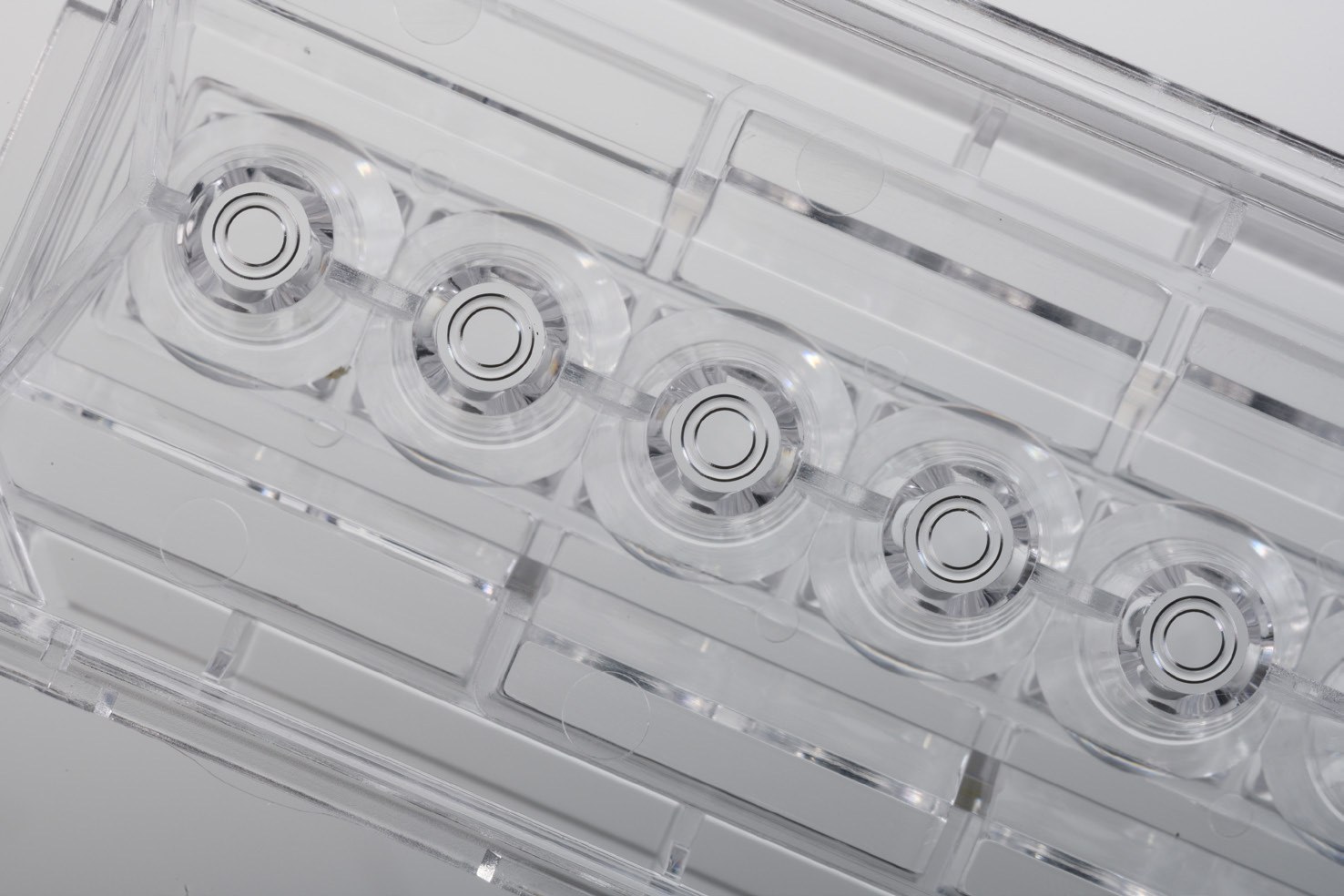
Agilent Technologies High-sensitivity metabolic analyzer, Seahorse XF HS Mini
Agilent Technologies High-sensitivity metabolic analyzer, Seahorse XF HS Mini — Cell analysis.
The Agilent Seahorse XF HS Mini is an 8-well high-sensitivity metabolic analyzer that measures oxygen consumption rate (OCR) and extracellular acidification rate (ECAR) in live cells. It uses XF HS miniplates with a microchamber area of 11.40 and a sensor positioned 200 µm above the well bottom, enabling 3-minute measurement intervals. This modification is distinguished within the Xf Analyzers series by its high-sensitivity microplate format, suited for samples with limited cell numbers.
Agilent Technologies Xf Analyzers Series — Model Comparison & Selection
| Model | Measurement range | Operating system |
|---|---|---|
| High-sensitivity metabolic analyzer, Seahorse XF HS Mini Current | 25...228 | — |
| Cell imaging and normalization, Seahorse normalization | — | 10 |
Full specifications
| Measurement range | 25...228 pmol/min |
| Microchamber area (XFp) mfr | 11.40 |
| Sensor position above well bottom mfr | 200 μm |
| Measurement duration mfr | 3 minutes |
| OCR range mfr | 7...55 pmol/min |
| ECAR range mfr | 10...90 mpH/min |
| Well count mfr | 8 wells |
| Cell seeding volume mfr | 30 μL |
| Cell seeding density (suspension cells) mfr | 10.0 cells/well |
| Cell seeding density (naive CD4 T cells) mfr | 70 cells/well |
Description
Construction and series positioning
- The XF HS Mini is an 8-well format analyzer that employs XF HS miniplates (part number 103724-100) or pre-assembled XF HS miniplates (part number 103723-100).
- It is positioned as the high-sensitivity modification within the Xf Analyzers series, using a microchamber area of 11.40 and a sensor 200 µm above the well bottom to concentrate analyte signals.
- Unlike the sibling normalization-focused model, this unit prioritizes direct metabolic rate measurement in low-cell-number samples.
Measurement behavior and ranges
- The instrument reports OCR over a range of 7–55 pmol/min and ECAR over 10–90 mpH/min, with a broader measurement range of 25–228 pmol/min for the primary assay.
- Each measurement cycle takes 3 minutes, allowing time-resolved metabolic profiling.
- Cell seeding is performed in 30 µL volumes; recommended seeding densities are 10.0 cells/well for suspension cells and 70 cells/well for naive CD4 T cells, reflecting the high-sensitivity design.
Installation and operation
- The system requires XF HS miniplates; PDL-coated variants are available for suspension cells.
- No electrical, environmental, or interface specifications are provided in the verified facts; refer to the instrument manual for supply and connection details.
- Operation follows standard Seahorse XF protocols for calibration and plate handling.
Integration & Operating Notes
The analyzer is designed for XF HS miniplates (103724-100) or pre-assembled XF HS miniplates (103723-100). Other plate types, such as XFp miniplates, have different microchamber geometry and will not yield accurate OCR/ECAR readings. Verify plate part number before loading.
For suspension cells, seed 10.0 cells/well; for naive CD4 T cells, seed 70 cells/well. Exceeding these densities may saturate the sensor and invalidate rate measurements, while lower densities may fall below the detection limit of 7 pmol/min OCR.
The sensor cartridge must be hydrated and calibrated according to the instrument manual prior to running plates. Skipping calibration leads to drift and inaccurate ECAR/OCR values. No automatic calibration is described in the provided facts.
Selection & Integration Q&A
Choose the XF HS Mini when working with limited cell numbers (e.g., 10–70 cells/well) and requiring high-sensitivity OCR/ECAR measurements. For standard sensitivity or normalization-focused workflows, consider the sibling normalization model.
The instrument requires XF HS miniplates (103724-100) or pre-assembled XF HS miniplates (103723-100); PDL-coated variants are available for suspension cells. These consumables are not included with the base unit and must be ordered separately.
Verified facts do not specify environmental or duty-cycle limits. Refer to the instrument manual for operating temperature, humidity, and maximum assay frequency. The 3-minute measurement duration suggests rapid cycling is possible, but continuous operation limits are not documented here.
Regular maintenance includes sensor cartridge calibration before each assay and proper hydration. Consumables such as XF HS miniplates and calibration solutions are not included in base delivery and must be procured separately. No specific service interval is provided in the verified facts.