
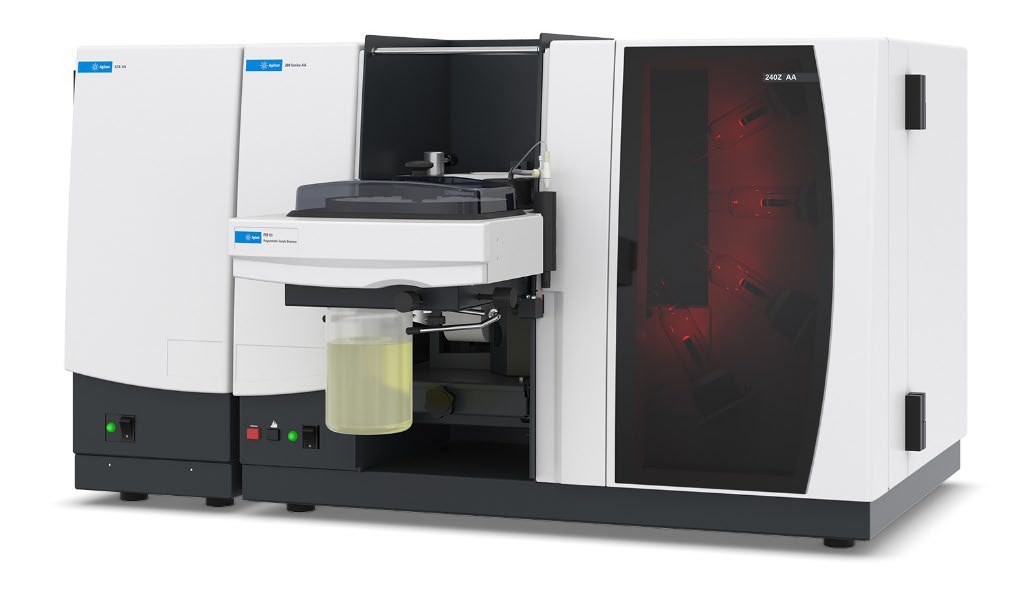
Agilent Technologies 280Z AA
Agilent Technologies 280Z AA — Atomic spectroscopy.
The Agilent 280Z AA is a flame atomic absorption spectrometer with a Zeeman furnace configuration, part of the 240/280 series. It is distinguished by its flame safety envelope: acetylene supply 65–100 kPa, exhaust ≥6 m³/min, and UV Risk Group 3 exposure limits. It is used for trace metal determination in flame and furnace modes.
Full specifications
| Acetylene Purity | 99.5 % |
| Direct Viewing Distance From Flame | 0.2 m |
| Exempt Distance From Flame | 7.1 m |
| Maximum Flame Door Open Exposure | 13 minutes |
| Viewing Distance Rg1 | 2.3 m |
| Viewing Distance Rg2 | 0.8 m |
| Exhaust ventilation rate mfr | 6 minute |
| Exhaust fan distance from flame mfr | 3 meters |
| UV intensity emitted mfr | 37.7 |
| UV hazard classification mfr | 3 |
| Burner slot replacement limit, nitrous-oxide/acetylene mfr | 0.47 mm |
| Burner slot replacement limit, air/acetylene mfr | 0.54 mm |
| Acetylene maximum pressure mfr | 105 kPa |
| Acetylene fuel supply pressure range mfr | 65 kPa |
| Acetylene cylinder minimum pressure before replacement mfr | 700 kPa |
| Acetylene maximum consumption rate mfr | 1 hour |
| Solvent minimum specific gravity mfr | 0.75 |
| Acetylene fuel supply pressure mfr | 65...100 kPa |
| Acetylene cylinder replacement pressure mfr | 700 kPa |
| Burner slot replacement threshold mfr | 0.54 mm |
| Minimum solvent specific gravity mfr | 0.75 |
| Schedule mfr | 62 |
| Cleaning mfr | 63 |
| Gas cylinders mfr | 64 |
| Preventing flashbacks mfr | 65 |
| Spare parts mfr | 65 |
| Ultraviolet Hazard mfr | 3 |
| Acetylene cylinder minimum pressure mfr | 700 kPa |
| Acetylene maximum consumption mfr | 1 hour |
| Zeeman magnetic field peak mfr | 0.8 Tesla |
| Zeeman magnet exclusion distance mfr | 300 mm |
| UV intensity mfr | 37.7 |
| Hollow cathode lamp capacity 240 series mfr | Four lamp capacity capacity |
| Hollow cathode lamp capacity 280 series mfr | Eight lamp capacity capacity |
| Burner slot width maximum, N2O/Acetylene Mark 7 mfr | 0.46 mm |
| Burner slot width maximum, Air/Acetylene Mark 7 mfr | 0.54 mm |
| Burner slot maximum width mfr | 0.54 mm |
| Nitrous-oxide/acetylene burner slot maximum width mfr | 0.47 mm |
| Air/acetylene burner slot maximum width mfr | 0.54 mm |
| Mark 7 N2O/acetylene burner slot maximum width mfr | 0.46 mm |
| Mark 7 air/acetylene burner slot maximum width mfr | 0.54 mm |
| Non-Zeeman 240/280FS fuse rating mfr | 4 mm |
| Zeeman circuit breaker rating mfr | 15 breaker |
| Zeeman fuse T3.15 A rating mfr | 3.15 mm |
| Zeeman fuse F315 mA rating mfr | 315 mm |
| Zeeman fuse F1A rating mfr | 1 mm |
| Zeeman fuse T6.3 A rating mfr | 6.3 |
| Zeeman fuse F800 mA rating mfr | 800 mm |
Description
Construction and series positioning
The 280Z AA belongs to the Agilent 240/280 AA series, which includes flame-only, furnace (Zeeman or D2), and Duo configurations. This model is a Zeeman furnace variant, meaning it combines flame operation with a Zeeman-effect graphite furnace for trace analysis. The manual covers the whole series, so safety and maintenance facts apply broadly; the 280Z AA specifically includes the Zeeman furnace module. No sibling models are listed for direct comparison, but the series spans flame and furnace capabilities.
Behavior under load and media
Flame operation requires acetylene fuel at 65–100 kPa (never exceeding 105 kPa) and an oxidant of air or nitrous oxide (never oxygen). The burner slot width must be monitored: maximum 0.46 mm for N2O/acetylene and 0.54 mm for air/acetylene; exceeding these limits requires burner replacement. The liquid trap must be filled with the same solvent as samples, and solvents with specific gravity below 0.75 must not be used, as they can breach the trap seal and cause flashback. UV emission is 37.7 mW/m², classified Risk Group 3 under IEC 62471, so direct viewing at ≤0.2 m is hazardous; with the flame door open, exposure must not exceed 13 minutes per 8-hour period.
Installation, connection, and control
The instrument requires an exhaust system providing at least 6 m³/min, with the exhaust fan located at least 3 meters from the flame. Gas connections use left-hand threads for fuel gases and right-hand threads for support gases to prevent cross-connection. Acetylene cylinders must be replaced when pressure falls below 700 kPa, and consumption must stay below 1/7 of cylinder contents per hour to avoid acetone carryover. The flame door interlock prevents ignition if the door is opened during ignition; bypassing is prohibited. Daily leak tests at all joints with soapy water are mandatory. The manual also covers SpectrAA software (version 5.6.8 or higher) and USB-GPIB communications for control and data acquisition.
Integration & Operating Notes
Supply pressure must be regulated to 65–100 kPa; pressures above 105 kPa risk spontaneous acetylene decomposition. The regulator must be set within this range and verified before each use, as higher pressures can cause explosion.
For N2O/acetylene Mark 7 burners, slot width must not exceed 0.46 mm; for air/acetylene, 0.54 mm. If exceeded, the burner must be replaced. Regular inspection and cleaning are critical to prevent flashback.
Using a solvent with specific gravity below 0.75 can breach the liquid trap seal, leading to flashback. The liquid trap must be filled with the same solvent as the samples, and the drain tube free end must remain above the waste vessel liquid level.
The instrument must not be connected to mains until the operating voltage is verified for the specific outlet. Use only the Agilent-supplied power cord or an equivalent specified in the AA Site Preparation Guide to ensure proper grounding and electrical safety.
If the flame door is opened during ignition, the interlock prevents ignition. If the interlock is lost or malfunctioning, contact Agilent immediately; bypassing the interlock is prohibited as it is a critical safety feature.
Before each use, test all joints and seals for leaks using soapy water or a proprietary solution; never use a naked flame. This daily check is mandatory to prevent gas accumulation and fire hazards.
Check three O-rings inside the burner, spray chamber, and bung, and two sealing gas inlets to the spray chamber. Damaged O-rings can cause gas leakage, fire, or flashback; replace immediately if worn or damaged.
When using nitrous oxide, decompression cooling can freeze the regulator. Use an in-line or wrap-around heater to prevent regulator malfunction and possible flashback.
The exhaust system must provide at least 6 m³/min and the fan must be located at least 3 meters from the flame to avoid drawing flame or fumes improperly. The instrument must be vented to outside air via a self-contained collector hood and ducting; never vent within the building.
Selection & Integration Q&A
Choose the 280Z AA when you need both flame AA for higher concentrations and Zeeman furnace AA for trace levels with background correction. A flame-only variant suffices for routine flame work; a D2 furnace variant may be chosen if Zeeman correction is not required.
Use instrument-grade acetylene (≥99.5% purity) in acetone, with supply pressure 65–100 kPa (never >105 kPa). Fuel gas fittings use left-hand threads; support gas fittings use right-hand threads. Replace cylinders below 700 kPa and keep consumption <1/7 of cylinder per hour.
Exhaust must provide ≥6 m³/min with fan ≥3 m from flame. UV emission is 37.7 mW/m² (Risk Group 3); direct viewing at ≤0.2 m is hazardous. With flame door open, limit exposure to 13 minutes per 8-hour period and wear UV-protective eyewear.
The base delivery does not include gas regulators, exhaust system, or UV-protective eyewear. Daily leak tests and weekly O-ring inspections are mandatory. Spare parts must be Agilent-supplied; order via Agilent website. Burners and O-rings are consumables requiring periodic replacement.