
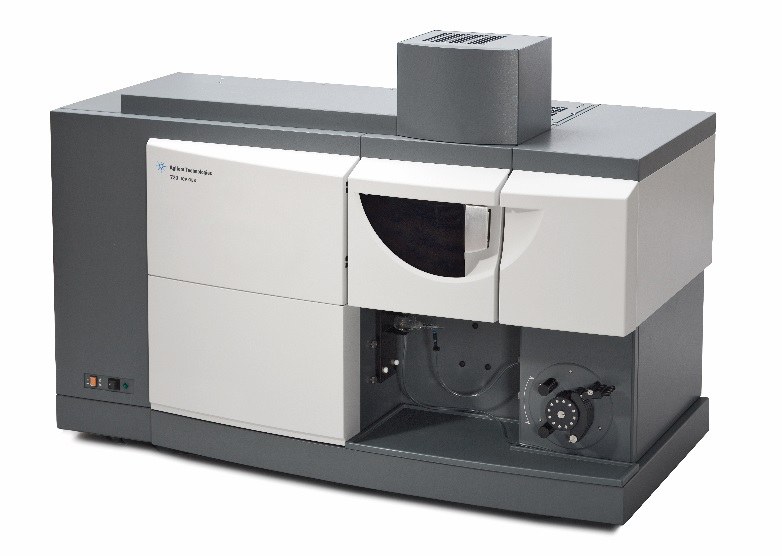
Agilent Technologies 715 ICP OES
Agilent Technologies 715 ICP OES — Atomic spectroscopy.
The Agilent 715 ICP OES is a radial-plasma optical emission spectrometer in the 700 Series, distinguished from the axial-plasma 710/720 by its radial viewing configuration. It operates an argon plasma at approximately 10,000 K, driven by a 40 MHz, 1500 V RMS work coil, for elemental analysis in laboratory process and materials testing. The 715 shares the series' gas, cooling and control architecture but is selected where radial viewing is preferred over axial.
Full specifications
| Nitrogen (argon Only) | 20 ppm |
| Plasma Temperature | 10000 K |
| Standby Mode Flow | 0.75 L/min |
| Water Vapor | 4 ppm |
| Argon purity mfr | 99.996 |
| Nitrogen purity mfr | 99.996 |
| Oxygen mfr | 5 ppm |
| Permissible pressure range mfr | 400...600 kPa |
| Recommended pressure mfr | 550 kPa |
| Operational range (plasma on) mfr | 9...32.8 L/min |
| Measuring wavelengths > 200 nm (poly boost off) mfr | 13.5...21.75 L/min |
| Measuring wavelengths < 200 nm (poly boost on) mfr | 15.75...24 L/min |
| Drain vessel minimum capacity mfr | 2 liters |
| Radial induction coil pitch mfr | 4.7 mm |
| Axial induction coil pitch mfr | 7.5 mm |
| Instrument weight mfr | 203 kg |
| Gas supply hose length mfr | 1.8 m |
| Work Coil Frequency | 40 MHz |
| Fuse 1FS1 and 1FS2 mfr | 6.3 mm |
| Circuit breaker 1CB1 mfr | 30 A |
| Work coil voltage mfr | 1500 RMS |
| Ambient temperature limit | 20 °C |
| Maximum permissible cooling water pressure mfr | 310 kPa |
| Minimum cooling water flow mfr | 1.1 L/min |
Description
Construction and series positioning
The 715 is one of four models in the Agilent 700 Series ICP-OES platform. Within the series, the 710 and 720 use an axial plasma configuration, while the 715 and 725 are radial-plasma instruments; the 715 is therefore the radial-viewing modification. The instrument weighs approximately 203 kg and requires mechanical lifting equipment for relocation. The RF generator feeds a work coil operating at 1500 V RMS and approximately 40 MHz, sustaining a plasma at about 10,000 K. Radial induction coil pitch is specified at 4.7 ±0.5 mm center-to-center; coil service is recommended only by an Agilent field service engineer, since a deformed coil distributes RF energy unevenly and can melt the torch or torch clamp.
Gas and cooling behavior
Argon is the primary plasma gas; argon or nitrogen may serve as polychromator purge gas. Gas purity must be 99.996% for both argon and nitrogen, with oxygen below 5 ppm, water vapor below 4 ppm, and nitrogen in argon below 20 ppm. Supply pressure must remain within 400–600 kPa, with 550 kPa recommended. Standby argon flow is 0.75 L/min, while operational flow spans 9–32.8 L/min; with the optional nitrogen purge kit fitted, operational argon flow is 8.3–29.1 L/min and nitrogen flow is 0.45–2.1 L/min. For measurements above 200 nm with Poly Boost off, argon flow is 13.5–21.75 L/min; below 200 nm with Poly Boost on, 15.75–24 L/min. Cooling water flow must stay above 1.1 L/min, below which a flow sensor stops the plasma and camera Peltier assembly; supply pressure must not exceed 310 kPa without regulation.
Installation, control and operation
Installation must be performed by an Agilent-trained or authorized field service engineer and includes ICP Expert II software, the USB-GPIB-HS converter, dark current scan, wavelength calibration and torch scan. The USB-GPIB-HS converter is the only supported instrument-to-software interface for ICP Expert II on Windows 10. Both the rear RF supply circuit breaker and the front-left instrument power switch must be on for operation. The exhaust fan must be running before plasma ignition, and the plasma interlock extinguishes the plasma if mains power fails or the torch compartment door is opened. The torch and torch compartment remain hot for up to five minutes after plasma extinction.
Integration & Operating Notes
Argon and nitrogen must meet 99.996% purity with oxygen below 5 ppm, water vapor below 4 ppm, and nitrogen in argon below 20 ppm. Lower-purity gases can destabilize the plasma and degrade optical purge performance, so verify cylinder certificates and regulator/line cleanliness before connection.
A water flow sensor stops the plasma and the camera Peltier assembly if flow drops below 1.1 L/min (0.3 gpm). The cooling system must be running before plasma ignition, and supply pressure must not exceed 310 kPa (45 psi) without a pressure regulator.
Optimum analytical performance requires ambient temperature held constant to within ±2 °C throughout the working day, in the 20–25 °C range. HVAC design must account for the instrument's heat load and for exhaust extraction, which must vent to outside air, never within the building.
The RF supply circuit breaker at the right rear and the instrument power switch at the front left must both be on for the instrument to work. Operator-replaceable fuses 1FS1 and 1FS2 are T6.3 AH 250 V, 5 x 20 mm; circuit breaker 1CB1 is 30 A fast trip. Power boards and extension cables are not recommended.
Provide a chemically inert drain vessel, not glass or narrow-necked, holding at least 2 liters, located underneath the sample compartment or on the right side of the instrument. Check and empty it hourly during operation to prevent overflow of sample waste.
Selection & Integration Q&A
The 715 is the radial-plasma instrument; the 710 and 720 are axial-plasma models. Choose the 715 when radial viewing suits your matrices and detection-limit requirements. The 725 is also radial but is a separate modification; compare its configuration against the 715 before finalizing.
Argon (and nitrogen if the purge kit is fitted) at 99.996% purity, oxygen <5 ppm, water vapor <4 ppm, nitrogen in argon <20 ppm. Regulated pressure 400–600 kPa, 550 kPa recommended. PTFE hoses are 1.8 m with Swagelok fittings; size supply for 9–32.8 L/min operational argon flow, not the 0.75 L/min standby flow.
Ambient temperature 20–25 °C held within ±2 °C over the working day. Exhaust must vent outside and run before every plasma ignition. Cooling water flow above 1.1 L/min and pressure at or below 310 kPa. The torch area stays hot up to five minutes after plasma extinction, so allow cooling before access.
Operator tasks at hourly/daily/weekly/monthly intervals are listed in the manual; detailed procedures are in ICP Expert II Help. Consumables include torch, cone cleaning, peristaltic pump tubes and fuses. Coil service and non-listed maintenance require Agilent field service. The USB-GPIB-HS converter and ICP Expert II software are installation items; gas regulators, chiller and drain vessel are site-provided.