
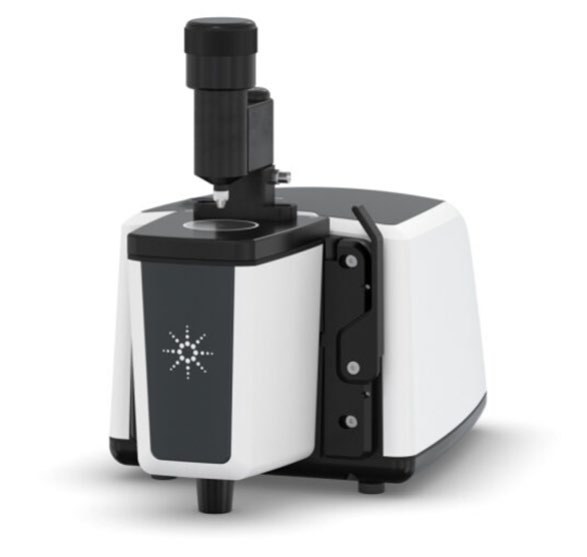
Agilent Technologies Cary 630 FTIR
Agilent Technologies Cary 630 FTIR — Molecular spectroscopy.
The Cary 630 FTIR is a compact 16 × 22 × 13 cm, 2.9 kg Fourier-transform infrared spectrometer with a dovetailed accessory recess that accepts interchangeable single-reflection ATR, transmission, reflectance and diffuse accessories. It is customer-installable, requires a 5-minute warmup for analysis and 120 minutes for validation, and serves as a bench-top molecular spectroscopy engine for liquids, pastes, powders and solids.
Full specifications
| Diamond Atr Active Area | 200 µm |
| Diamond Atr Sampling Surface Diameter | 1 mm |
| Firmware Load Time | 15 seconds |
| Ge Atr Effective Pathlength | 0.15 µm |
| Power Requirement | 15 W |
| Spectral resolution | 2 dimensionless |
| Warmup Period | 5 minutes |
| Znse Atr Active Area | 200 µm |
| Znse Atr Sampling Surface Diameter | 1 mm |
| Dimensions (main optical unit) mfr | 16 cm |
| Warmup period before validation tests mfr | 120 minutes |
| Power button hold time mfr | two seconds seconds |
| Energy (center-burst) - Optimal mfr | 28000 |
| Energy (center-burst) - Marginal mfr | 28000 |
| Energy (center-burst) - Critical mfr | 30000 |
| Laser signal - Optimal mfr | 15000 |
| Laser signal - Marginal mfr | 15000 |
| Laser signal - Critical mfr | 17000 |
| Diamond ATR window thickness mfr | 0.5 mm |
| ZnSe ATR window thickness mfr | 0.5 mm |
| Performance test resolution mfr | 4 |
| Performance test collection time mfr | one minute minute |
| Performance test duration mfr | two minutes per test test |
| Minimum number of performance tests mfr | 10 |
| Stability test regions mfr | 3000 |
| Main optical unit dimensions mfr | 16 centimeters |
| Diamond ATR crystal thickness mfr | 0.5 mm |
| ZnSe ATR crystal thickness mfr | 0.5 mm |
| Energy (center-burst) diagnostic, optimal mfr | 28000 |
| Energy (center-burst) diagnostic, marginal mfr | 28000 |
| Energy (center-burst) diagnostic, critical mfr | 30000 |
| Laser signal diagnostic, optimal mfr | 15000 |
| Laser signal diagnostic, marginal mfr | 15000 |
| Laser signal diagnostic, critical mfr | 17000 |
| G8043-67483 mfr | Replacement flat tip for ATR ATR |
| G8043-67484 mfr | Replacement pellet tip for ATR ATR |
| G8043-67405 mfr | Polystyrene film for ATR/Transmission sampling a |
| G8043-67406 mfr | Polystyrene film for TumblIR/DialPath sampling a |
| PIKE-162-5450 mfr | 38 μm |
| G8043-67400 mfr | Infrared source with purge fitting fitting |
| G8043-67401 mfr | Desiccant with purge fitting fitting |
| G8043-67402 mfr | KBr window with removal tool tool |
| G8043-67403 mfr | ZnSe window with removal tool tool |
| G8043-67003 mfr | Cary FTIR Swivel Diamond ATR Press Press |
| G8043-67004 mfr | Cary FTIR Swivel Ge-ZnSe Press Press |
| G8043-67012 mfr | Purge kit for engine and Transmission sampling a |
| System OFF mfr | Red Red |
| System startup mfr | Red / green green |
| System ON mfr | Green Green |
| Firmware update mfr | Red / green green |
| Detector diameter mfr | 1.3 mm |
| Depth | 10.2 cm |
| Diamond Atr Depth Of Penetration | 2 µm |
| Height | 17.1 cm |
| Weight | 2.9 kg |
| Width | 21 cm |
| Source current - Optimal mfr | 1.9 A |
| Source current - Marginal mfr | 2.2 A |
| Source current - Critical mfr | 2.4 A |
| Laser frequency calibration reference mfr | 1921 film |
| Source diagnostic, optimal mfr | 1.9 A |
| Source diagnostic, marginal mfr | 2.2 A |
| Source diagnostic, critical mfr | 2.4 A |
| Power supply output mfr | 15 A |
| ZnSe ATR pH range mfr | 5...9 |
| Signal-to-noise test regions mfr | 2500 |
Description
Construction and series positioning
- The main optical unit is a sealed, factory-aligned bench-top spectrometer measuring 16 × 22 × 13 cm and weighing 2.9 kg; no optical or mechanical alignment is required after installation.
- The sampling accessory is a field-interchangeable module: the release lever is pressed outward, the accessory slides into the dovetailed recess, and two stainless-steel dowel pins seat it; an RFID reader identifies the fitted accessory and the software displays the matching image and diagnostic values.
- The series spans two frequency-range configurations and a family of accessories (Diamond ATR, ZnSe ATR single- and multi-bounce, Germanium ATR, 5-bounce ZnSe ATR, Transmission, 10°/45° Specular Reflectance, TumblIR, DialPath, Diffuse Reflectance). This card describes the base spectrometer; the accessory fitted determines the sampling mode.
Behavior under load and in different media
- Diamond ATR: type IIa single-reflection crystal, pH 1–14, 1 mm sampling surface, 200 µm active area, ~2 µm depth of penetration at 1,700 cm⁻¹; suitable for liquids, pastes, powders and some solids.
- ZnSe ATR: single-reflection crystal, pH 5–9, same 1 mm surface and 200 µm active area; hard or abrasive samples and strong acids must not be analyzed.
- Germanium ATR: single-bounce 45° crystal with effective pathlengths of 0.15 µm at 4,000 cm⁻¹, 0.36 µm at 1,700 cm⁻¹ and 1.02 µm at 600 cm⁻¹, intended for highly absorbing samples such as tires, rubbers, o-rings and carbon-black-filled materials.
- All ATR sample presses use a slip clutch that clicks at maximum pressure; diamond and ZnSe windows are 0.5 mm or less thick and can crack under extreme pressure or sharp/pointed samples.
Installation, control and operation
- Customer-installable: power connects at the lower left rear and Mini USB at the back right, both under blue caps threaded finger-tight; connect the power cord to the spectrometer first, then to the outlet.
- Power button must be held two seconds; the LED flashes red/green during firmware loading (<15 s) and turns solid green when ready. A 5-minute warmup precedes reliable analysis; validation tests require 120 minutes of warmup.
- Diagnostics (source current, detector temperature, CPU temperature, center-burst energy, laser signal) are checked daily or weekly; performance validation is quarterly, bi-annual or annual (monthly in highly regulated industries).
- The signal-to-noise performance test uses 4 cm⁻¹ resolution, one-minute collection, two minutes per test, and at least 10 tests (≥20 minutes). Laser frequency calibration uses NIST SRM 1921 polystyrene film and is not compatible with multi-bounce ATR or diffuse reflectance accessories.
Integration & Operating Notes
All power supplies for the instrument and its accessories must be single-phase AC, 3-wire systems (active, neutral, ground; or two active and ground) compliant with IEEE 519-2022. Verify site wiring and power quality before installation, and use a UL-approved surge protection strip; replace the power cord only with an equivalent cord.
After a two-second press of the power button the LED alternates red/green while firmware loads (less than 15 seconds), then goes solid green. Data collection must wait for solid green plus the 5-minute warmup; cutting power during the load sequence interrupts startup and the system will not be ready.
Diamond ATR accepts pH 1–14, but ZnSe ATR is limited to pH 5–9 and must not be used with strong acids or hard/abrasive samples. Using the wrong crystal risks etching or cracking the 0.5 mm-or-less window; the sample press slip clutch clicks at maximum pressure and should not be forced past that detent.
Maintenance is limited to cleaning, desiccant replacement, window replacement and source replacement. Breaking the spectrometer seal to clean interior surfaces voids the warranty, and shipping the unit in packaging other than the original container also voids the warranty — retain all original packing material.
The system is not intrinsically safe and must be used only in atmospheres that have been tested for flammable materials. Ambient temperature also drives detector and CPU temperatures: CPU above 80 and detector below 36 or above 44 are critical diagnostic states indicating cooling-circuit or ambient-temperature problems.
Selection & Integration Q&A
Choose Diamond ATR for pH 1–14 samples including strong acids, pastes, powders and some solids; choose ZnSe only for pH 5–9 liquids, gels and soft solids (no strong acids or abrasives); choose Germanium for highly absorbing carbon-black-filled samples such as tires, rubbers and o-rings, where its 0.15 µm pathlength at 4,000 cm⁻¹ avoids saturation.
Provide an IEEE 519-2022 compliant single-phase 3-wire AC supply (active, neutral, ground; or two active and ground) and a UL-approved surge strip. Connect power at the lower left rear and Mini USB at the back right, both under finger-tight blue caps; connect the cord to the spectrometer before the outlet. The unit is customer-installable and needs no optical alignment.
Allow 5 minutes after the solid green LED before routine analysis, but at least 120 minutes of warmup before performance validation tests to avoid false out-of-specification results. A signal-to-noise test uses 4 cm⁻¹ resolution, one-minute collection and two minutes per test, with at least 10 tests — budget roughly 20 minutes per validation run.
Scheduled maintenance covers cleaning, desiccant replacement, window replacement and source replacement; do not break the spectrometer seal. Sampling accessories, the Mini USB cable, power cord and NIST SRM 1921 polystyrene film for laser frequency calibration are separate items — confirm each against the order, and retain the original shipping container to preserve the warranty.